
A single data breach at a CPA firm can expose the complete financial lives of hundreds of clients in one incident. Social Security numbers, bank accounts, tax returns, and years of financial history—all stored in one place, all valuable to attackers who know exactly where to look.
CPA firms face a distinct combination of high-value data, seasonal pressure, and trusted client relationships that cybercriminals actively exploit. This guide covers the specific threats targeting accounting practices, the emerging risks gaining momentum, and the protective measures that actually work.
CPA firms store exactly what cybercriminals want most: Social Security numbers, bank account details, tax returns, and complete financial histories for hundreds or thousands of clients. A single breach at an accounting practice can expose more sensitive data than attacks on many larger organizations. This concentration of valuable information makes CPA firms disproportionately attractive targets compared to other small and mid-sized businesses.
Tax season and year-end close periods create predictable vulnerability windows. Staff working long hours under deadline pressure tend to click faster and verify less. Attackers know this pattern well, and they time phishing campaigns to coincide with peak workload periods when vigilance naturally drops.
The trust between CPAs and clients also works in attackers’ favor. When a client receives an email that appears to come from their accountant requesting documents or payment information, they’re far more likely to comply without question. Cybercriminals exploit this established trust to bypass the skepticism that might stop attacks in other contexts.
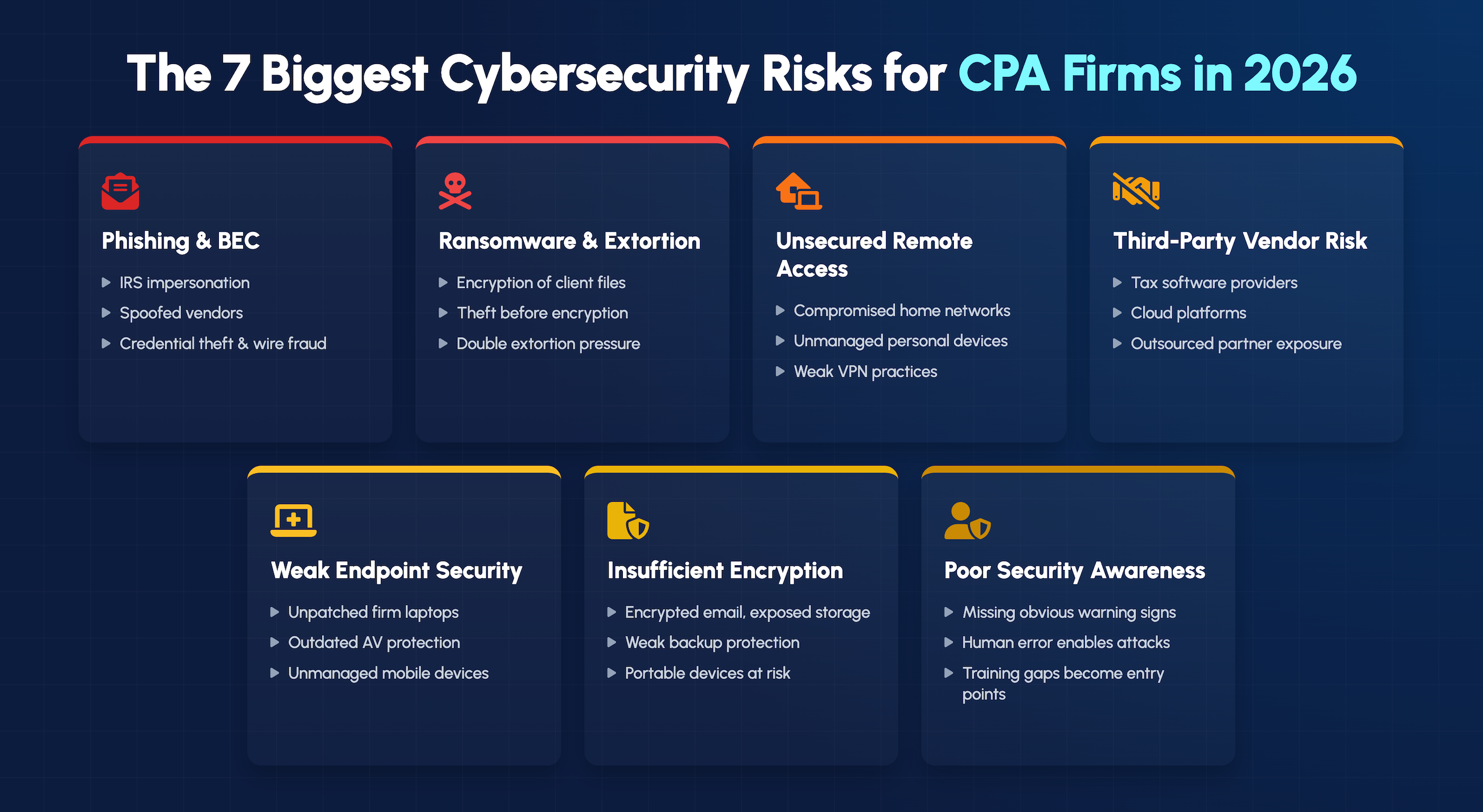
The threat landscape facing accounting practices includes both familiar attack methods and evolving tactics. While new threats emerge regularly, several attack types consistently cause the most damage to CPA firms and their clients.
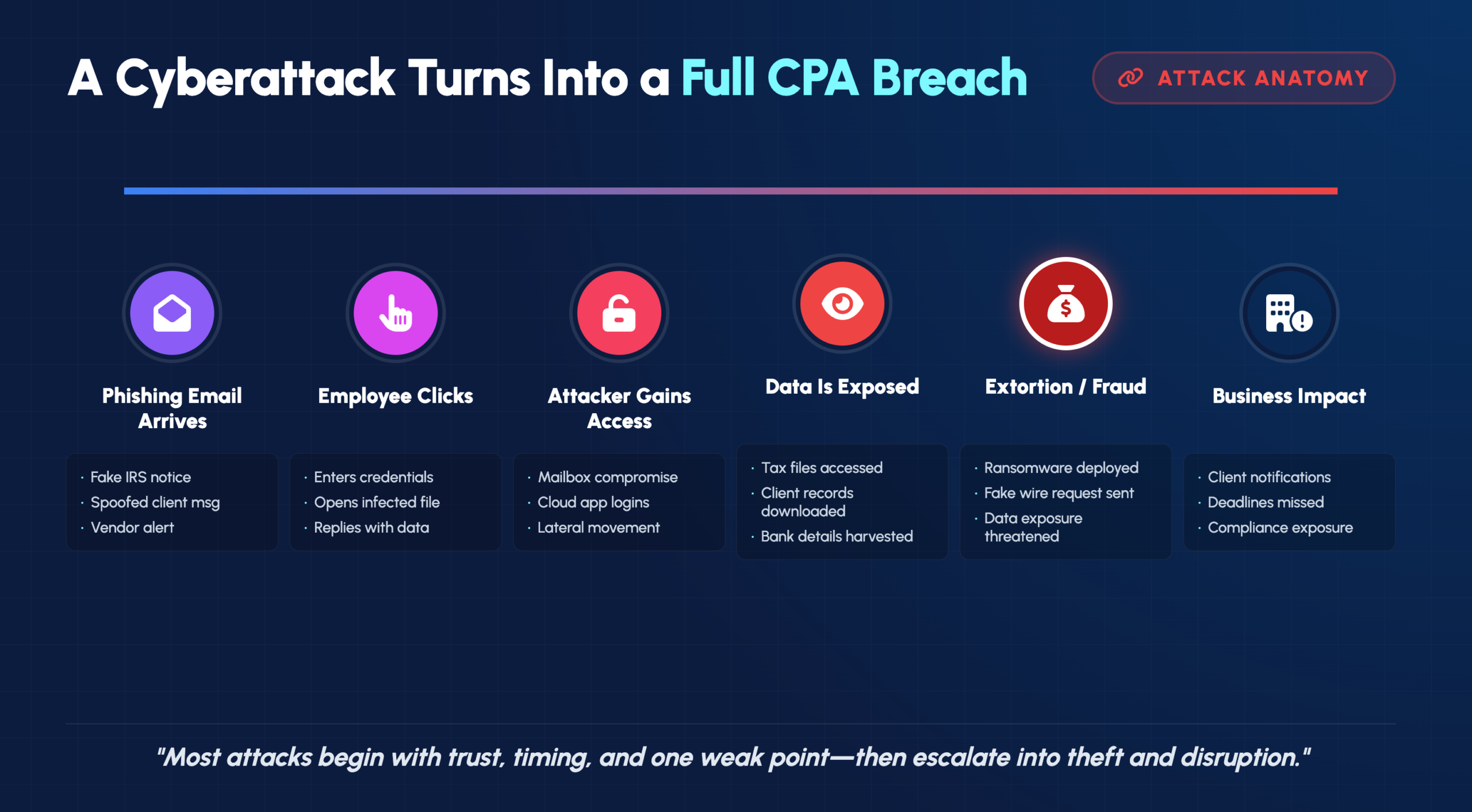
Phishing attacks use deceptive emails to trick recipients into revealing passwords, clicking malicious links, or transferring funds. For CPA firms, attackers commonly impersonate the IRS, software vendors, or even the firm’s own clients. Business email compromise takes this further by gaining access to legitimate email accounts and using them to request wire transfers or sensitive documents.
Spoofed domains make detection difficult. An attacker might register a domain like “smithcpa-firm.com” instead of “smithcpafirm.com,” and the difference often goes unnoticed during a busy workday.
Ransomware is malicious software that encrypts files and demands payment for the decryption key. For accounting practices, losing access to client files during tax season can be catastrophic. Modern ransomware groups now practice “double extortion,” where they steal data before encrypting it, then threaten to publish sensitive client information publicly if the ransom isn’t paid.
Even firms with solid backup systems face difficult choices when attackers hold client data hostage.
Remote work has become standard for many accounting professionals, yet home networks typically lack enterprise-grade protection. Personal devices accessing client data may not have proper security controls, and weak or missing VPN configurations expose firm systems to unauthorized access. Each remote connection point represents a potential entry for attackers.
CPA firms rely on tax software, cloud storage, practice management platforms, and various service partners. A security breach at any of these third parties can compromise firm data indirectly. Supply chain attacks have increased significantly, with attackers targeting smaller vendors specifically to gain access to their customers’ systems.
Endpoints include laptops, desktops, tablets, and mobile devices that connect to firm systems. Unpatched software, outdated antivirus protection, and unmanaged personal devices create openings that attackers actively scan for. Each device connecting to firm resources expands the potential attack surface.
Encryption scrambles data so only authorized parties can read it. Data “at rest” sits stored on devices or servers, while data “in transit” moves across networks. Many firms encrypt email but overlook file storage, backups, or portable devices. Unencrypted data on a lost laptop or intercepted during transmission becomes immediately readable by whoever obtains it.
Human error enables most successful cyberattacks against CPA firms. Staff members who cannot recognize phishing attempts, social engineering tactics, or suspicious requests become the weakest link in any security program. Technical controls alone cannot compensate for employees who inadvertently grant attackers access to firm systems.
Beyond established attack methods, several newer threats are gaining sophistication and becoming more common in attacks against financial services firms.
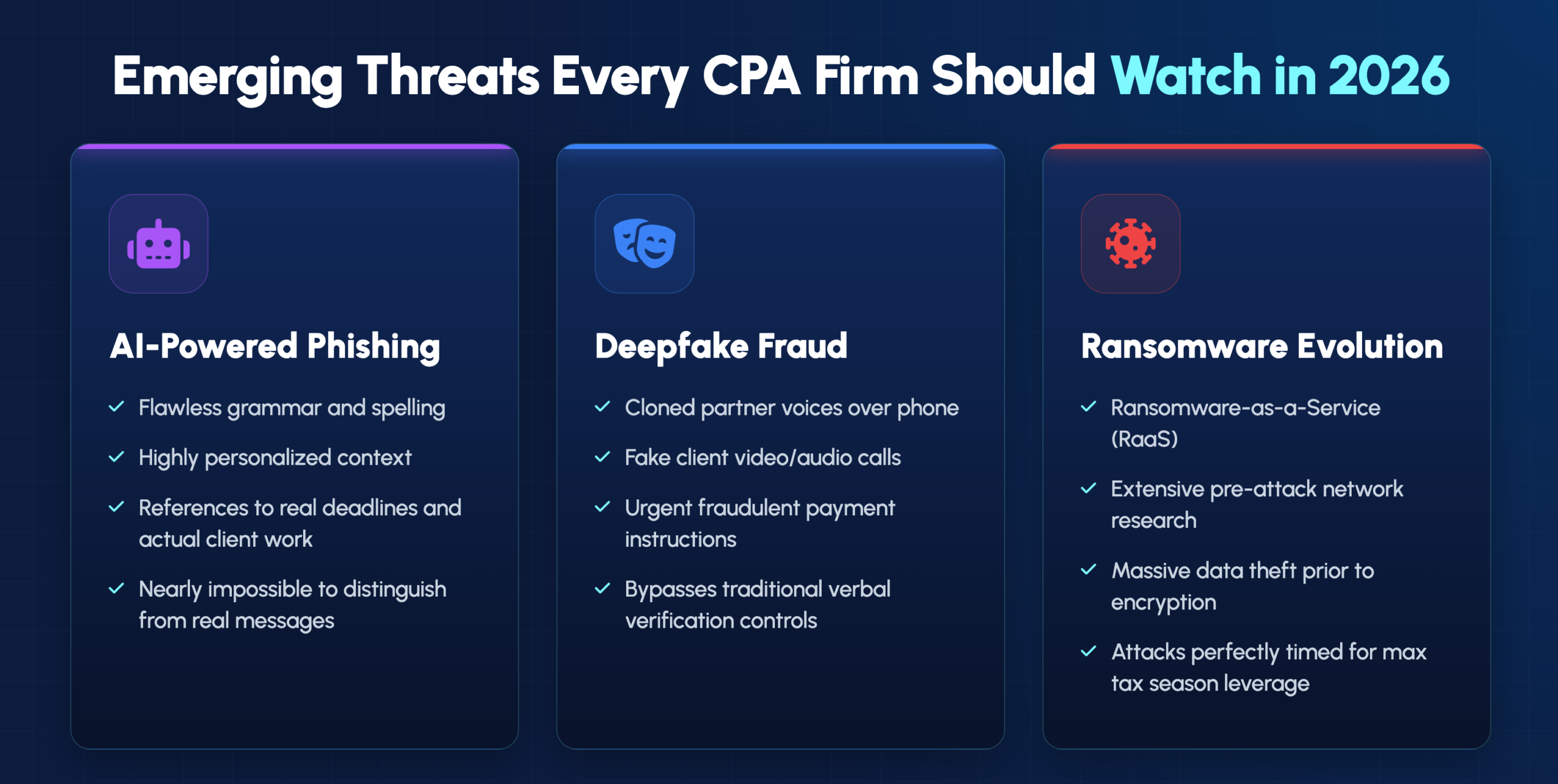
Artificial intelligence now enables attackers to generate highly personalized phishing emails at scale. Gone are the obvious grammatical errors and awkward phrasing that once helped identify fraudulent messages. AI tools can analyze publicly available information about a firm and its clients to craft messages that reference real projects, deadlines, or business relationships.
Deepfakes are AI-generated audio or video recordings that convincingly impersonate real people. Attackers can now create voice recordings that sound exactly like a firm partner or client, then use phone calls to authorize fraudulent wire transfers. Several documented cases involve criminals using cloned voices to request urgent payments that bypassed normal verification procedures.
Ransomware continues to evolve as criminal groups develop more sophisticated tools and tactics. “Ransomware-as-a-service” platforms now allow less technical criminals to launch sophisticated attacks by renting access to proven malware. Attackers increasingly research their targets before striking, identifying the most valuable data and timing attacks for maximum leverage.
When CPA firms use outsourced accounting services or work with offshore providers, additional security considerations come into play. Outsourcing arrangements can introduce risks that require careful evaluation and ongoing management.
Transferring client data to external parties creates vulnerability windows at each handoff point. Unsecured file sharing methods, excessive access permissions, and unclear data handling procedures can expose sensitive information. The more parties handling client data, the more opportunities exist for something to go wrong.
Different providers maintain varying security standards and regulatory compliance levels. A firm may meet all requirements internally while unknowingly partnering with vendors who fall short. This inconsistency creates unpredictable protection for client data across the service chain.
Vetting outsourced partners involves examining several key factors before sharing client data:
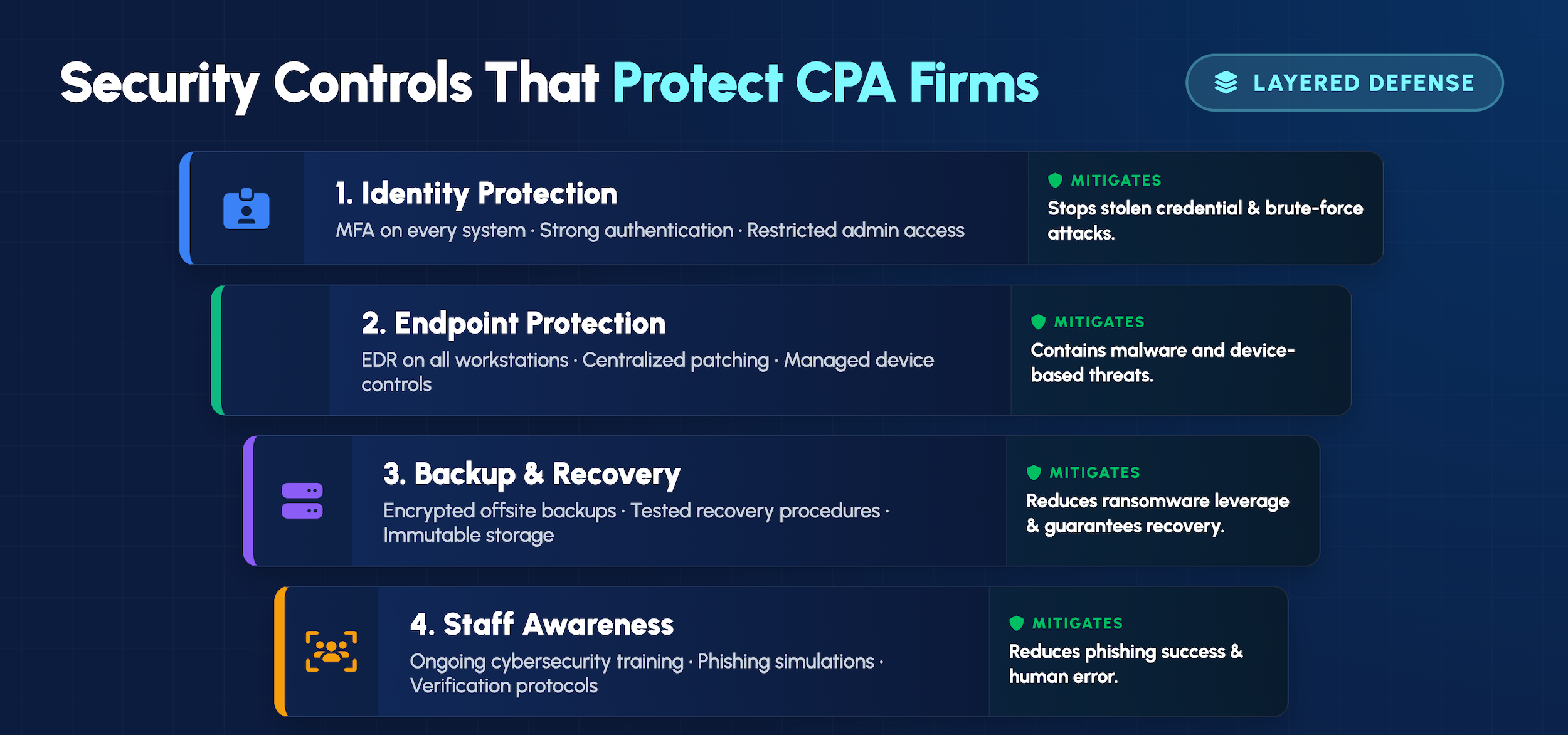
Addressing the risks outlined above involves implementing specific countermeasures. The following protective measures directly counter the most common attack vectors targeting accounting practices.
Multi-factor authentication, or MFA, requires users to verify their identity through multiple methods. Typically this means entering a password plus a code from a mobile device or authentication app. MFA blocks the vast majority of credential-based attacks because stolen passwords alone aren’t enough to gain access. This protection applies to all firm systems, not just email.
Endpoint detection and response, known as EDR, goes beyond traditional antivirus software. Rather than simply checking files against known malware signatures, EDR continuously monitors devices for suspicious behavior patterns that may indicate an attack in progress. When threats are detected, EDR can automatically isolate compromised devices before damage spreads.
Secure, offsite backups that are regularly tested neutralize ransomware leverage. When firms can restore their data independently, attackers lose their primary bargaining chip. However, backups only help if they actually work when needed, so regular testing confirms recoverability before an emergency occurs.
Ongoing education programs that include simulated phishing tests build lasting security habits among staff. One-time training fades quickly from memory, while continuous reinforcement keeps security awareness fresh. Employees who regularly practice identifying threats become significantly more resistant to social engineering attempts.
A Security Operations Center, or SOC, provides 24/7 monitoring that identifies threats in real time. Continuous surveillance catches attacks during their early stages, often before significant damage occurs. This proactive approach dramatically reduces the impact of security incidents compared to discovering breaches days or weeks later.
Regulatory obligations increasingly mandate specific security controls for firms handling financial and tax data. Understanding where compliance and security intersect helps firms align their investments with legal requirements.
The IRS requires all tax preparers to implement written information security plans under Publication 4557 and the FTC Safeguards Rule. A Written Information Security Plan, or WISP, documents the administrative, technical, and physical safeguards protecting client tax information. Non-compliance can result in penalties and loss of the ability to file returns electronically.
State-level privacy laws impose additional requirements that vary by jurisdiction. California, New York, and other states have enacted regulations affecting how firms handle resident data. Firms serving clients across multiple states may face overlapping compliance obligations that require careful coordination.
Data breaches create significant professional liability exposure for CPA firms. Cyber insurance provides financial protection for breach response costs, legal fees, and client notification expenses. Many clients now require proof of cyber coverage before sharing sensitive financial information with their accountants.
| Requirement | Applies To | Key Obligation |
|---|---|---|
| IRS Safeguards Rule | All tax preparers | Written security plan (WISP) |
| State privacy laws | Firms with state residents | Data protection standards |
| Professional standards | All CPAs | Client confidentiality |
The threat landscape facing accounting practices continues to shift. Several developments are shaping how firms approach security heading into 2026.
The cybersecurity risks facing CPA firms call for more than reactive fixes after problems occur. Ongoing vigilance and specialized expertise address both the technical threats and regulatory requirements discussed throughout this article.
Proactive monitoring catches threats before they escalate into breaches. Rapid response minimizes damage when incidents do occur. And strategic guidance helps firms make informed decisions about where to invest limited security budgets.
IT GOAT’s fully U.S.-based security team provides continuous protection and compliance support designed for firms handling sensitive financial data. Book an Appointment to discuss your firm’s specific security requirements.


