
Texas SB 2610, passed by the 89th Texas Legislature and effective September 1, 2025, gives businesses with fewer than 250 employees a legal tool to limit their exposure in a data breach lawsuit. If a qualifying cybersecurity program was in place when a breach occurred, the business can assert an affirmative defense against exemplary damages. The specific program required depends on how many employees the business has, and the program must exist before the breach happens.
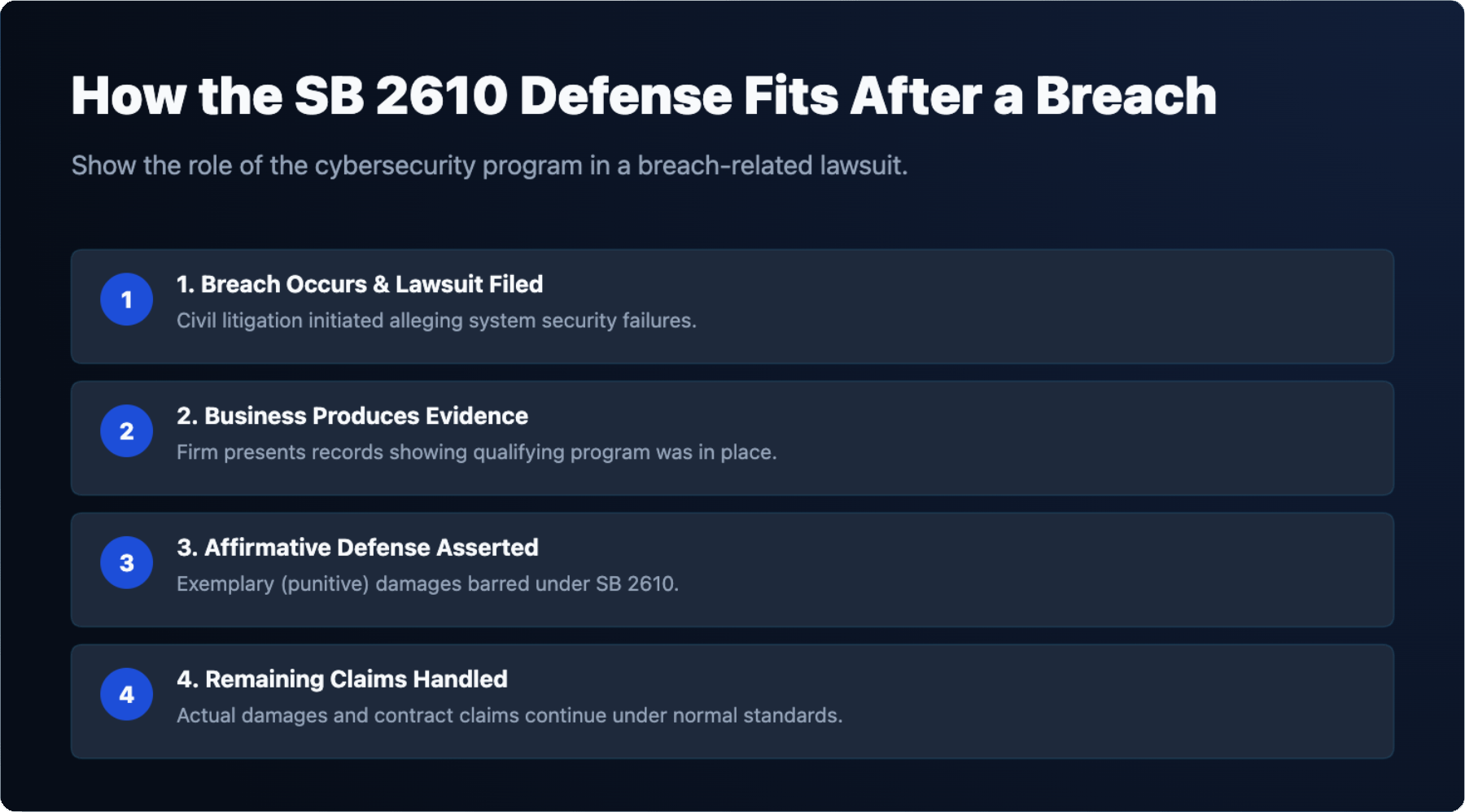
SB 2610 creates an affirmative defense in civil litigation. When a plaintiff sues a business over a breach of system security, the business can invoke the defense to block an award of exemplary damages if it can show it had a qualifying cybersecurity program in place at the time of the breach. The law does not prevent lawsuits from being filed, and it does not eliminate liability for actual damages. It addresses only the punitive layer of a damages award.
The bill also requires that a qualifying program be updated after a relevant framework revision. A program frozen at an outdated version of a framework does not satisfy the law’s requirements going forward.
The safe harbor is narrow and specific. It is an affirmative defense to exemplary damages only. Exemplary damages, sometimes called punitive damages, are awarded on top of actual damages to punish particularly egregious conduct. SB 2610 does not shield a business from claims of negligence, breach of contract, or statutory violations. It does not prevent a court from awarding actual damages, and it does not create immunity from regulatory enforcement.
This distinction matters. A business that suffers a breach can still face significant liability for direct losses, notification costs, and other compensatory claims. The law reduces one category of financial exposure, not all of it. Understanding Texas data breach laws in full context is essential before treating SB 2610 as a complete risk management solution.
This page is not legal advice. Consult qualified legal counsel to evaluate how SB 2610 applies to your business.
The law applies to businesses with fewer than 250 employees. That threshold covers a wide range of Texas companies, from sole proprietors to mid-sized firms. The employee count determines which tier of requirements applies, so getting the headcount right matters before selecting a framework or building a program.
The law does not define “employees” further in the evidence available here. [ADD: statutory definition or clarification of how SB 2610 counts employees, e.g., full-time equivalents, part-time, contractors] Businesses near a tier boundary should confirm their classification with legal counsel before deciding which requirements to follow.
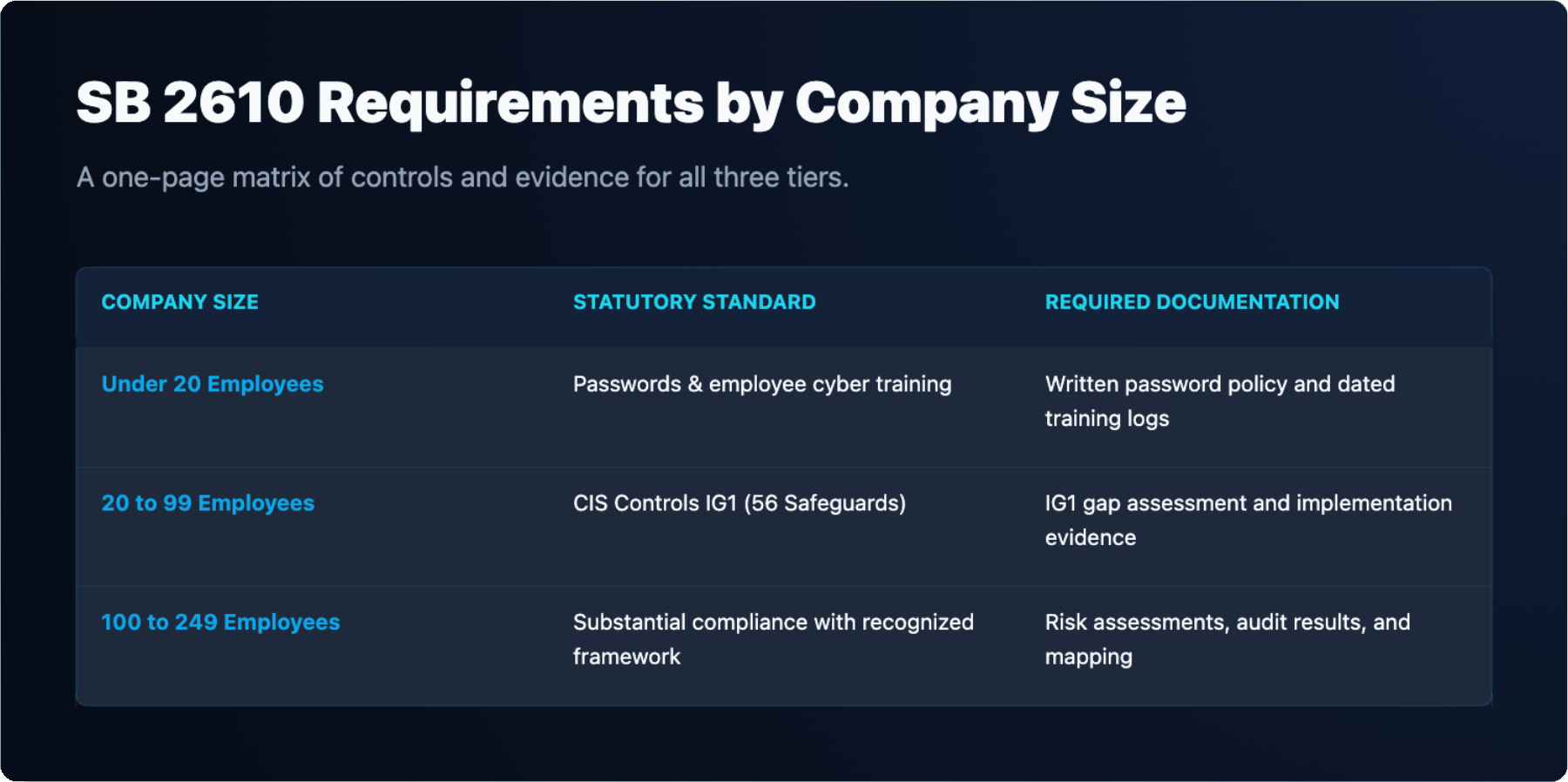
The smallest tier covers businesses with fewer than 20 employees. SB 2610 requires two things from these businesses: reasonable password requirements and employee cybersecurity training. The law does not prescribe a specific password standard or mandate a particular training curriculum, but the program must be implemented and maintained, not simply documented and forgotten.
In practice, reasonable password requirements typically include minimum length, complexity rules, and controls against reuse. Employee training should cover phishing recognition, safe handling of sensitive data, and incident reporting procedures. These are baseline controls, but they must be active and enforced when a breach occurs for the defense to apply.
Businesses in this tier should document their password policy and keep records of training completion. Documentation is what makes the defense usable in court. Our data security and compliance services can help small businesses build and maintain these records systematically.
Businesses in the 20-to-99 employee range must implement and maintain a cybersecurity program that meets CIS Controls Implementation Group 1 (IG1). CIS IG1 is the foundational tier of the CIS Controls framework, designed specifically for smaller organizations with limited IT resources. It covers 56 safeguards across 18 control categories, addressing areas such as asset inventory, data protection, secure configuration, account management, and basic incident response.
IG1 is not a light lift for a business without dedicated IT staff, but it is structured and well-documented. The Center for Internet Security publishes the full control set with implementation guidance. The key obligation under SB 2610 is that the program must be in place and maintained, and it must be updated when the CIS Controls framework is revised.
Businesses at this tier should map their existing controls to IG1, identify gaps, and close them before a breach occurs. Working with a Dallas IT services provider familiar with CIS Controls can accelerate that process for Texas-based companies.
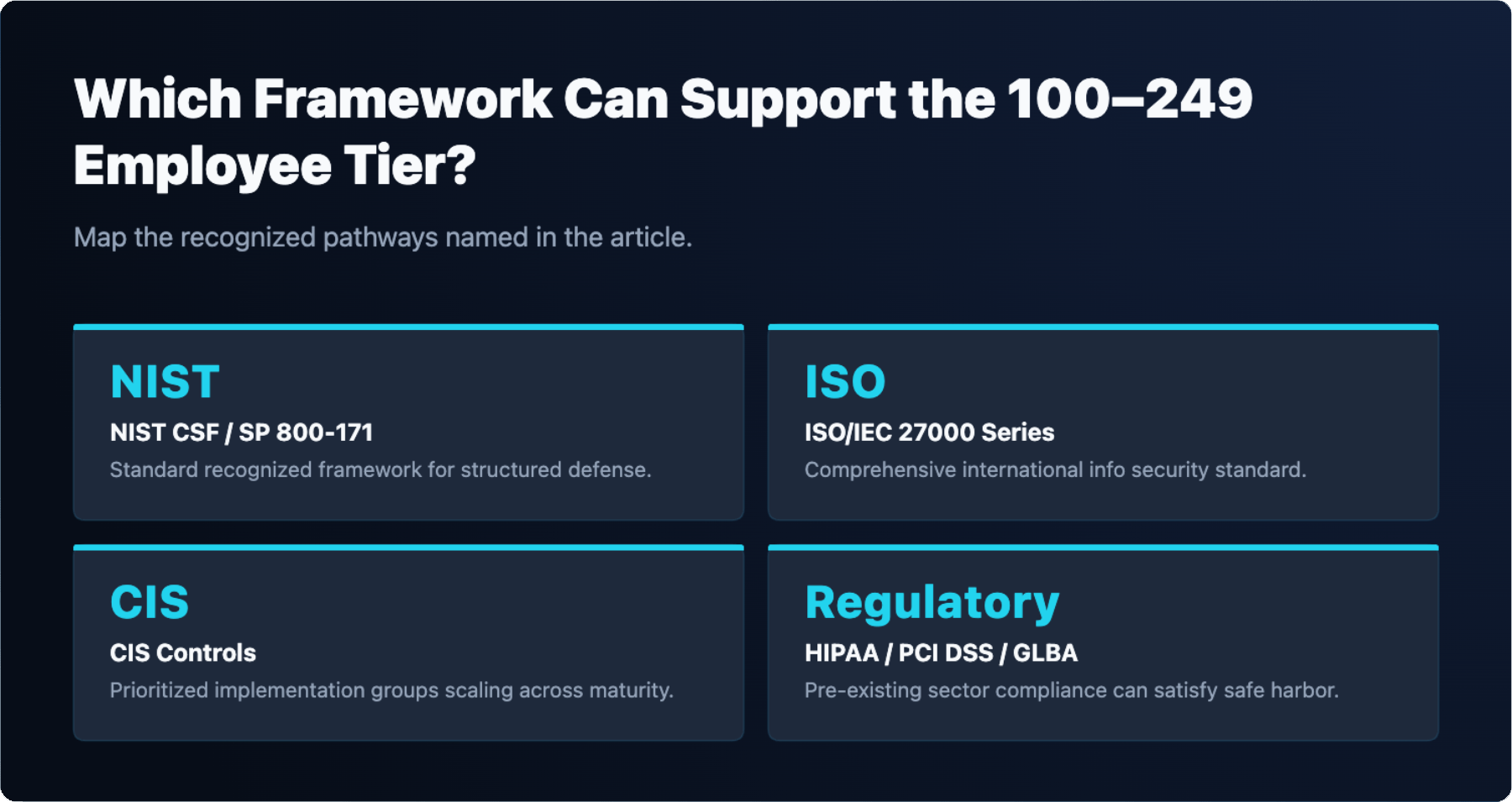
The largest tier under SB 2610 covers businesses with 100 to 249 employees. These businesses must substantially comply with a recognized cybersecurity framework or an applicable regulatory standard. The bill identifies several options:
The standard is substantial compliance, not perfect compliance. That said, substantial compliance still requires a documented, functioning program. Selecting a framework and doing nothing with it does not qualify. Businesses in this tier should choose the framework most aligned with their industry and existing controls, then build toward it systematically. Our NIST compliance framework guidance covers how to structure that process for businesses using NIST CSF or SP 800-171.
| Employee Count | What the Law Requires | Example Controls | Documentation to Keep |
|---|---|---|---|
| Fewer than 20 | Reasonable password requirements and employee cybersecurity training | Password policy with minimum length and complexity; annual phishing and security awareness training | Written password policy; training completion records with dates and employee names |
| 20 to 99 | CIS Controls Implementation Group 1 | Hardware and software asset inventory; data protection controls; secure configuration baselines; multi-factor authentication; basic incident response plan | IG1 gap assessment; control implementation records; evidence of framework updates applied after CIS revisions |
| 100 to 249 | Substantial compliance with a recognized framework (NIST CSF, NIST SP 800-171, ISO/IEC 27000 series, CIS Controls) or applicable regulation (HIPAA, GLBA, PCI DSS) | Risk assessment; access control policy; vulnerability management program; incident response and recovery plan; vendor risk management | Framework selection rationale; risk assessment reports; policy documents; audit or assessment results; evidence of updates after framework revisions |
For businesses already subject to HIPAA, GLBA, or PCI DSS, SB 2610 creates an alignment opportunity. If a business in the 100-to-249 employee tier is already maintaining a HIPAA Security Rule compliance program, that program can serve as the qualifying cybersecurity program under SB 2610, provided it is implemented and maintained as the law requires. The same logic applies to PCI DSS for payment card processors and GLBA for financial services firms.
The Texas Data Privacy and Security Act (TDPSA) operates separately from SB 2610. TDPSA imposes data processing and privacy obligations on businesses that meet its applicability thresholds. SB 2610 addresses breach litigation exposure. The two laws can overlap in practice: a breach that triggers TDPSA obligations may also be the event that tests whether a business qualifies for the SB 2610 affirmative defense. Reviewing the Texas breach notification law requirements alongside SB 2610 gives a more complete picture of what a breach response involves.
Businesses subject to multiple frameworks should map their existing compliance work to SB 2610’s tier requirements and identify whether any gaps remain. Our compliance services team works with businesses navigating overlapping regulatory obligations.
The affirmative defense requires a business to show it implemented and maintained a qualifying program when the breach occurred. That showing happens in litigation, which means documentation is the evidence. Verbal policies and informal practices do not hold up in court.
Every tier requires written documentation. For the smallest tier, that means a written password policy and training records. For IG1, it means a gap assessment, control implementation records, and evidence that the program was updated when the CIS Controls framework was revised. For the top tier, it means a formal risk assessment, written policies aligned to the chosen framework, and periodic review records.
Key documentation practices include:
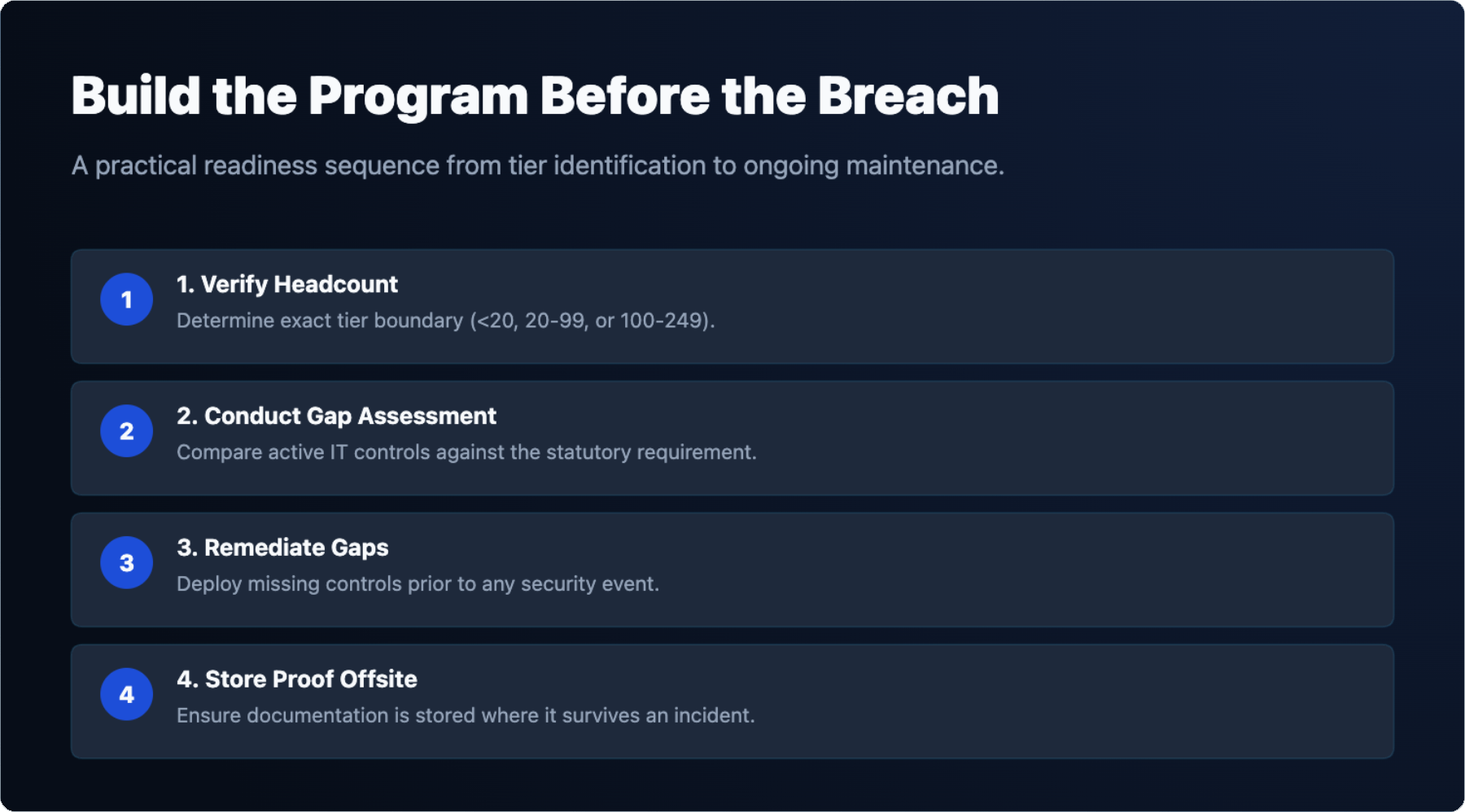
Start by confirming your employee count and identifying which tier applies to your business. Then assess your current controls against that tier’s requirements. For businesses with fewer than 20 employees, the gap analysis is straightforward: do you have a written password policy and documented training? For businesses in the 20-to-99 range, map your existing controls to CIS IG1 and identify what is missing. For businesses with 100 to 249 employees, select the framework most relevant to your industry and conduct a formal risk assessment against it.
Build the program before a breach occurs. The law requires the program to be in place at the time of the breach. Retroactive compliance does not qualify for the affirmative defense. Set a review schedule so the program stays current as frameworks are updated, and assign clear internal ownership so the program does not lapse between reviews.
Legal counsel should review your program design and documentation approach to confirm it meets the law’s requirements. SB 2610 is new, and how courts interpret “reasonable password requirements,” “substantial compliance,” and related terms will develop over time.


