
Most SaaS platforms running on Kubernetes treat container security as a configuration task handled once at deployment and revisited only after an incident.
That approach no longer reflects the actual threat environment. Nearly nine in ten security leaders reported at least one cloud-native security incident in the past twelve months, and the attack surface they are defending has grown significantly more complex as container adoption has moved from experimental to production-critical.
Containers enable rapid deployment cycles without full environment rebuilds. They support horizontal scaling under variable load. They underpin multi-tenant architectures where a single cluster may serve dozens or hundreds of customer accounts simultaneously. That last point is where shared risk becomes a board-level concern: a compromise in one tenant’s workload can create a lateral movement path into another’s data if isolation controls are absent or misconfigured.
Securing a traditional virtual machine means hardening a discrete operating system with its own kernel. Securing containers means accepting that isolation is logical, not physical, and enforcing controls accordingly.
Nearly nine in ten security leaders reported at least one cloud-native security incident in the past twelve months, which reflects how often that distinction gets underestimated in production environments.
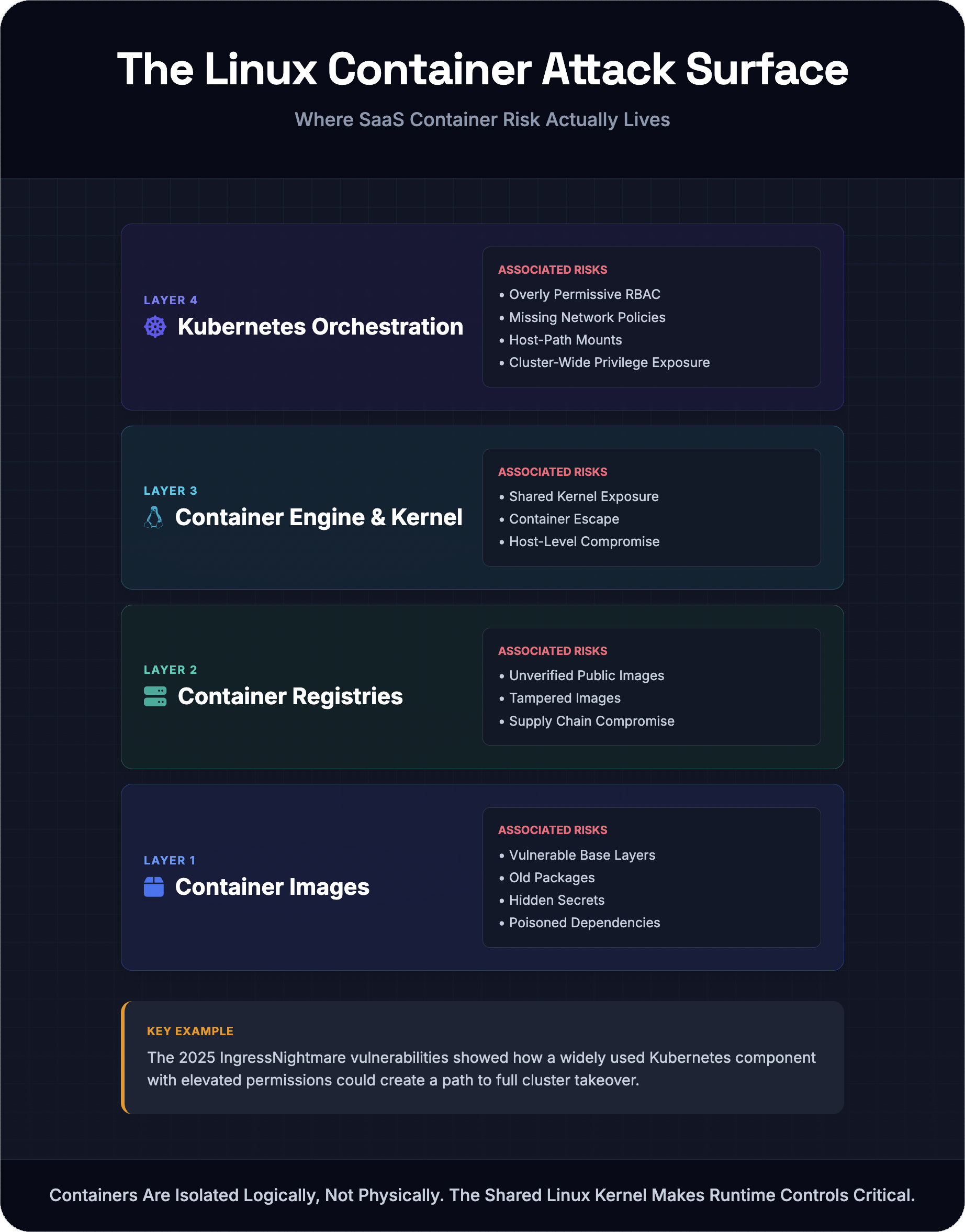
Understanding where attackers enter a containerized environment is prerequisite to defending one. The attack surface is not a single point of failure: it spans four distinct layers, each with its own risk profile and each capable of cascading damage if compromised.
A container image is the blueprint that defines everything a running container contains: the operating system libraries, application dependencies, and configuration files. The problem is inheritance. Most images are built on top of publicly available base images: official or community-maintained distributions of Alpine, Ubuntu, or Debian, and any vulnerability present in that base layer ships directly into production. Teams that pull a base image once and never update it are running known, patchable vulnerabilities on live infrastructure. Build-time scanning tools catch CVEs in these layers, Dockerfile misconfigurations, and secrets embedded in image layers before they reach a runtime environment.
Registries are the storage and distribution systems for container images — Docker Hub, Amazon ECR, and Google Artifact Registry are common examples. The supply chain risk is straightforward: a team that pulls an image from a public registry without verifying its provenance accepts whatever was built into it. The XZ Utils backdoor, disclosed in March 2024, demonstrated this precisely. A deliberately introduced backdoor in a widely distributed Linux compression library was present in many base images, and conventional scanners would not have flagged it because no CVE existed at the time of discovery.
Container engines such as Docker and containerd are the runtime systems that execute images as containers. Unlike virtual machines, containers do not run on isolated kernels: they share the host Linux kernel directly. A kernel-level exploit does not compromise one container; it compromises every container running on that host simultaneously.
Kubernetes is the orchestration platform that manages container deployment, scaling, and networking across clusters. With 80% of organizations running Kubernetes in production, it has become the operational backbone of modern SaaS infrastructure, and a high-value target. Default Kubernetes configurations do not enforce rootless execution, network policies, or host-path restrictions. Overly permissive RBAC rules create cluster-wide exposure, as the IngressNightmare vulnerabilities demonstrated in March 2025, where a flaw in the Ingress NGINX Controller allowed unauthenticated remote code execution across affected clusters. Mapping the attack surface is the foundation; the eight controls that follow address each layer directly.
Runtime security controls do not exist in isolation from compliance obligations, and for SaaS companies operating under SOC 2, HIPAA, PCI DSS, or ISO 27001, the connection between what your containers do at runtime and what auditors expect to see is direct and non-negotiable. The frameworks differ in scope, but they converge on the same operational requirement: demonstrable, continuous control over workload behavior.
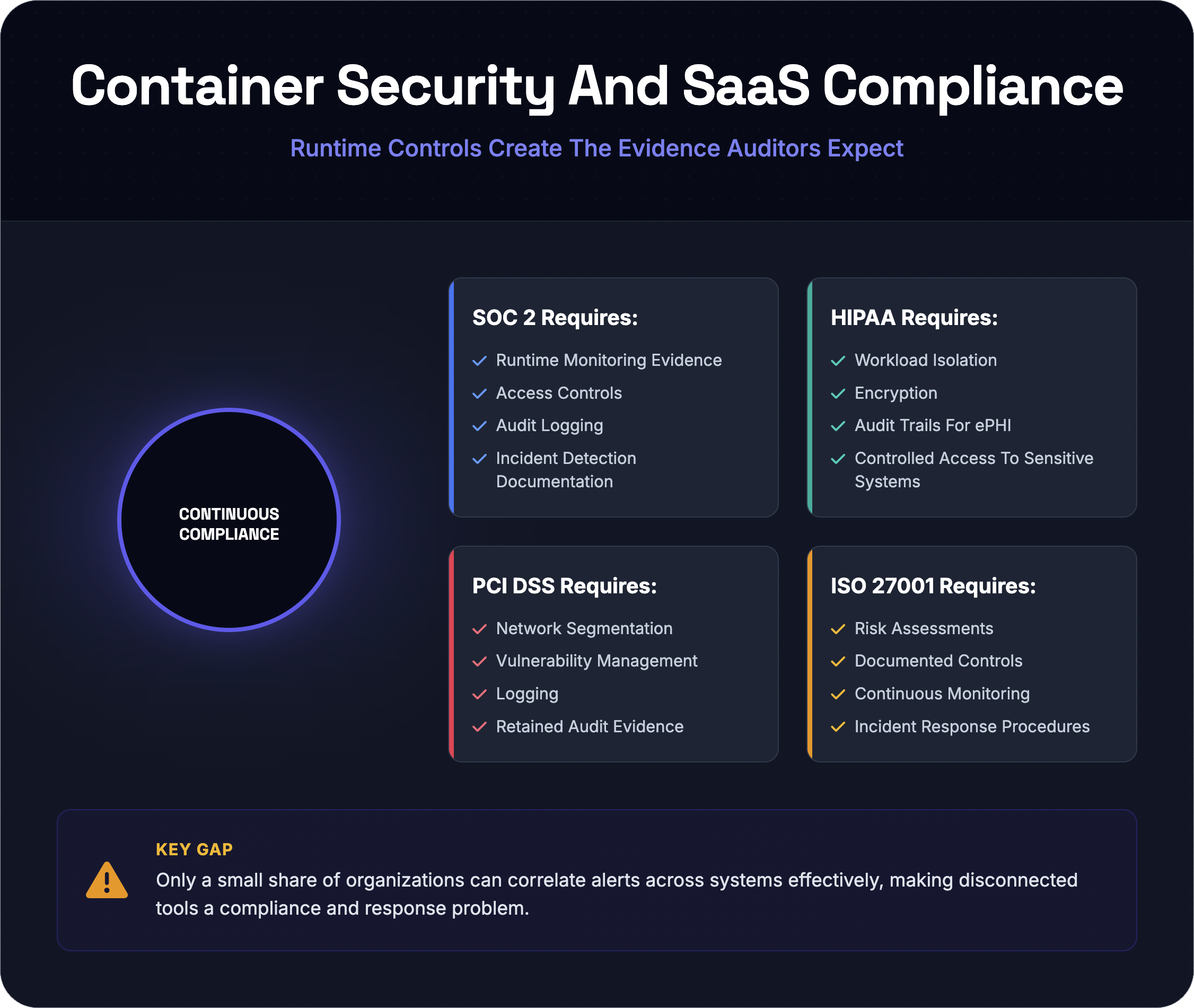
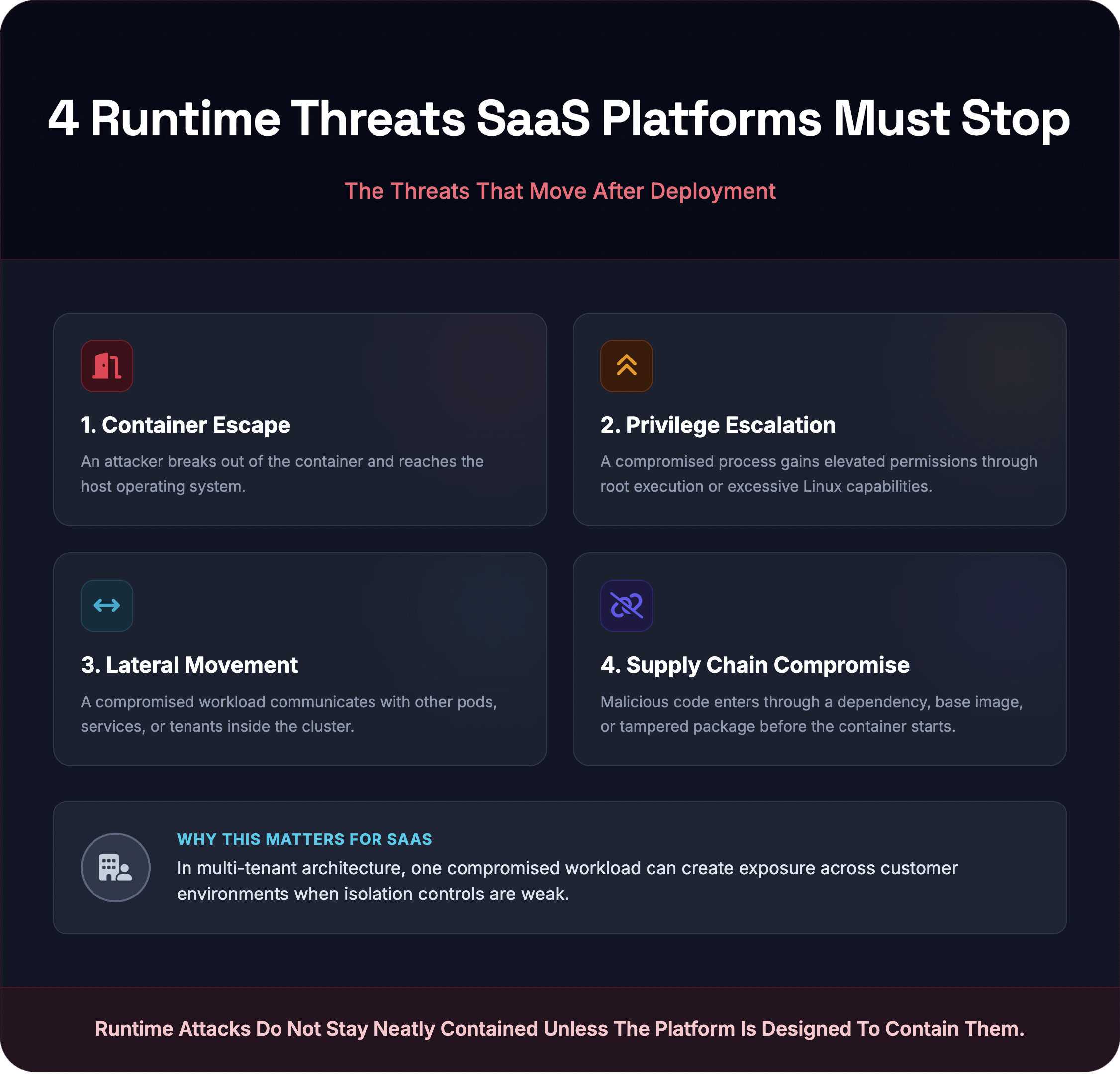
Understanding where attacks actually originate is the starting point for building effective defenses. Nearly nine in ten security leaders reported at least one cloud-native security incident in the past twelve months, and the attack patterns behind those incidents follow predictable paths that SaaS operators encounter repeatedly.
Container escape occurs when an attacker breaks through container isolation boundaries to access the underlying host. Because all containers on a host share the same Linux kernel, a successful kernel exploit does not compromise one workload in isolation; it exposes every container running on that host. The IngressNightmare vulnerabilities disclosed in March 2025 demonstrated exactly this risk: flaws in the Ingress NGINX Controller allowed unauthenticated remote code execution in exposed configurations, and because the controller ran with elevated cluster-wide permissions, the blast radius extended to the entire cluster. Container-level controls offer no protection once an attacker reaches the kernel.
Privilege escalation exploits the gap between the permissions a container needs and the permissions it actually has. Running containers as root is the most common contributing factor. When a process inside a container runs as root and the container has excessive Linux capabilities or mounts the Docker socket, an attacker who gains code execution inside that container immediately has a path to host-level control. Kubernetes default configurations do not enforce rootless execution, which means many production workloads carry this exposure without deliberate action to close it.
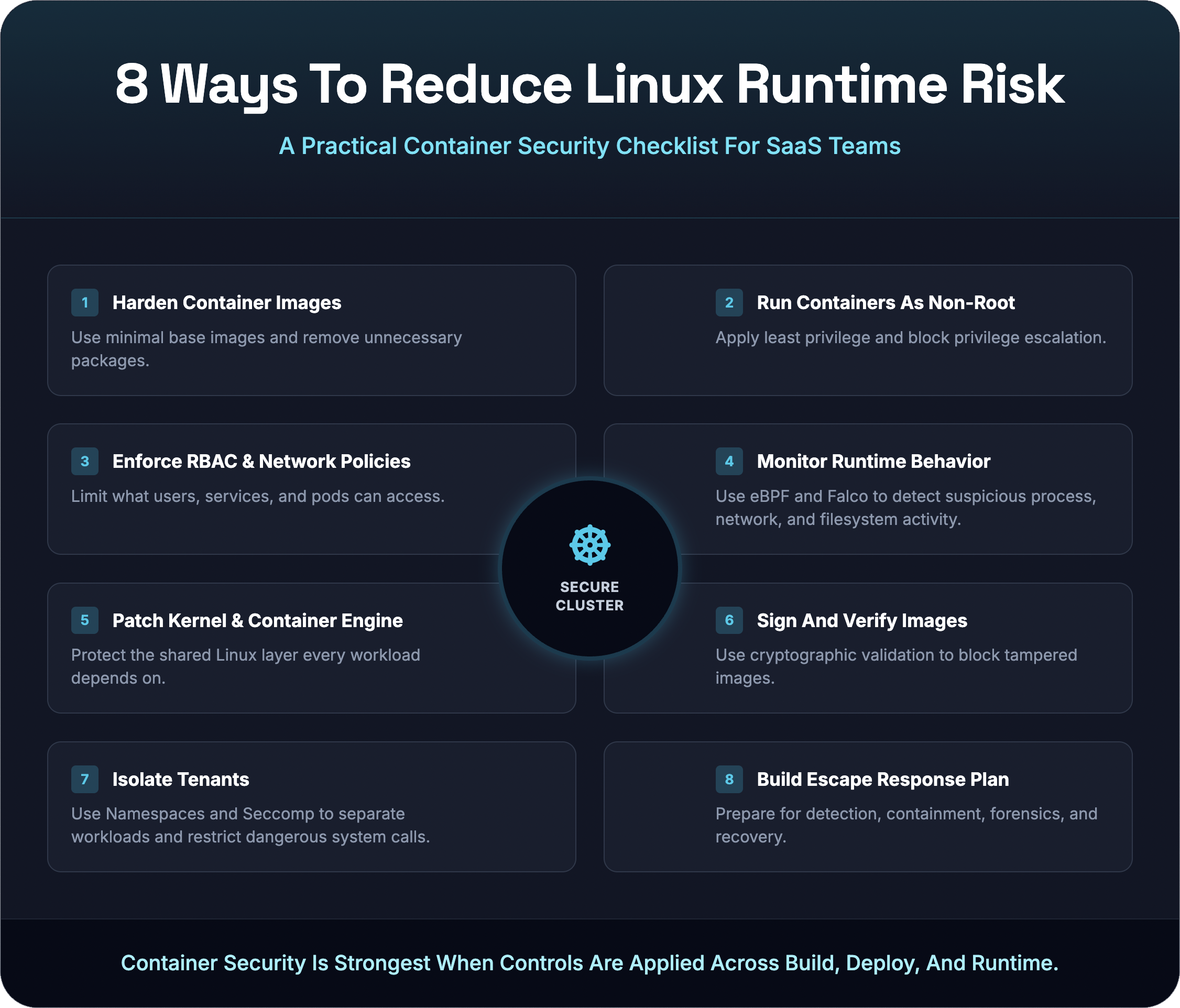
Reducing runtime risk is not a single control problem. It requires layered decisions made at build time, deployment time, and during live operations. Each of the eight practices below addresses a specific attack surface that SaaS teams running containerized Linux workloads face in production.
Image hardening starts with choosing minimal base images such as Alpine or distroless variants, removing packages that serve no function in the workload, and scanning for known vulnerabilities before images reach production. Tools like Trivy and Grype catch CVEs in base layers, Dockerfile misconfigurations, and secrets baked into image layers. An unhardened image is a liability that compounds with every deployment.
Running a container as root grants it the same permissions on the host kernel as a root-level process. The least privilege principle means granting only the permissions a workload absolutely requires to function. Kubernetes default configurations do not enforce rootless execution, so this must be explicitly defined in pod specifications or enforced through admission policies. The CIS Restricted pod security profile requires non-root execution, no privilege escalation, and dropping all Linux capabilities except those explicitly needed.
RBAC, Role-Based Access Control, governs which users and service accounts can interact with cluster resources. Wildcard rules granting verbs across all resources are a common misconfiguration that creates broad lateral movement risk. Network policies complement RBAC by restricting pod-to-pod communication at the network layer.
eBPF is a Linux kernel technology that provides deep observability into system calls, network activity, and process behavior without requiring kernel modifications or heavy agents. Falco, an open-source runtime detection tool, uses eBPF to flag anomalous behavior such as unexpected outbound connections, writes to read-only filesystems, or privilege escalation attempts as they happen. Given that 89% of organizations report their current processes fail to detect active threats effectively, real-time behavioral detection is not optional for production SaaS environments.
Containers share the host Linux kernel. A kernel exploit compromises every container running on that host simultaneously. Waiting for a critical CVE to force an emergency patch is a reactive posture that creates unnecessary exposure windows. Establish a regular patching cadence and use CISA’s Known Exploited Vulnerabilities catalog as a signal for prioritizing which patches require accelerated timelines.
Image signing uses cryptographic verification to confirm that a container image has not been modified since it was built and approved. The XZ Utils backdoor disclosed in March 2024 demonstrated that malicious code can be introduced into widely-used Linux libraries and base images before any CVE exists to detect. Tools like Cosign enable signature verification at admission time, blocking unauthorized or tampered images from reaching production clusters.
Kubernetes namespaces create logical boundaries that separate workloads, resource quotas, and permissions within a cluster. Seccomp, a Linux kernel feature, restricts which system calls a container is permitted to make, reducing the attack surface available to a compromised process.
Prevention controls reduce risk but do not eliminate it. Teams need a documented playbook specifically for container environments that covers detection of anomalous runtime behavior, containment of affected pods or nodes, forensic collection before ephemeral containers are terminated, and recovery procedures that restore known-good workloads. NIST SP 800-61 Rev. 3 provides the foundational incident response framework, but it requires adaptation for the ephemeral and distributed nature of container infrastructure. Implementing these eight controls creates a defensible baseline, and the next question is how to operationalize them within the compliance frameworks most SaaS platforms are already required to meet.
IT GOAT brings the context that generic managed security providers lack. Container escape paths, RBAC misconfigurations, supply-chain integrity gaps, and multi-tenant isolation failures each carry distinct risk profiles in SaaS environments.
Addressing them requires security partners who understand how those risks interact at the infrastructure layer, not just at the perimeter.
Image scanning checks container images before deployment, identifying known CVEs in base images, hardcoded secrets in layers, and Dockerfile misconfigurations. Runtime security operates after deployment, monitoring active containers for malicious behavior as workloads execute. The XZ Utils backdoor illustrates why both layers matter: conventional scanners would not have detected it as a known CVE at the time of discovery, because it had not yet been catalogued. Build-time controls establish a clean starting point; runtime controls catch what slips through or emerges after containers are running.
Smaller teams gain meaningful runtime visibility without building an in-house SOC by combining managed security providers with purpose-built open source tooling. Falco, for instance, operates as a syscall-based detection engine that flags unexpected processes, unusual outbound connections, and writes to read-only filesystems without requiring a full security operations team to configure and maintain it. Managed detection services layer on top to handle alert triage, which keeps internal engineering focused on product delivery rather than incident response.
Modern eBPF-based tools attach at the kernel level, intercepting system calls with negligible processing overhead. For most SaaS workloads, the performance impact is not a practical concern. The tradeoff that actually demands attention is alert volume: nearly 9 in 10 security leaders report that current processes fail to detect active threats effectively, often because teams are buried in uncorrelated signals across multiple tools rather than because the monitoring itself is too resource-intensive.
Configuration audits work best as a continuous process rather than a periodic event. Automated scanning integrated directly into deployment pipelines catches drift before it reaches production, and benchmarks like the CIS Kubernetes Benchmark provide a consistent standard against which configurations can be measured at every release. Treating audits as a one-time or quarterly activity creates windows where misconfigurations accumulate undetected, which is precisely the exposure pattern that compliance frameworks like PCI DSS and HIPAA are designed to eliminate. Establishing that continuous audit baseline is also what makes the runtime controls discussed throughout this article operationally sustainable over time.
We use cookies to enhance site performance and user experience. Your data stays private — we don’t sell your information or share it with unrelated third parties. To find out more about the cookies we use, view our Privacy Policy.