
Manufacturing was the most attacked industry on the planet for the fourth year running. The average data breach now costs $4.88 million. And most mid-sized manufacturers are still running on a one- or two-person IT team that clocks out at 5 p.m.
That’s not a staffing strategy. It’s a liability.
Most operations leaders compare an MSP’s monthly fee to a salary and stop there. That’s the wrong calculation.
When you account for everything, a single internal IT hire costs $130,000–$150,000 per year, before you buy a single tool.
In manufacturing, downtime isn’t an IT problem, it’s a production problem.
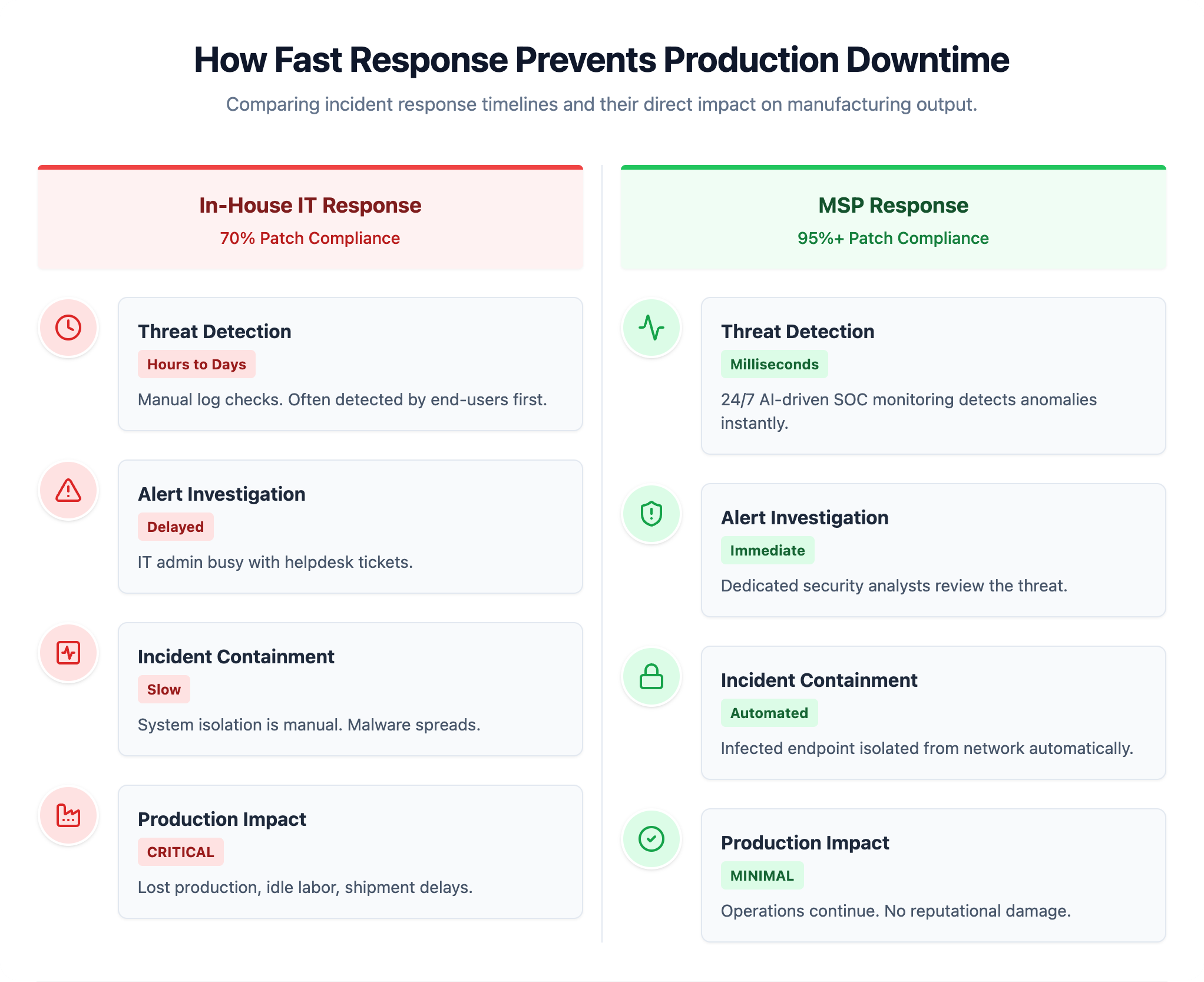
In-house teams typically detect and respond to incidents in hours or days. An MSP with 24/7 monitoring responds in minutes. That gap is where the financial damage accumulates.
| What You’re Actually Paying For | In-House IT | MSP |
|---|---|---|
| Annual cost (50-user operation) | $130K–$150K+ | $40K–$50K |
| Coverage hours | Business hours only | 24/7/365 |
| Cybersecurity expertise | Generalist | Full specialist team |
| Patch compliance rate | ~70% | 95%+ |
| CMMC / compliance support | Self-managed | Built in |
| Scales with growth | Hire each time | Adjusts to your needs |
To be direct: MSPs aren’t right for every manufacturer. Internal IT holds up in these specific scenarios:
If your situation doesn’t fit one of these three, the financial and operational math shifts significantly.
A one-year salary comparison tells you very little. The model that looks cheaper in year one often breaks down in year three. Here’s how to structure an honest comparison:
Year 1 — Startup costs In-house: Recruiter fees, onboarding time, hardware procurement, software licensing, and the productivity gap while your new hire learns your ERP and OT environment. MSP: Onboarding fee, documentation, and transition period before full coverage is operational.
Year 2 — Steady state In-house: Salary + benefits (add 20–30% above base), ongoing training, tool renewals, and growing compliance overhead. MSP: Fixed monthly fee. Costs adjust only when headcount or infrastructure changes.
Year 3 — Where in-house often breaks With average IT tenure under three years at SMBs, year three frequently brings a full replacement cycle. Recruiting, institutional knowledge loss, and a coverage gap during transition — while your business keeps running and your risk exposure quietly climbs.
A realistic comparison at 50 users:
| In-House (3-Year Total) | MSP (3-Year Total) | |
|---|---|---|
| Staffing (fully loaded) | $390,000–$450,000+ | — |
| Tooling and licensing | $30,000–$60,000 | Included |
| Recruiting / turnover (1 cycle) | $20,000–$40,000 | — |
| MSP contract | — | $120,000–$150,000 |
| Estimated 3-Year Total | $440,000–$550,000+ | $120,000–$150,000 |
Note: Neither figure includes the cost of a significant downtime event or data breach, which IBM estimates at an average of $4.88M.
For manufacturers with existing IT staff who aren’t ready to fully outsource, co-managed IT is a practical middle path.
Your internal team handles day-to-day support, on-site presence, and vendor coordination. The MSP provides after-hours monitoring, security escalation, compliance projects, and specialized expertise your single hire can’t realistically cover alone.
The result: you keep the institutional knowledge of your plant floor and ERP environment. You stop carrying all the risk.
This structure also creates budget predictability. Instead of a second full-time hire to cover nights, weekends, and compliance projects, you pay for MSP capacity only where you need it.

Whether you’re running in-house IT today or considering a change, these five numbers give you an objective baseline:
Cost per user — Total annual IT spend ÷ supported users. Puts both models on equal footing.
Mean time to resolution — Average hours from ticket open to confirmed close. Every blocked hour is lost production time.
Uptime percentage — Tracked monthly. ERP and MES downtime is a production continuity metric, not just an IT one.
Patch compliance rate — Are you at 70% or 95%+? The gap is your attack surface.
Compliance audit readiness — Can you produce documentation, access logs, and control evidence on demand? With CMMC now enforceable, the answer has financial consequences.
Not every manufacturer has the headcount, budget, or operational profile to justify a full internal IT function, and for many, an MSP delivers measurably better outcomes at lower total cost.
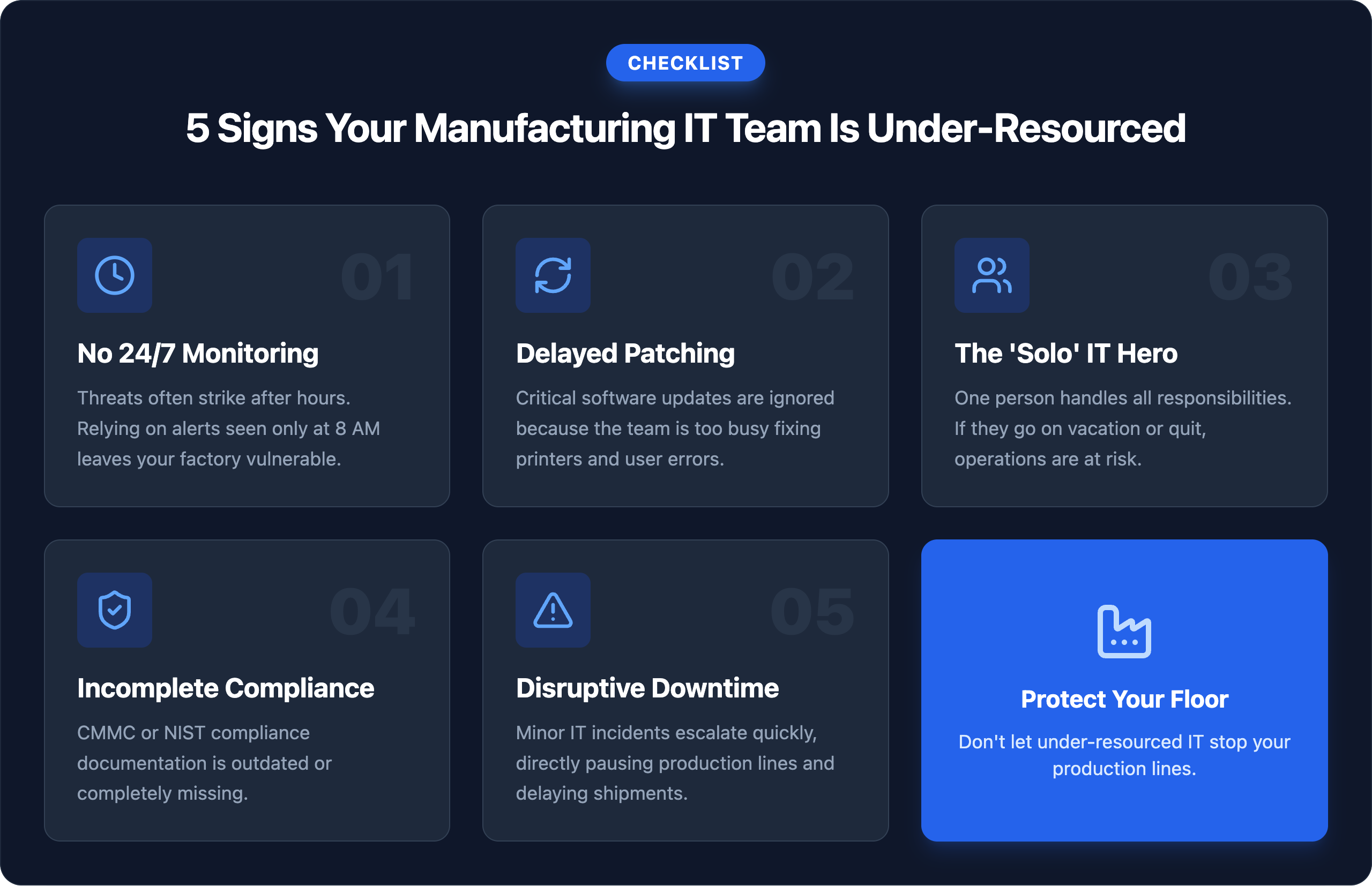
The lowest monthly fee rarely reflects the lowest total cost. Before committing to either model, you need a clear picture of what your current IT setup is actually costing you, in dollars, in downtime, and in compliance exposure.
Book a Free Cost Review with IT GOAT →
We’ll walk through your specific headcount, infrastructure footprint, and risk profile and show you exactly where your current model is creating exposure.
For a 50-user operation, a full-service MSP contract typically runs $40,000–$50,000 annually. Per-user pricing generally falls between $100–$200/user/month depending on scope and service level.
MSPs with genuine manufacturing experience support OT environments, SCADA systems, and PLCs alongside traditional IT infrastructure. Ask specifically about OT network segmentation experience and manufacturing client references before signing.
Most manufacturers retain internal staff in strategic or liaison roles. Co-managed arrangements — where internal staff handle daily operations while the MSP covers 24/7 monitoring and escalation — have become the most common structure at mid-sized facilities.
Most onboarding processes complete in a few weeks to a few months, depending on environment size and documentation quality. Manufacturers with documented network inventories move through onboarding significantly faster.
Reputable MSPs maintain cyber liability and errors-and-omissions coverage, transferring meaningful risk exposure away from your operation. Verify this coverage before signing any agreement.
We use cookies to enhance site performance and user experience. Your data stays private — we don’t sell your information or share it with unrelated third parties. To find out more about the cookies we use, view our Privacy Policy.