Since June 3, 2026, every SEC-registered adviser must be able to demonstrate to examiners that its service providers will report a breach within 72 hours of becoming aware of it. Your MSP typically holds more access to client data than any other outside vendor. This page lists exactly what to ask for, what to read, and what to keep on file.
The SEC adopted amendments to Regulation S-P in May 2024 under Release No. 34-100155. The amendments require covered institutions to maintain a written incident response program and to extend that program to the service providers they use. The rule is explicit: outsourcing a function does not transfer the adviser’s obligation to protect sensitive customer information. If your MSP suffers a breach that exposes client data, the regulatory exposure lands on your firm.
The service provider oversight requirement means advisers must take affirmative steps to select, contract with, and monitor vendors. Signing a contract and moving on is not sufficient. Reg S-P compliance is listed in the SEC Division of Examinations FY2026 priorities, which means examiners are actively looking at how firms manage this obligation. Firms that provide IT for financial and wealth advisors need to understand this framework as well as the advisers they serve.
The SEC set two compliance dates based on entity size. Larger entities, defined as advisers with $1.5 billion or more in assets under management, had to comply by December 3, 2025. Smaller entities had until June 3, 2026. Both deadlines have now passed, so every covered adviser is in scope regardless of size.
The AUM threshold of $1.5 billion is the dividing line the SEC used in the final rule. Verify your firm’s classification against the SEC final rule text and the SEC small entity compliance guide if there is any question about which category applies. The compliance dates are fixed; there is no grace period remaining for either group.
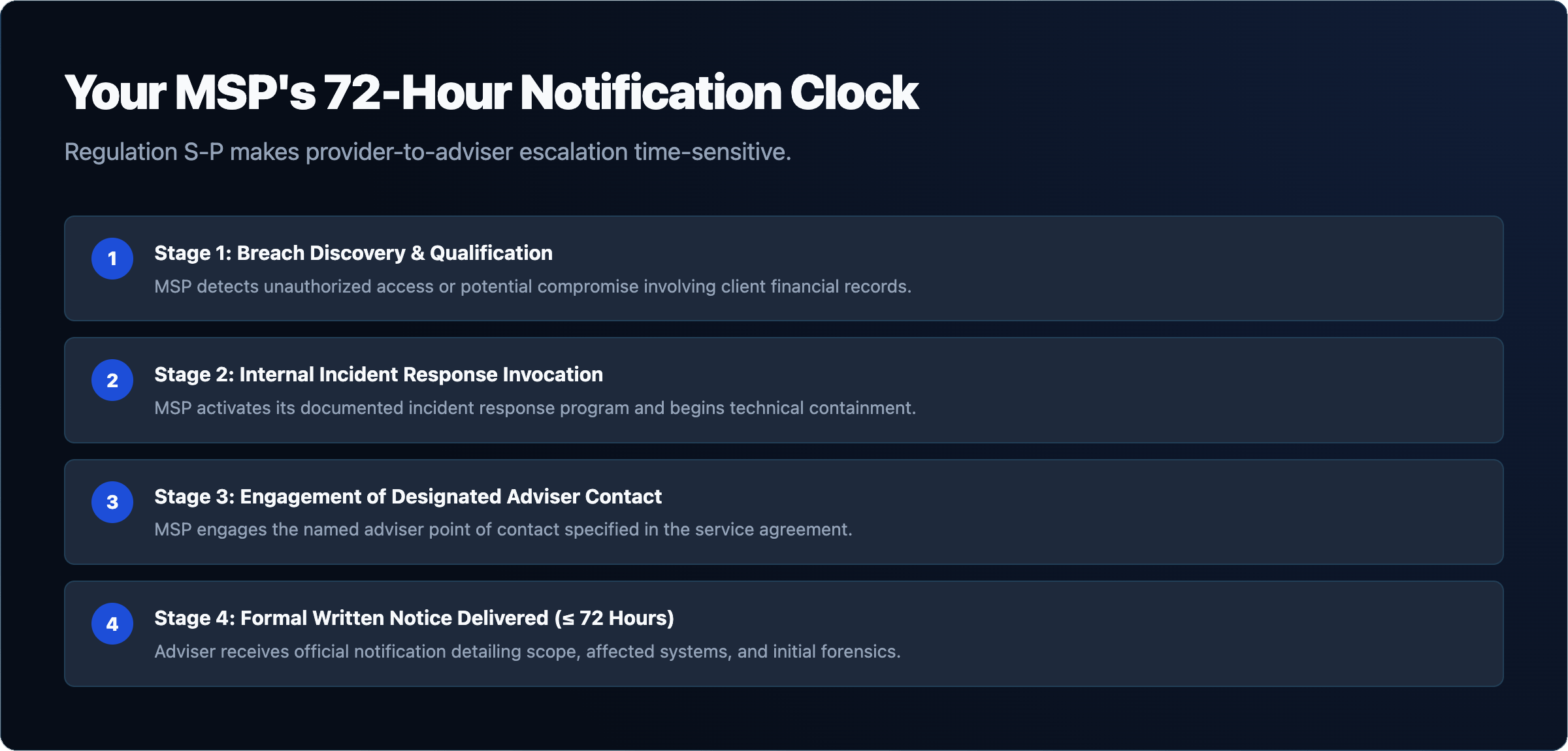
The amended rule requires service providers to notify the covered institution within 72 hours of becoming aware of a breach involving sensitive customer information. That 72-hour clock starts when the MSP becomes aware, not when the breach is fully investigated or contained. Your MSP must have a detection and escalation process capable of meeting that window.
In practice, this means your MSP needs documented internal procedures for identifying a potential breach, escalating it to a designated contact, and issuing a formal notification to your firm. Ask your MSP to show you those procedures in writing. Ask who sends the notification, what format it takes, and what information it will include. A verbal commitment is not enough. The obligation must appear in the contract and be backed by an operational process. Understanding how your MSP handles cyber incident response before a breach occurs is essential to evaluating whether the 72-hour requirement is realistic.
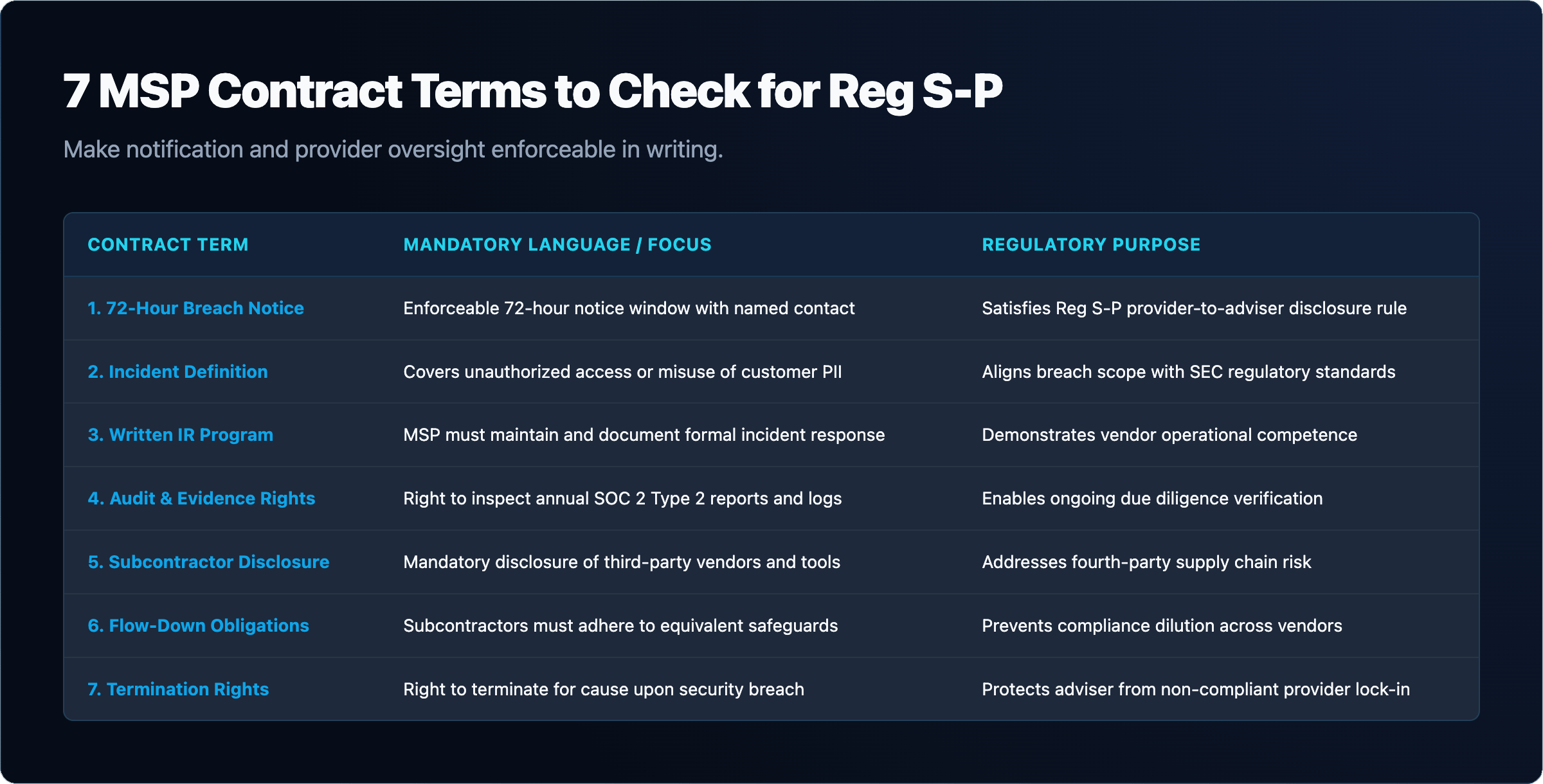
The contract between your firm and your MSP is the foundation of your service provider oversight program. It must contain specific terms to satisfy the Reg S-P framework. A general services agreement that does not address breach notification is not compliant.
Require the following terms in writing:
Review your existing MSP contract against this list. If any of these terms are absent, the contract needs to be amended before your next examiner review.
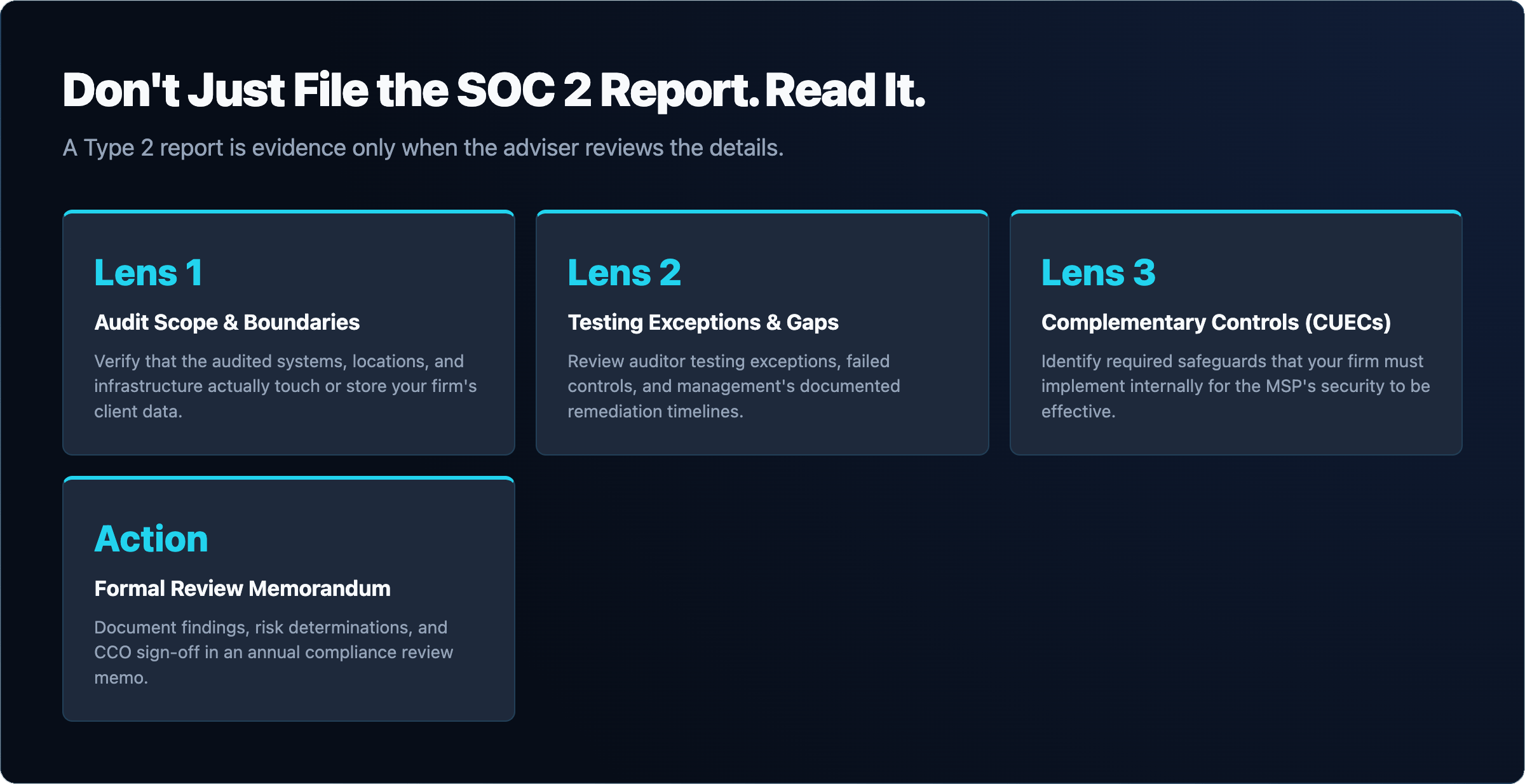
A SOC 2 Type 2 report confirms that an independent auditor tested an MSP’s security controls over a defined period and found them operating effectively. It is a meaningful document. It is also frequently misread. Receiving the report and filing it is not due diligence.
Read the report in three places. First, look at the scope. Confirm that the systems handling your data are included in the audit boundary. Second, read the exceptions section. Any control that failed during the audit period is listed there. An exception does not automatically disqualify an MSP, but you need to understand what failed, why, and what remediation was taken. Third, read the complementary user entity controls. These are controls the auditor assumed your firm would implement. If your firm has not implemented them, the SOC 2 assurance does not fully apply to your environment.
Document your review. Write a memo summarizing what you found, what questions you asked the MSP, and what your firm did in response to any gaps. That memo belongs in your vendor due diligence file. For a detailed breakdown of what the audit process covers, the SOC 2 requirements and timeline page explains the structure of each trust service criteria.
SEC examiners reviewing Reg S-P compliance will ask to see evidence of ongoing oversight, not just a signed contract. The vendor due diligence file is where that evidence lives. Build it before an exam, not during one.
| Document | What it proves | Who owns it | How often refreshed |
|---|---|---|---|
| Contract with 72-hour notification clause | The MSP is contractually obligated to notify within 72 hours of becoming aware of a breach | CCO or General Counsel | At each contract renewal or amendment |
| SOC 2 Type 2 report and review memo | Controls were independently tested and the adviser reviewed the results, exceptions, and user entity controls | CCO with IT input | Annually, upon receipt of each new report |
| Subcontractor list | The adviser knows which fourth parties access its environment and has assessed the associated risk | MSP provides; CCO maintains | Annually and upon any change |
| Access inventory | The adviser can account for every system and data set the MSP can reach | IT lead or MSP | Quarterly or upon personnel or system changes |
| Incident contact tree | Named individuals on both sides know who to call and in what order when a breach is suspected | CCO | Annually and upon any personnel change |
| Annual review sign-off | The adviser conducted a formal review of the MSP relationship and documented the outcome | CCO | Annually |
Keep this file current. An outdated SOC 2 report or a subcontractor list that does not reflect current platforms will raise questions during an exam. The file should show a pattern of active oversight over time, not a single point-in-time review.
Send us your current MSP contract and the vendor documents you keep for examiners.
We will mark what is missing against the amended Regulation S-P requirements and give you a list of terms and evidence to request.
Regulation S-P applies to the adviser, not directly to the MSP, but the adviser is responsible for overseeing any service provider that handles customer information. Outsourcing does not transfer the compliance obligation. The adviser must contractually require the MSP to notify them within 72 hours of becoming aware of a breach involving sensitive customer information.
The compliance date for smaller entities is June 3, 2026. Larger entities, defined as advisers with $1.5 billion or more in AUM, had an earlier compliance date of December 3, 2025. The SEC adopted these amendments in May 2024 under Release No. 34-100155, meaning all covered advisers are now within scope.
At minimum, the contract should require the MSP to notify the adviser within 72 hours of becoming aware of a breach, grant the adviser audit rights and access to SOC reports, include flow-down obligations to any subcontractors handling customer data, and specify procedures for returning or destroying customer data at contract termination.
A SOC 2 report alone is not sufficient for vendor due diligence under Reg S-P. Reviewers should examine any exceptions noted by the auditor and identify complementary user entity controls that your firm is expected to operate. The review itself must be documented and retained as part of the vendor due diligence file.
Based on SEC Division of Examinations FY2026 priorities, examiners are expected to review the adviser’s written incident response program, the vendor due diligence file, evidence of ongoing monitoring of service providers, and documentation showing that incident response procedures have been tested, including vendor notification timelines.
The cost depends primarily on the number of vendors in scope and the current state of your contract and monitoring documentation. Advisers with a larger vendor population will generally require more time to conduct initial due diligence, remediate contract gaps, and establish ongoing review processes. Engaging an MSP experienced with Reg S-P requirements allows the adviser to scope the work accurately and prioritize the highest-risk vendor relationships first.
We use cookies to enhance site performance and user experience. Your data stays private — we don’t sell your information or share it with unrelated third parties. To find out more about the cookies we use, view our Privacy Policy.