
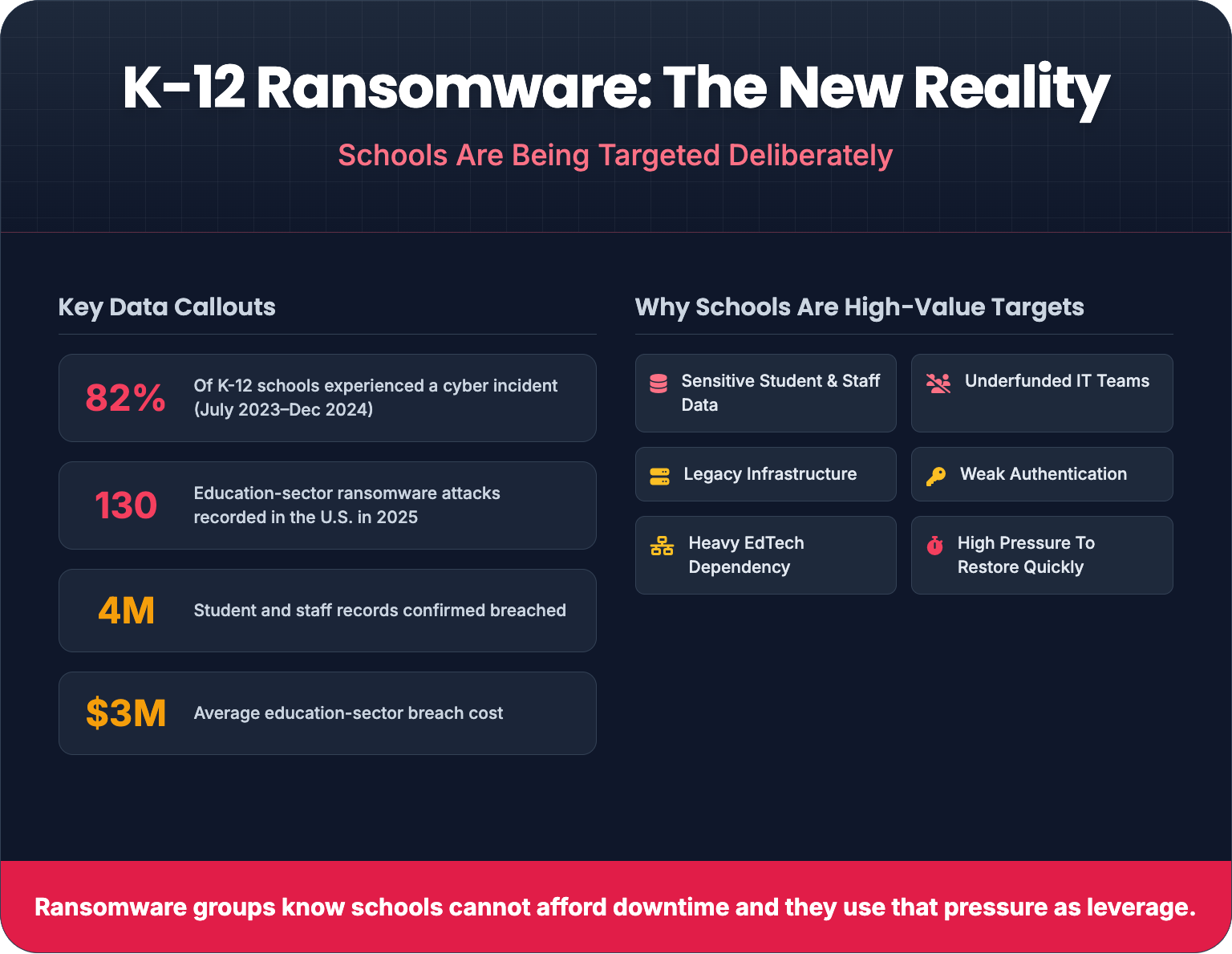
What makes the K-12 sector particularly vulnerable is the combination of factors that threat actors actively exploit: underfunded IT teams, legacy infrastructure, widespread credential reuse, and remote access points that rarely receive consistent patching.
Groups like Vice Society have specifically built operational playbooks around school district weaknesses. When Uvalde Consolidated Independent School District was hit in September 2025, the attack disabled phones, camera monitoring, and visitor management systems simultaneously, forcing school closures for several days. The district restored operations using backups, but most districts do not have tested offline recovery infrastructure in place before an incident forces the question.
The financial exposure extends well beyond any ransom demand. IBM’s research puts the average education-sector data breach cost at $3.65 million, a figure that absorbs forensic investigation, legal counsel, regulatory response, and the extended notification process that can run several months after initial containment.
Threat actors have also shifted tactics, using direct contact with affected families and public data leaks as secondary pressure against districts that refuse to pay.
Attackers conduct deliberate reconnaissance, and what they find in the K-12 sector is a combination of structural weaknesses that exist nowhere else at the same scale: constrained budgets, irreplaceable data, sprawling third-party software ecosystems, and an academic calendar that makes even a few days of downtime catastrophic.
Most school districts operate without a dedicated security team. IT staff manage networks, devices, and helpdesk tickets simultaneously, leaving no bandwidth for threat monitoring or proactive hardening. Unlike a mid-sized corporation that can absorb the cost of endpoint detection tools and 24/7 SOC coverage, schools routinely defer security investments to fund instruction. That gap is visible to attackers, and groups like Vice Society have specifically oriented their operations around exploiting it.
Schools hold some of the most durable personal data in existence. Student records contain Social Security numbers, health information, special education classifications, and household financial data collected for aid eligibility. Because minors rarely monitor their credit, this data goes undetected on dark web markets for years after a breach. The IBM Cost of a Data Breach Report puts the average education-sector breach at $3.65 million, a figure that reflects both the sensitivity of the records and the regulatory exposure that follows their loss.
The rapid adoption of learning management systems, assessment tools, and rostering platforms has multiplied the attack surface far beyond what any district IT team directly controls. The PowerSchool breach in late 2024 exposed sensitive student and staff data across dozens of districts through a single vendor compromise, illustrating how one third-party relationship can become a systemic liability.
Schools cannot absorb extended downtime the way a manufacturer can shift production schedules. When ransomware disabled phones, cameras, and visitor management systems at Uvalde Consolidated Independent School District in September 2025, the district closed entirely for several days. That pressure to restore operations before the next school day shortens the decision window considerably and is precisely the leverage attackers count on. Understanding why schools are targeted is the foundation, but the more pressing question is what the operational and financial consequences look like when an attack succeeds.
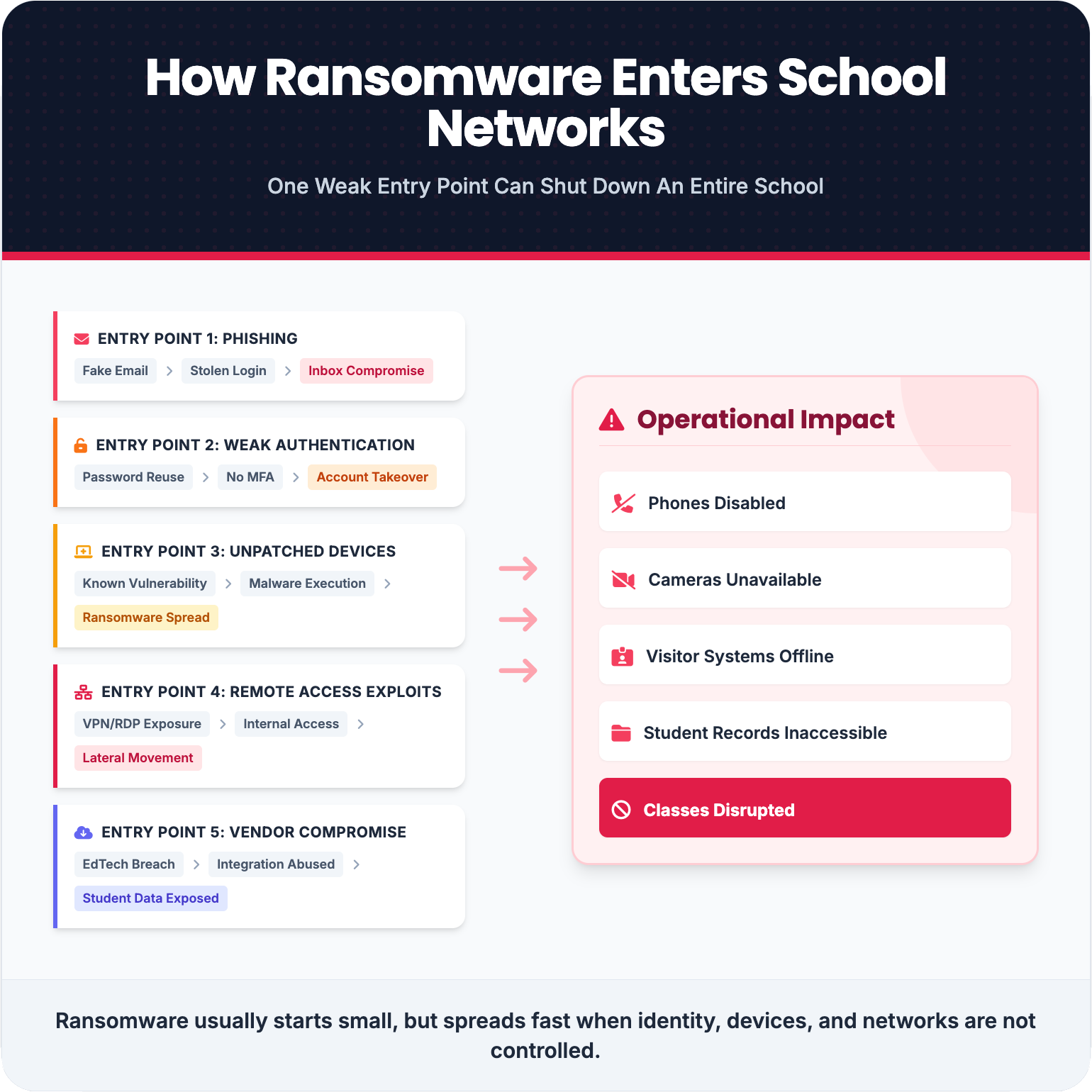
Understanding why schools get hit repeatedly starts with understanding how attackers get in. School environments combine large, distributed user populations with chronically underfunded IT departments, creating conditions where multiple attack paths exist simultaneously and often go undetected for weeks.
Attackers gain initial access to school networks primarily through deceptive emails targeting teachers, administrators, and students. Education staff receive high volumes of external email from parents, vendors, and government agencies, which makes phishing messages easier to disguise as legitimate communications. A single credential harvested from a teacher’s inbox is frequently enough to establish a foothold inside the network.
Password reuse across personal and professional accounts is endemic in K-12 environments. Without multi-factor authentication enforced across administrative systems, attackers running credential stuffing campaigns against known breach databases can authenticate as legitimate users without triggering any alerts. CISA and the FBI specifically named weak authentication as a primary enabler of successful school ransomware attacks in their October 2024 joint advisory.
Schools operate fleets of devices running outdated operating systems and unpatched applications, often because update cycles are deferred during the academic year to avoid disrupting instruction. Those unpatched endpoints represent known, catalogued vulnerabilities that ransomware groups actively scan for and exploit at scale. With 3.96 million records breached across 94 confirmed education ransomware incidents in 2025 alone, the exposure from delayed patching carries direct financial and legal consequences.
Remote learning infrastructure expanded rapidly and in many districts was never hardened after the initial deployment. Attackers exploit misconfigured VPN gateways and exposed remote desktop protocol ports to move from an external network position directly into core systems. The Uvalde CISD attack demonstrated exactly this pattern, where compromised network access cascaded into the disruption of phones, cameras, and visitor management systems simultaneously.
Knowing how attackers enter is only part of the problem; the deeper issue is what they find once they are inside, and that depends heavily on how schools have structured their data environments and access controls.
Detection determines how quickly a school identifies that something is wrong. Given that the average education-sector data breach costs $3.65 million, the window between initial compromise and full encryption is where the financial outcome is decided. Schools need continuous monitoring, endpoint visibility, and defined thresholds that trigger alerts before ransomware completes its work.
Response is the operational and communications layer that activates once a threat is confirmed. This includes isolating affected systems, notifying legal counsel and insurance carriers, and communicating with parents, staff, and regulators on a defined timeline. Improvised responses extend downtime and increase liability exposure.
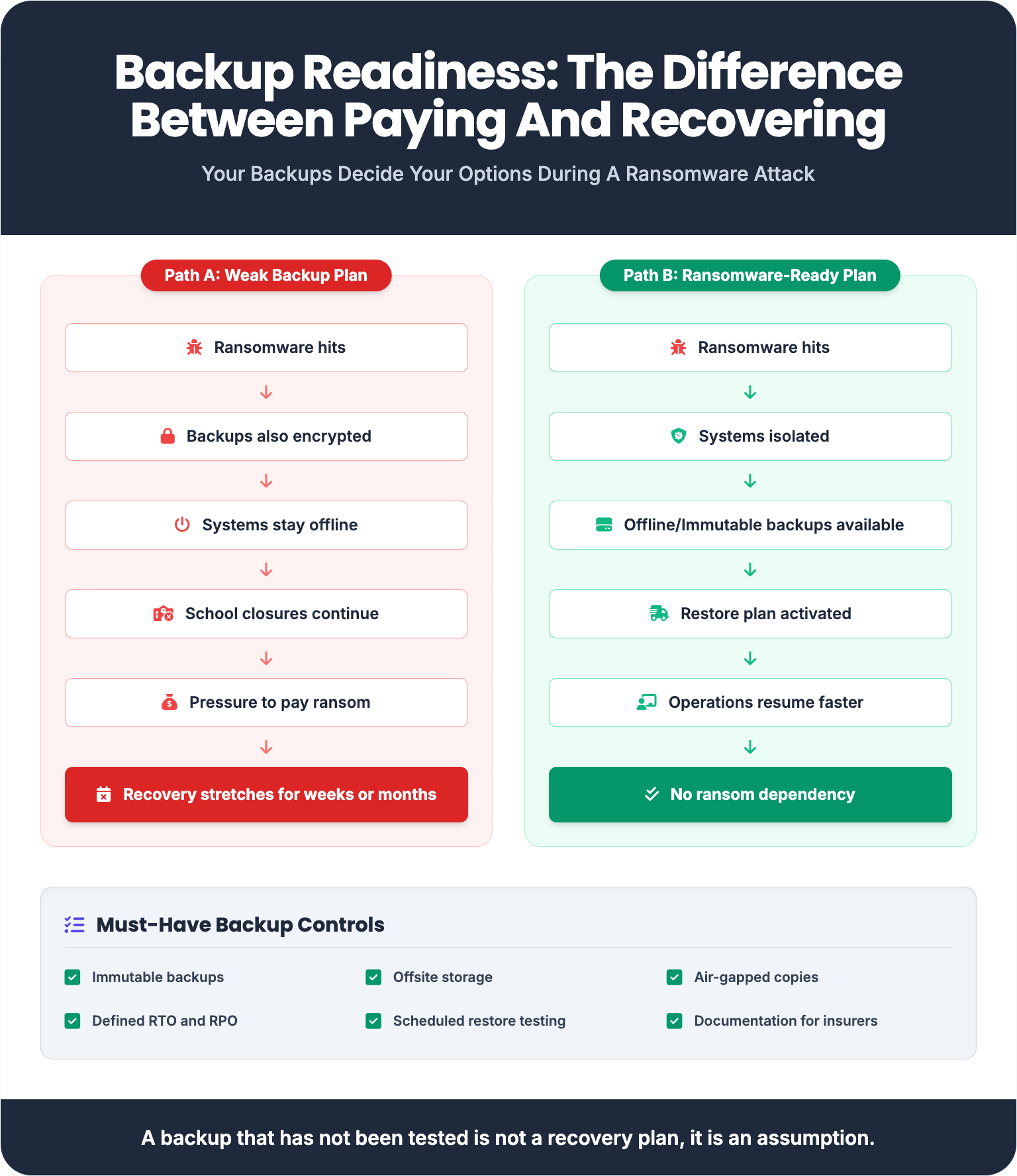
Recovery is where readiness either proves its value or exposes its gaps. Uvalde CISD restored systems using offline backups after a 2025 attack that shut down phones, cameras, and visitor management systems. Schools without tested, segmented backups face a much harder choice. Restoration must be validated, not assumed, before systems return to production.
Understanding what readiness requires is the starting point, knowing which specific threats are driving these incidents in 2026 is what shapes the actual defense strategy.
Knowing the threat landscape matters little without a structured defense built on controls that actually reduce exposure and limit damage when an attack occurs. For K-12 and private schools, that structure rests on five operational pillars, each addressing a distinct attack surface that ransomware groups actively exploit.
Schools operate sprawling device environments: student laptops, staff workstations, administrative servers, and increasingly, IoT systems tied to physical security. The Uvalde CISD attack disabled cameras, visitor management, and phone systems because those assets shared network infrastructure with vulnerable servers. Continuous endpoint monitoring gives IT teams the visibility to detect anomalous behavior before encryption begins, not after.
CISA and the FBI have both identified compromised credentials and weak remote access as the dominant entry points in education-sector attacks. MFA must be enforced across staff email, student information systems, and all administrative portals, including remote desktop and VPN access. Password reuse across platforms is a systemic risk that identity controls directly eliminate.
Student networks and administrative systems should never share the same flat network architecture. Segmentation contains lateral movement, meaning an attacker who compromises a student device cannot traverse directly into payroll systems, HR records, or the SIS. This single architectural decision limits the blast radius of an intrusion significantly.
With 3.96 million records breached across confirmed education ransomware incidents in 2025 alone, unpatched systems remain the most consistently exploited entry point. Scheduled patch cycles combined with proactive vulnerability scanning close the gaps attackers rely on finding first.
The PowerSchool breach demonstrated that a single EdTech vendor compromise can expose student and staff data across dozens of districts simultaneously. Schools must require security attestations, review vendor incident response protocols, and contractually define breach notification timelines before signing any platform agreement.
These controls establish the defensive foundation, but even a hardened environment requires a tested response plan for the moment a breach gets through.
IT GOAT works directly with K-12 and private schools to build the kind of layered defense that holds up under real attack conditions, not just on paper.
That work covers three areas where most schools have critical gaps. First, proactive monitoring: IT GOAT deploys continuous threat detection across endpoints, network traffic, and identity systems so that compromised credentials and unauthorized access are identified before an attacker moves laterally through district infrastructure.
Recovery timelines depend almost entirely on preparation. Uvalde Consolidated Independent School District restored operations within days in September 2025 because staff executed against tested backup systems. Districts without that infrastructure face weeks or months of disruption to instruction, communications, and administrative functions. FTI Strategic Communications has documented that forensic investigation and regulatory notification alone can extend the incident lifecycle by several months beyond initial restoration, compounding both cost and reputational damage.
The FBI’s position is unambiguous: do not pay. Ransom payment does not guarantee data recovery, does not prevent threat actors from selling exfiltrated records, and directly finances the criminal operations targeting the next school. With the average education-sector data breach costing $3.65 million according to IBM, the financial logic of paying a $400,000 demand to avoid a larger loss is a false calculation when payment routinely fails to stop secondary extortion.
No state currently mandates cyber insurance for educational institutions, but school boards increasingly require it as a condition of fiscal governance. Insurers have tightened underwriting standards, meaning schools with weak access controls or untested backups face higher premiums or coverage denials outright.
Public districts operate under stronger regulatory oversight and qualify for federal and state cybersecurity funding streams, though recent federal program eliminations have reduced those resources. Private schools carry more vendor selection flexibility but typically run leaner IT operations with limited dedicated security staff, which makes third-party risk management and outsourced incident response planning especially critical for that segment.
Understanding these distinctions shapes how each institution should structure its incident response plan and where it allocates its security investment.
We use cookies to enhance site performance and user experience. Your data stays private — we don’t sell your information or share it with unrelated third parties. To find out more about the cookies we use, view our Privacy Policy.