
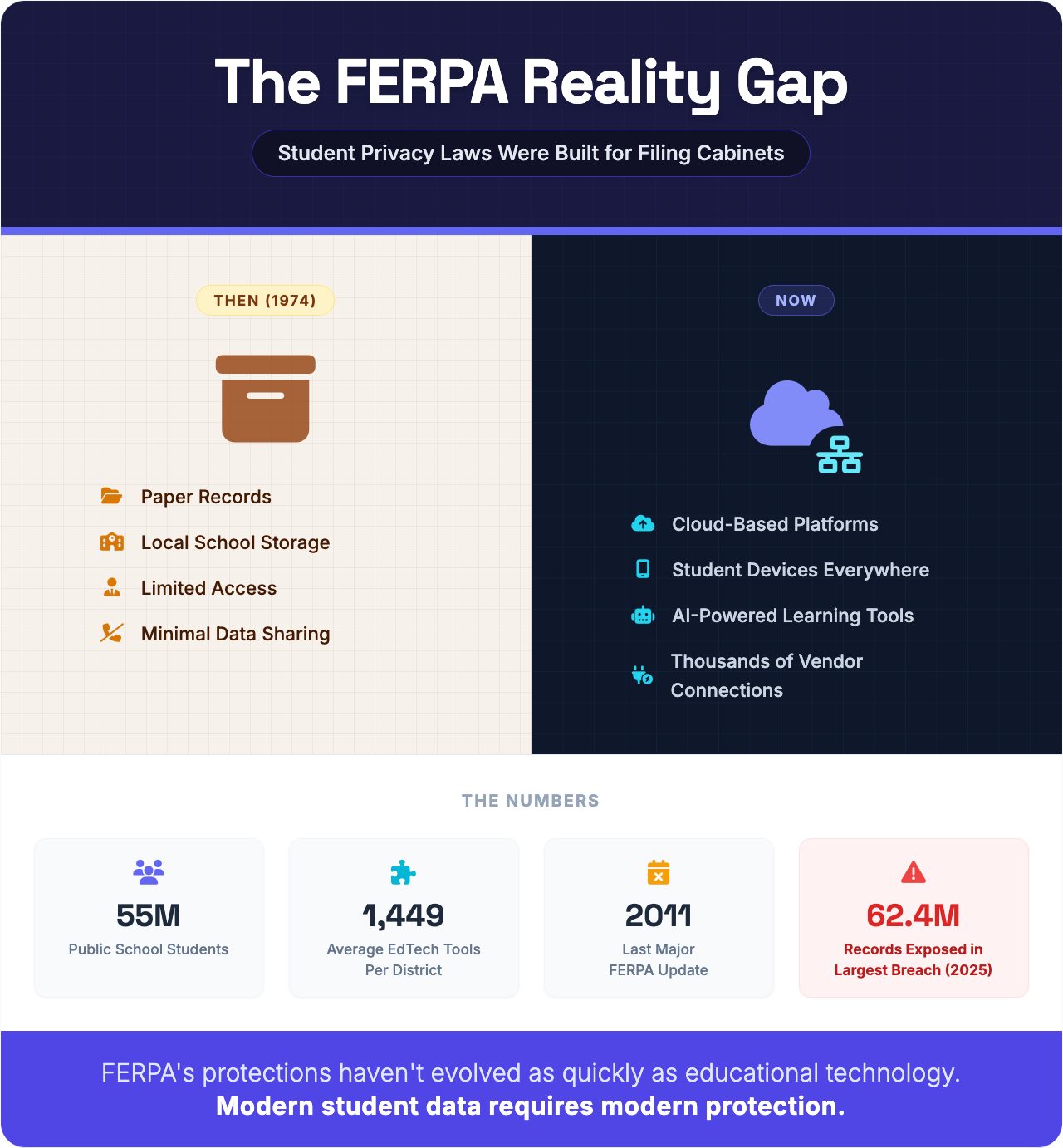
FERPA has governed student data privacy since 1974. The law was written for paper filing cabinets, not cloud infrastructure, AI-driven learning platforms, or vendor ecosystems where the average school district now deploys 1,449 distinct EdTech tools. Every one of those tools can potentially be granted access to student records without parental consent under a provision called the “school official” exception — a loophole so broad that it has quietly transformed compliance from a manageable obligation into a systemic liability.
The federal enforcement office responsible for overseeing all of this operates with approximately 30 staff members and a $10 million budget. In 50 years, it has never once withdrawn funding from a violating institution.
The gaps between what FERPA promises and what it actually protects are wider than most administrators and operations leaders realize, and understanding exactly where those gaps exist is the first step toward closing them.
With FERPA’s last major regulatory update occurring in 2011, the framework was built for a world of paper files and local servers, not the reality of 1,449 distinct EdTech tools operating inside a single school district.
Three definitions govern how FERPA applies in practice:
The school official exception is where institutional risk concentrates. Schools routinely designate third-party vendors as school officials to share data without triggering consent requirements, but FERPA places the compliance burden on the institution, not the vendor. When a vendor mishandles that data, the school bears the legal exposure.
Understanding where that exception is being applied, and whether legitimate educational interest actually exists in each case, is the first step toward identifying where the real gaps in compliance sit.
Sharing a student’s grades, disciplinary records, or health information with anyone outside the legally authorized circle constitutes a direct FERPA violation. This includes disclosing records to a non-custodial parent without a court order, discussing a student’s performance with another student’s parent, or allowing staff to access records outside their professional role. The personally identifiable information standard under FERPA is broad: it covers not just names and ID numbers but any data point that makes a student reasonably identifiable when combined with other information.
Releasing education records to third parties without written consent from parents, or from students aged 18 and older, is one of the most common compliance failures schools face. Exceptions exist, but they are narrow and specific. Districts that treat verbal authorization, informal email requests, or general enrollment agreements as sufficient consent are operating outside the law.
FERPA permits schools to designate certain data as directory information, typically a student’s name, address, phone number, and photograph, and share it without consent. The requirement is that families receive annual notice of what qualifies as directory information and a clear opportunity to opt out. Schools that skip that notification process, or that release directory information to commercial third parties without scrutiny, expose themselves to violation findings.
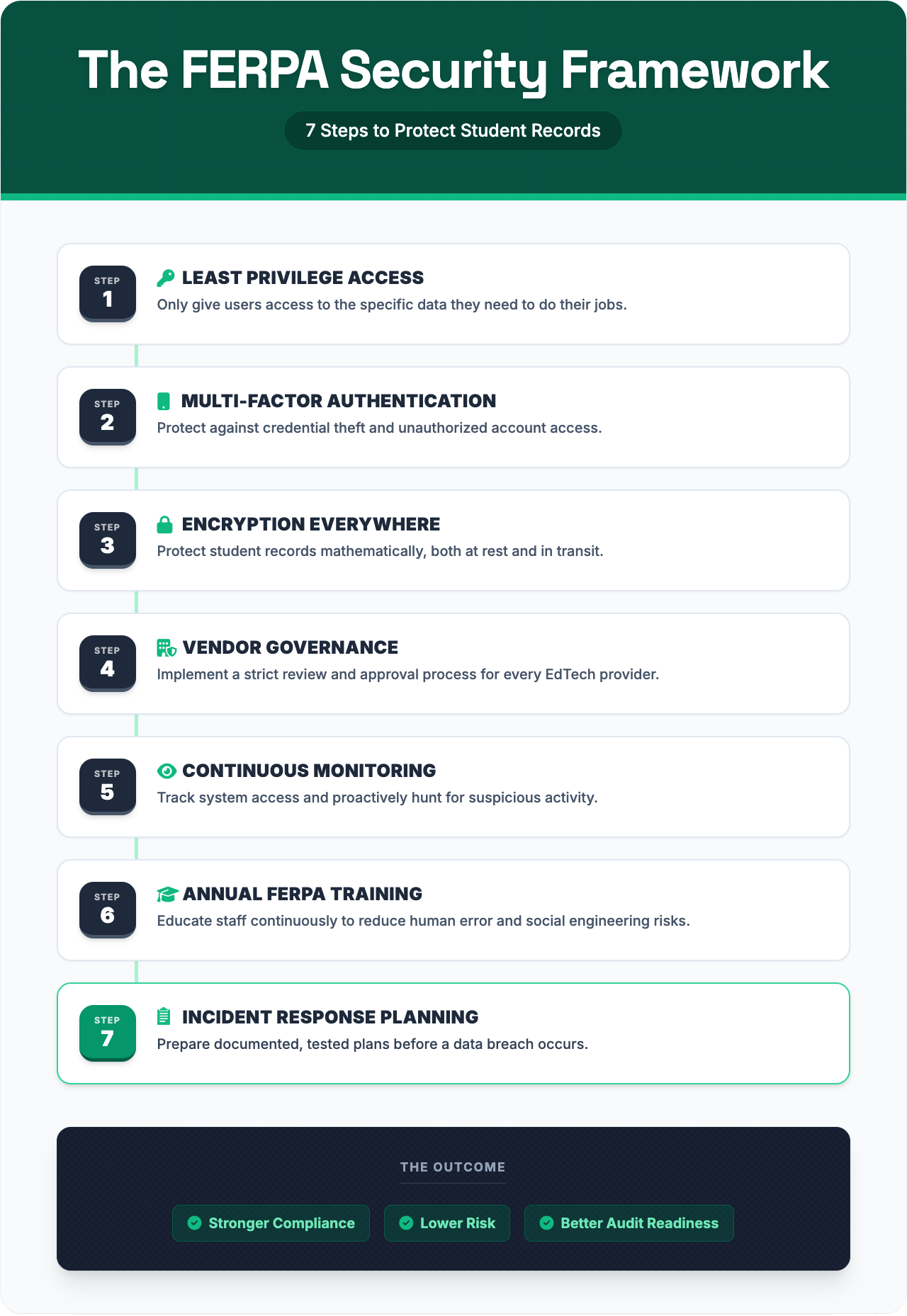
Closing these gaps requires more than policy updates. The following steps represent a practical compliance framework that reduces breach exposure, limits liability, and builds defensible data governance across the institution.
Limit access to the minimum data each role requires. Conduct regular access reviews and revoke permissions immediately when staff change roles or leave the organization. Broad, unchecked access is one of the most common vectors for both insider incidents and credential-based attacks.
Require multi-factor authentication for every system containing student records. Implement single sign-on where possible to centralize authentication management and reduce the attack surface created by dozens of separate login credentials.
Apply encryption to databases, file storage, email attachments, and all data transfers involving student PII. Encryption does not prevent breaches, but it significantly reduces the harm and legal exposure when unauthorized access occurs.
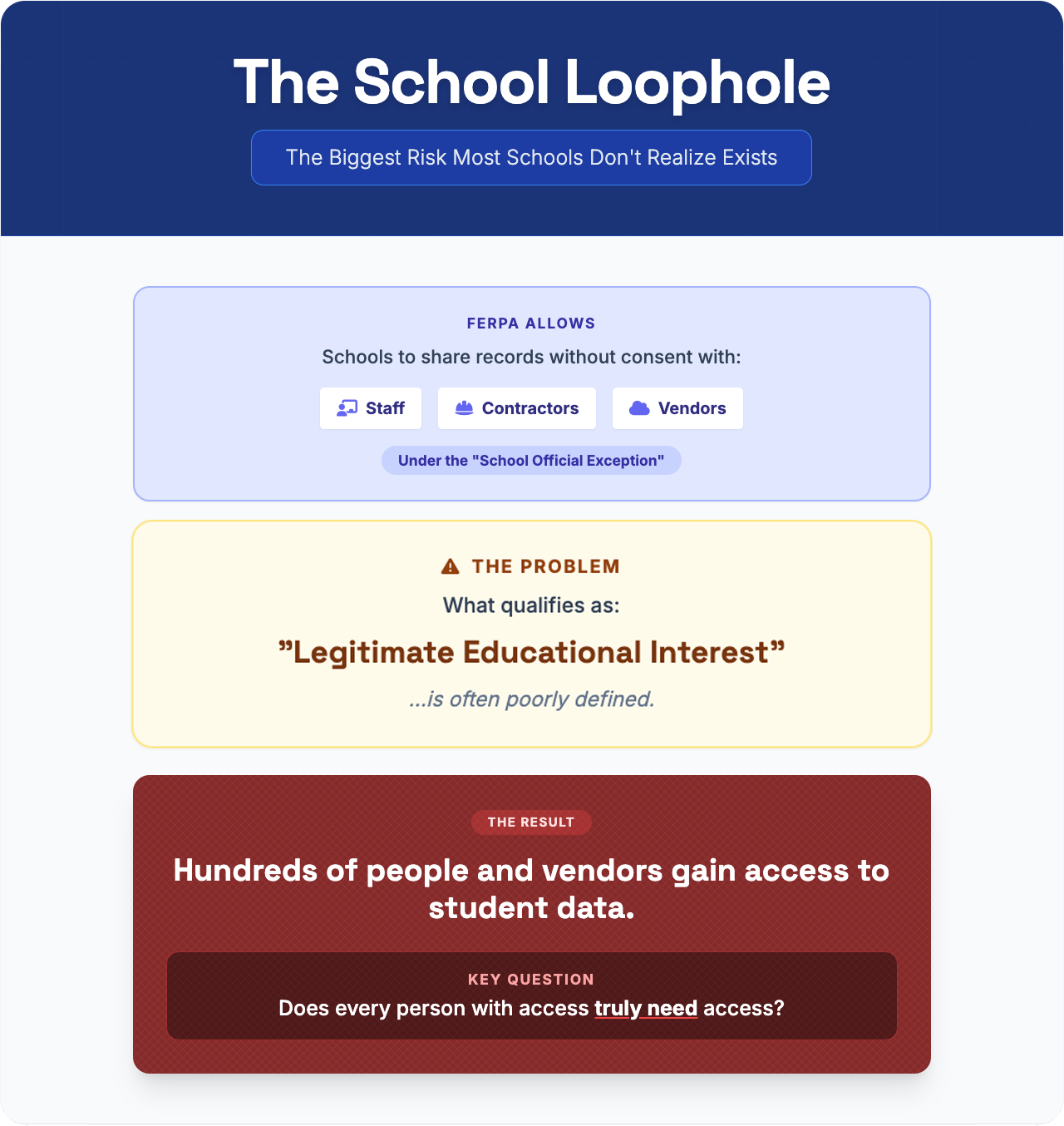
The school official exception is where FERPA’s internal access controls quietly collapse. The law permits schools to grant staff access to student records when those staff members have a “legitimate educational interest,” but FERPA provides no precise definition of what that phrase means in practice. Schools are left to interpret it themselves, and most interpret it far too broadly.
The operational result is predictable: access gets assigned by convenience rather than necessity. With the average school district running 1,449 distinct EdTech tools, each potentially designated as a school official under FERPA, the scope of who touches student records at any given moment is almost impossible to audit. The legitimate educational interest standard, rather than functioning as a filter, functions as a rubber stamp.
With the average school district now deploying 1,449 distinct EdTech tools, the school official exception has become the most abused provision in FERPA. That exception permits vendors to access student records only to perform contracted educational services. When vendors use student data for product development, behavioral profiling, or targeted marketing, the exception no longer applies and the school bears liability for the unauthorized disclosure.
More than 30 states have enacted student privacy laws that go beyond FERPA, several with direct financial penalties. Vendor contracts compound this exposure because breach liability provisions in EdTech agreements can shift costs back to the district when a third-party incident originates from inadequate oversight on the school’s side.
| Consequence Type | Impact on School |
|---|---|
| Federal funding loss | Potential withdrawal of Department of Education funds |
| Reputational harm | Erosion of parent and community trust |
| Civil liability | Lawsuits under state privacy laws |
| State penalties | Fines under state student privacy statutes |
These consequences point directly to the governance structures and vendor relationships that create the underlying exposure in the first place.
The compliance work IT GOAT delivers covers the full scope of what FERPA enforcement and state-level student privacy laws now require:
FERPA does not explicitly mandate encryption. The Department of Education frames it as a strongly recommended safeguard for protecting student personally identifiable information, not a codified requirement. That distinction does not reduce exposure. A breach of unencrypted records still constitutes a FERPA violation if unauthorized disclosure results, regardless of whether encryption was technically required.
The Student Privacy Policy Office within the U.S. Department of Education handles enforcement and investigates complaints filed by parents or eligible students. With a budget of approximately $10 million and roughly 30 staff members managing compliance across tens of thousands of institutions, the office’s investigative capacity is structurally limited.
The core requirements apply to both sectors, but rights shift at age 18. In higher education, students control their own records. Parents lose automatic access, and institutions must adjust consent workflows accordingly.
Video recordings qualify as education records when they are directly related to a student and maintained by the institution. That standard pulls recordings from remote learning platforms, behavioral monitoring tools, and classroom cameras into FERPA’s scope, requiring the same access controls and disclosure restrictions as any other protected record.
FERPA sets no specific retention periods. Schools must follow applicable state laws and retain records as long as they serve a legitimate educational purpose. The absence of a federal floor creates inconsistency across districts and leaves retention governance largely to institutional policy.
Understanding what FERPA requires is only part of the problem. The larger operational challenge is identifying where current practices fall short of those requirements before a breach or complaint forces the issue.
We use cookies to enhance site performance and user experience. Your data stays private — we don’t sell your information or share it with unrelated third parties. To find out more about the cookies we use, view our Privacy Policy.