
Between 2016 and 2022, U.S. public schools reported more than 9,300 cybersecurity incidents, including over 3,700 cases involving personally identifiable information disclosures, and the threat landscape has grown more aggressive since. For district administrators and operations leaders, this is no longer a peripheral IT concern.
It is a direct operational and financial liability that sits squarely on the leadership agenda.
The cost profile alone demands attention. Recovery from a single K-12 cyber incident has ranged from $50,000 to more than $9 million, with Baltimore County Public Schools exceeding $9.5 million in total costs after one attack.
Those figures do not account for the instructional disruption that follows, which routinely spans two to nine months of recovery time and up to three weeks of measurable learning loss.
When a ransomware event shuts down student information systems, payroll platforms, or communication infrastructure, the operational damage compounds daily.
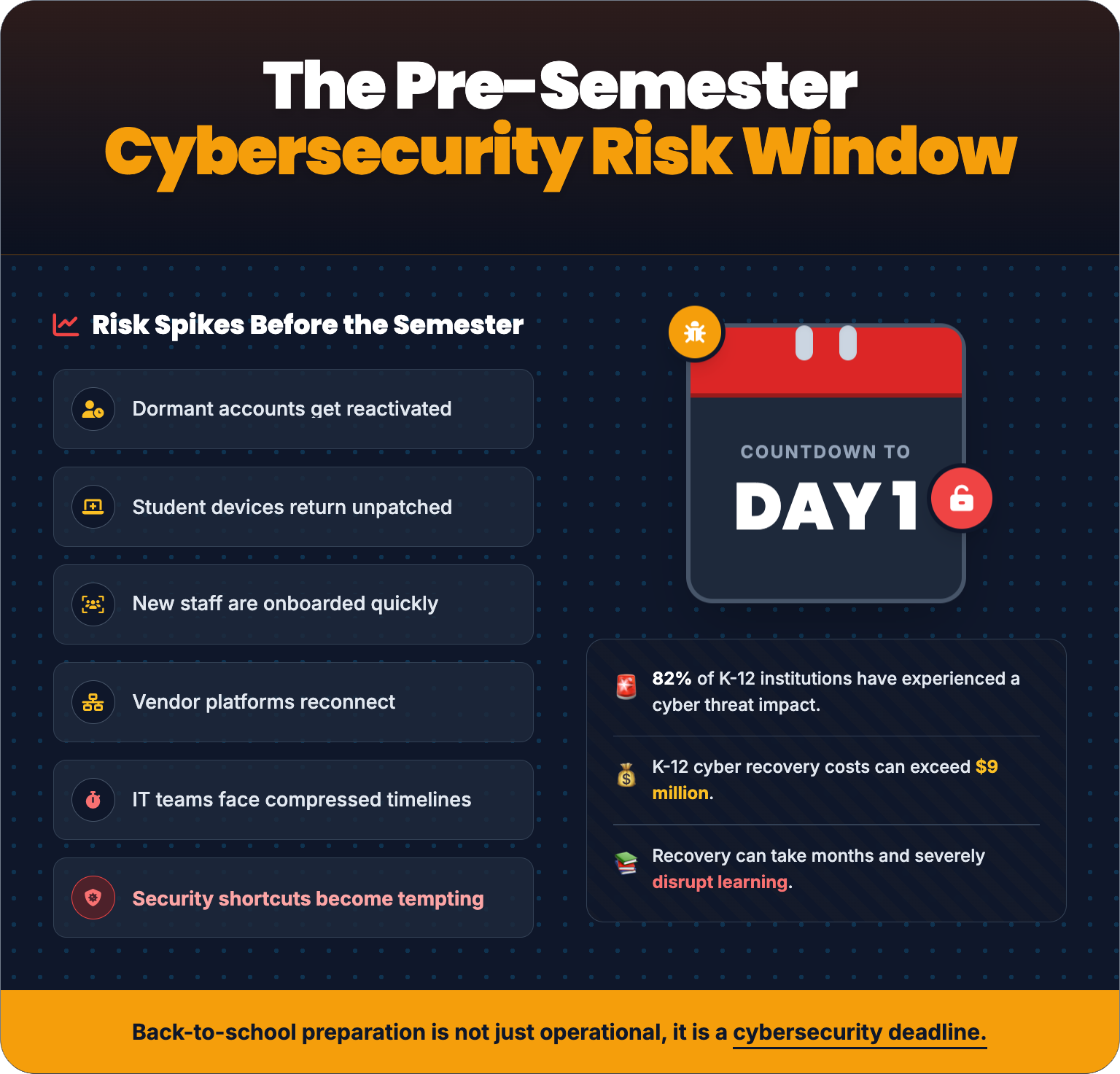
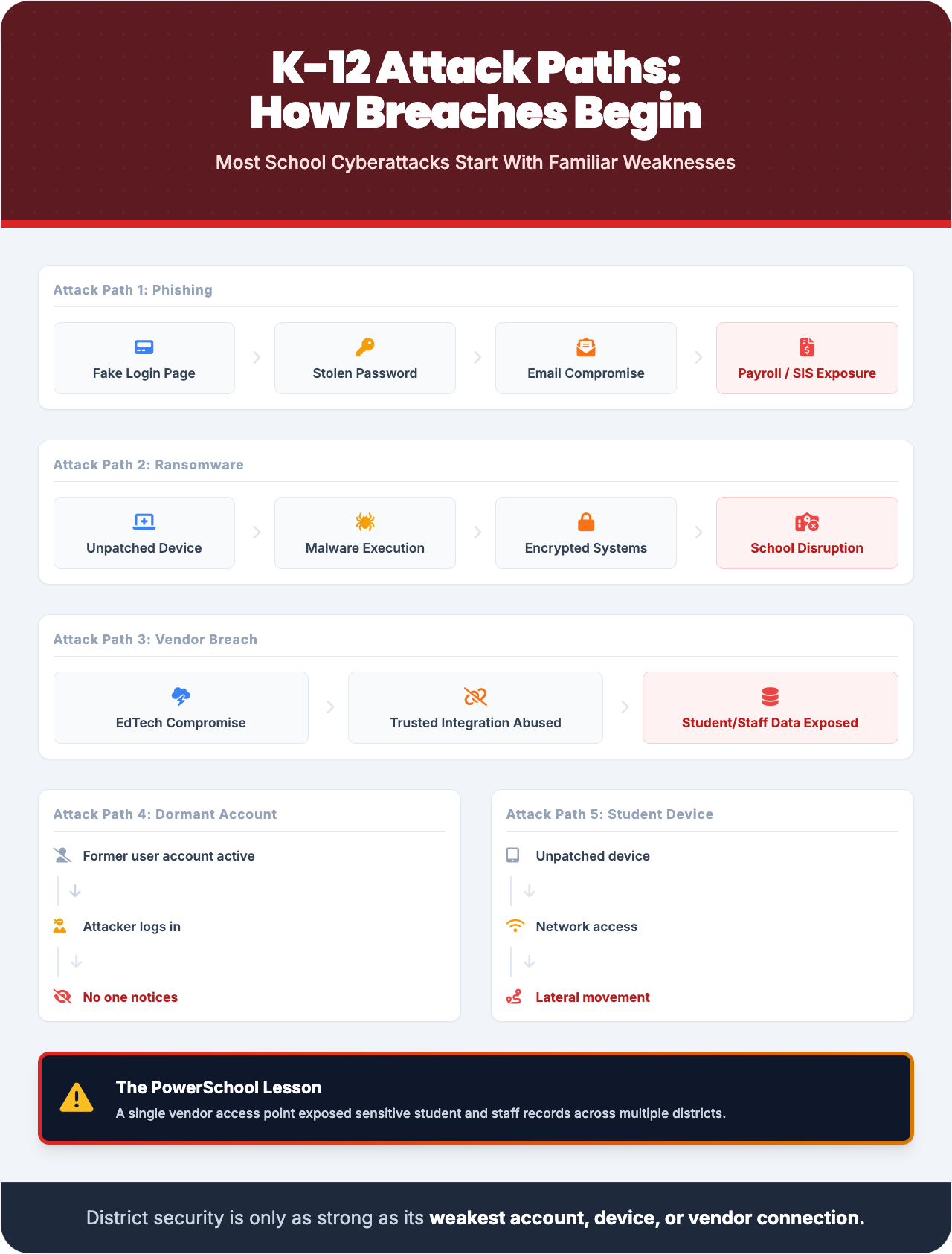
The weeks before school resumes are the highest-leverage window IT teams have to close gaps before student and staff traffic floods district systems. The following checklist reflects what CISA and the FBI have consistently identified as the most exploited weaknesses in K-12 environments, and it is sequenced to address the highest-risk exposures first.
Start by pulling a full account inventory. Remove access for staff who left during the year and graduated students who retain active credentials. Disable any account that sat dormant through the summer months. Review every privileged and shared account, because attackers routinely exploit credentials that no one is actively monitoring.
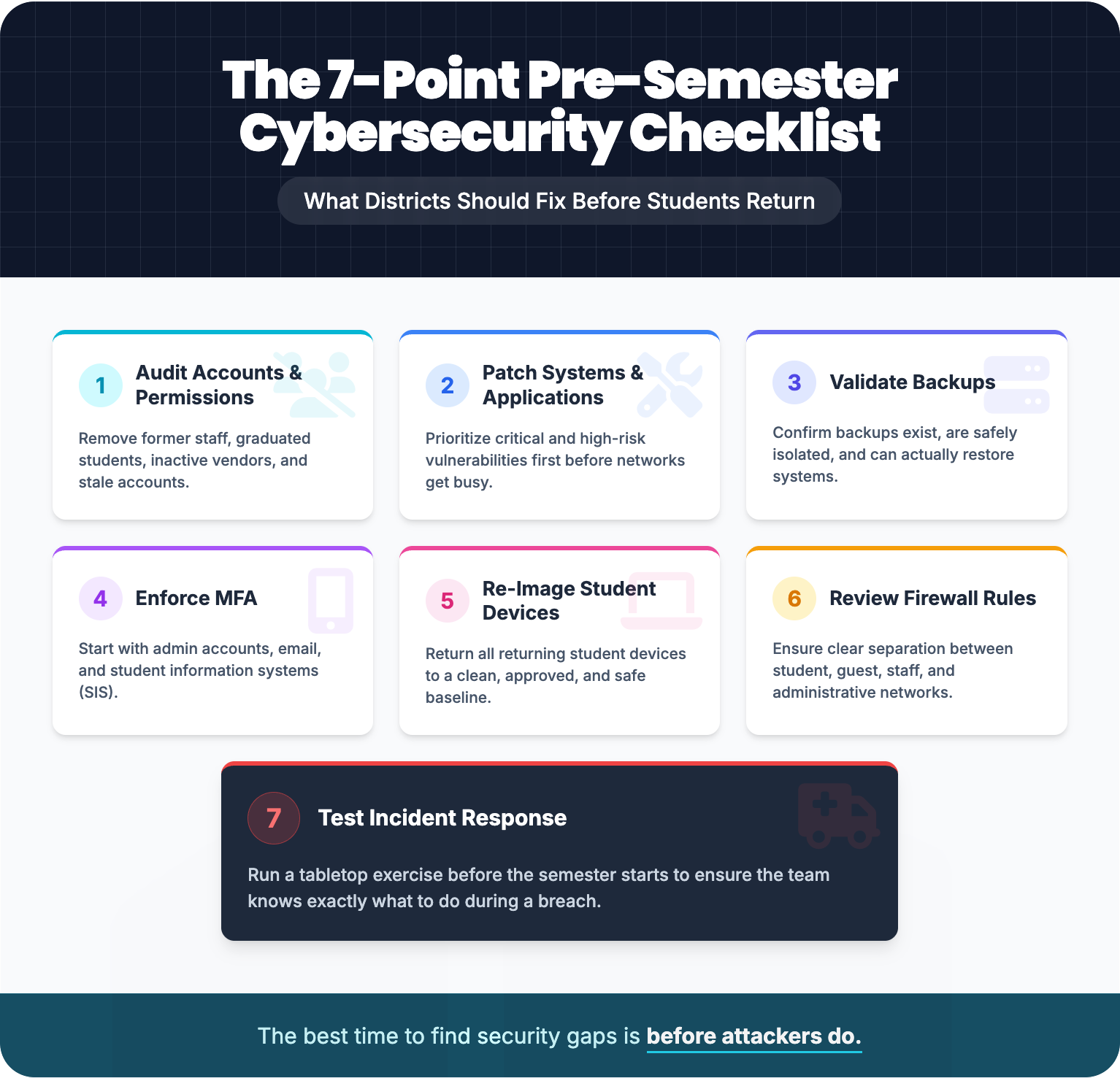
Understanding where attacks originate is the first step toward closing the gaps that cost districts millions in recovery, lost instructional time, and reputational damage. The following attack types account for the majority of incidents hitting K-12 systems right now.
Ransomware encrypts district files and systems, rendering them inaccessible until a ransom is paid. Modern ransomware groups layer on double extortion: they also exfiltrate data and threaten to publish it publicly if payment is refused. Minneapolis Public Schools experienced exactly this in 2023, when sensitive student and staff files were released online after the district declined to pay. Attackers target districts because operational disruption is immediate and severe, which compresses the decision window and increases pressure to pay fast.
Phishing remains the most common entry point into district networks. Business email compromise (BEC) is the targeted variant, where attackers impersonate a superintendent, principal, or vendor to authorize fraudulent transactions or credential handovers. Common lures include payroll redirection requests, vendor invoice approvals, and back-to-school communications timed to catch staff during high-volume periods.
A supply chain attack occurs when a threat actor breaches a third-party vendor to gain access to the vendor’s customers. In January 2025, PowerSchool disclosed that unauthorized actors accessed customer data through a support environment, exposing student names, Social Security numbers, and medical information across multiple districts. Any learning management system, student information platform, or communication tool a district uses is a potential entry point.
Without it, response decisions get made under pressure by people who have no clear mandate, and recovery costs reflect that disorganization. Baltimore County Public Schools incurred more than $9.5 million in recovery costs after a single attack, a figure that reflects not just technical remediation but the operational breakdown that follows an uncoordinated response.
The IRP must designate a single incident commander with decision-making authority, not a committee. Separate that role from the individuals responsible for external communication. Assign specific staff to handle notifications for parents, employees, law enforcement, and media, and document those assignments before an incident occurs. Escalation paths need to be written out explicitly, including after-hours contacts, so no one is searching for a phone number while a ransomware payload is spreading across the network.
Detection depends on knowing what normal looks like. Staff need to recognize indicators of compromise: unusual login times, unexpected account privilege changes, large outbound data transfers, and endpoint alerts. When a threat is confirmed, the immediate priority is isolation. Affected systems must be disconnected from the network to stop lateral movement, even if that means taking instructional systems offline mid-day. Speed of containment directly determines the scope of damage.
Recovery begins with validated, offline backups and a defined recovery time objective. Restoring from backups that were never tested is a common failure point districts discover at the worst possible moment. Once operations stabilize, a structured lessons-learned meeting is not optional. That debrief identifies which controls failed, which detection gaps existed, and what the IRP missed, feeding directly into the next round of improvements.
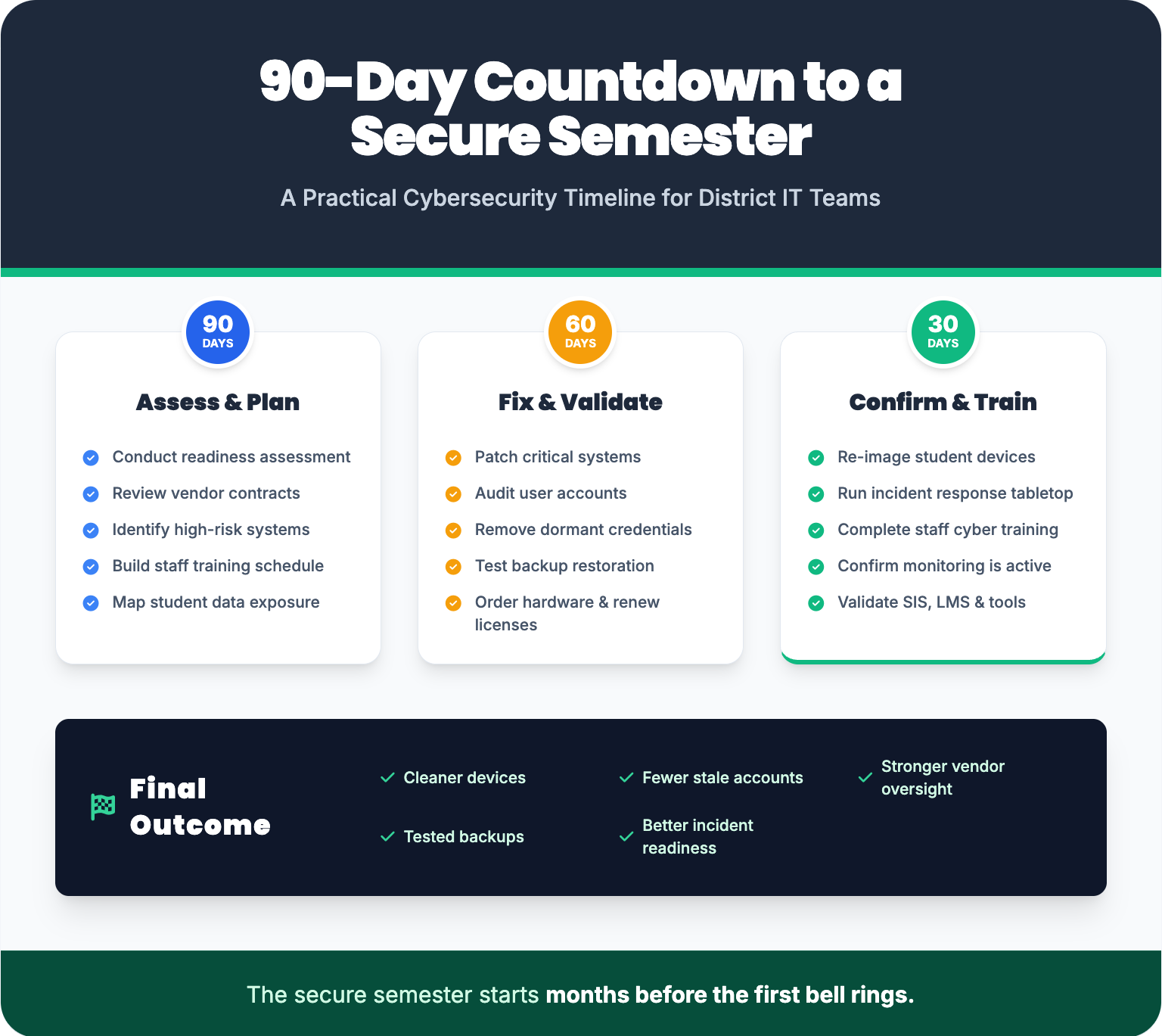
Treating cybersecurity preparation as a single pre-semester task is how districts end up scrambling to patch critical systems the week before students arrive. A structured countdown approach distributes the workload across a realistic window and ensures nothing gets deferred until it becomes a crisis.
This window is for assessment and planning, not execution. Conduct a full readiness assessment that maps current controls against known gaps, particularly around account management and backup integrity. Review all active vendor contracts, paying close attention to any third-party platforms that handle student records or authentication, given that supply-chain compromises like the January 2025 PowerSchool incident exposed names, Social Security numbers, and medical data across multiple districts.
With 52 percent of districts reporting IT staffing shortages, the 60-day mark is when execution has to start. Begin patching all systems and prioritize anything internet-facing or connected to student information systems. Audit all user accounts and disable or remove any that belong to former staff, contractors, or graduated students. Validate backup integrity by running a test restoration, not just confirming that backups exist. Order any hardware replacements or license renewals now, before procurement timelines compress against the semester start date.
The final 30 days are for confirmation, not discovery. Re-image devices that will be distributed to students, test the incident response plan with a tabletop exercise that includes defined communication roles and recovery steps, and finalize staff training completion. Confirm that all critical systems, including the student information system, learning management platform, and communication tools, are operational and monitored.
The window between now and the next semester start is narrow, and the cost of arriving unprepared is measured in recovery timelines that stretch months, not days.
IT GOAT works with school districts as a security-focused managed IT partner, not a break-fix vendor.
The approach is built around closing the gaps that matter most before they become incidents: proactive monitoring that catches anomalies before they escalate, U.S.-based support that understands the operational reality of district environments, and strategic guidance that helps leadership prioritize investments against actual risk rather than compliance checklists alone.
Phishing is the dominant initial attack vector in K-12 environments. Attackers target human error rather than technical vulnerabilities because it is faster, cheaper, and highly effective against organizations with limited security training. AI-generated phishing lures have raised the stakes further, producing convincing login pages and email messages that bypass standard awareness. The technical controls a district deploys matter far less if staff members hand over credentials before those controls ever activate.
Recovery timelines depend almost entirely on backup readiness and whether a tested incident response plan exists before the attack occurs. Districts without both face ransomware recovery spanning two to nine months, with documented learning loss ranging from three days to three weeks. The districts that recover fastest are those that maintained secure offline backups, defined recovery objectives in advance, and rehearsed their response procedures before an incident forced the issue.
Many insurers offer policies tailored to education, but coverage terms, exclusions, and premiums vary significantly across carriers. Insurers increasingly require documented security controls as a condition of coverage, meaning districts with weak MFA adoption or no incident response plan face higher premiums or outright denial.
Small districts consistently get better outcomes by partnering with a managed IT provider. With 52 percent of districts already short on IT support staff, building an internal security team from scratch is neither cost-effective nor realistic for most. A managed provider delivers specialized expertise and around-the-clock monitoring at a fraction of the cost of a dedicated hire, which matters when recovery from a single incident can exceed $9 million.
Understanding the answers to these questions clarifies where gaps exist, but closing those gaps requires a structured approach to implementation that maps directly to the semester timeline districts are working against.
We use cookies to enhance site performance and user experience. Your data stays private — we don’t sell your information or share it with unrelated third parties. To find out more about the cookies we use, view our Privacy Policy.