
Choosing between cloud and on-premises infrastructure shapes how your business operates for years to come. The decision affects everything from monthly budgets to how quickly you can respond to new opportunities—and getting it wrong creates headaches that compound over time.
This guide breaks down the real differences in costs, security, and performance so you can make an informed choice that fits your specific situation.
On-premises infrastructure refers to servers, networking equipment, and storage systems physically located within your company’s building. Your organization owns all the hardware, maintains it with internal staff, and controls every aspect of how data moves through your network.
With on-prem setups, everything lives under your roof. Your IT team handles server maintenance, software updates, and security patches. The hardware sits in a dedicated server room or closet, and your staff manages daily operations from backups to troubleshooting.
This approach gives businesses direct control over their technology environment. However, it also means taking on full responsibility for keeping systems running, secure, and up to date.
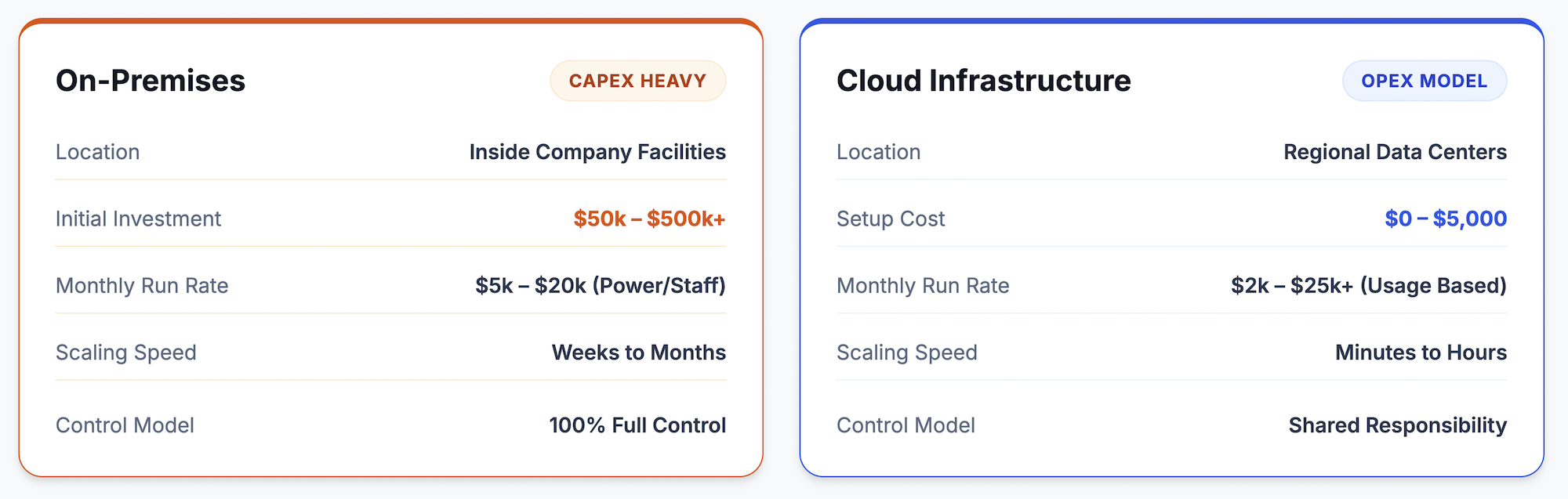
Cloud infrastructure consists of computing resources hosted by third-party providers like Amazon Web Services, Microsoft Azure, or Google Cloud Platform. Instead of buying servers, you rent capacity and access it over the internet.
The cloud model shifts hardware responsibility to the provider. They handle physical maintenance, facility security, and infrastructure upgrades while you focus on configuring services and managing your applications. Think of it like renting an apartment versus owning a house—someone else handles the roof and plumbing while you arrange the furniture.
This arrangement typically converts large upfront purchases into predictable monthly bills, which changes how businesses budget for technology.
The core distinction comes down to ownership versus rental. On-premises means you buy and maintain everything yourself. Cloud means you pay someone else to handle the infrastructure while you use their resources.
| Factor | On-Premises | Cloud |
|---|---|---|
| Location | Physical on-site servers | Remote data centers |
| Ownership | Company-owned hardware | Provider-owned, rented access |
| Upfront Cost | High capital investment | Low initial cost |
| Ongoing Cost | Maintenance and staffing | Subscription-based fees |
| Scalability | Limited by hardware | On-demand scaling |
| Control | Full control | Shared with provider |
On-premises infrastructure puts your organization in the driver’s seat. You decide when to upgrade hardware, how to configure security policies, and exactly where your data lives. Nothing happens without your approval.
Cloud computing involves sharing responsibility with your provider. You control your applications and data configurations, but the provider manages the underlying servers and network equipment. This trade-off reduces your management workload while limiting certain customization options.
On-premises deployments require capital expenditure, often called CapEx. You purchase servers, networking equipment, and software licenses upfront. These assets sit on your balance sheet, depreciate over time, and eventually require replacement.
Cloud services operate on an operational expenditure model, or OpEx. You pay monthly or annually for resources consumed, similar to a utility bill. This approach simplifies budgeting and removes the barrier of large initial investments.
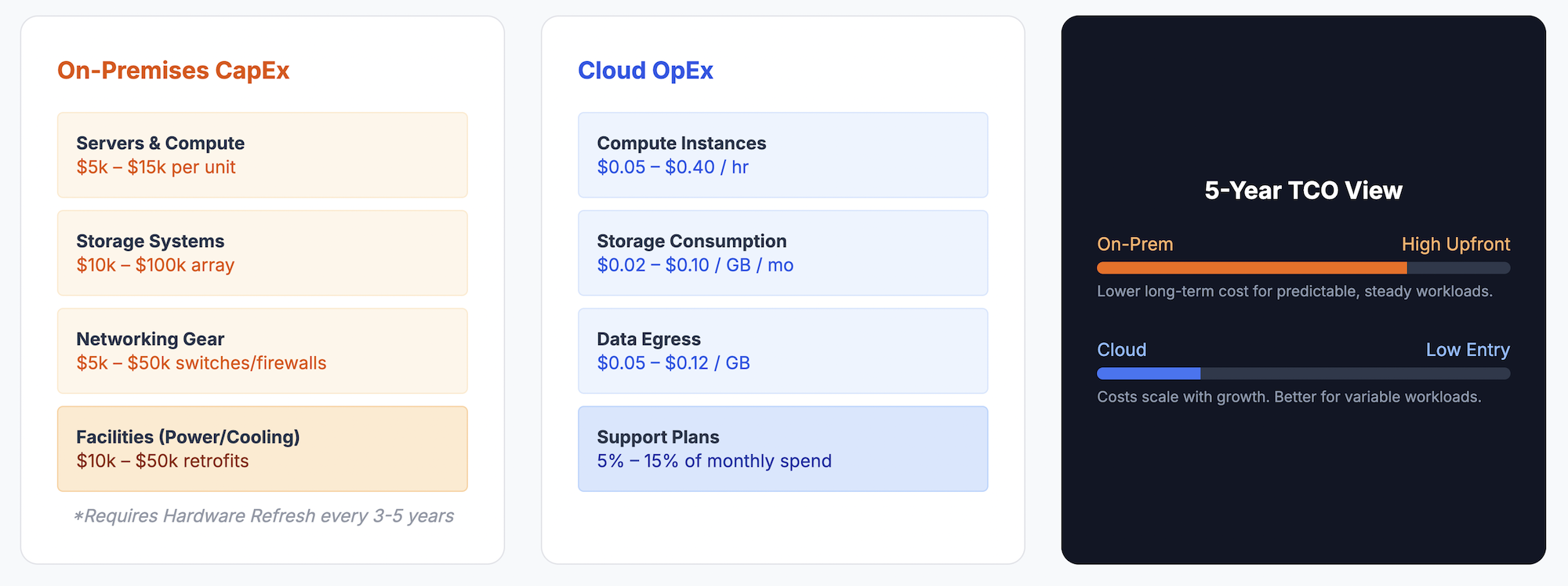
Cloud environments can spin up in minutes. Need additional servers for a new project? A few clicks and they’re running. This speed enables rapid testing and faster launches for new business initiatives.
On-premises deployments move slower by nature. Procurement cycles, shipping times, and physical installation add weeks or months before new equipment goes live. Even with hardware on hand, configuration and testing extend timelines further.
With on-premises infrastructure, your internal IT team handles everything—hardware failures, software updates, security patches, and capacity planning. This requires skilled staff and ongoing training investments.
Cloud providers manage infrastructure maintenance on your behalf. Your team can focus on business applications and strategic projects instead of replacing failed drives or patching operating systems. However, you remain responsible for properly configuring services and securing your data within the cloud environment.
Which model costs less? The honest answer depends on your specific situation. Business size, usage patterns, growth trajectory, and time horizon all influence the calculation.
Building on-premises infrastructure requires substantial initial investment. Beyond servers, you’ll pay for networking equipment, storage systems, backup hardware, and physical facilities including cooling systems and power redundancy.
For many small and mid-sized businesses, this barrier makes on-premises infrastructure impractical regardless of long-term economics. The cash simply isn’t available upfront.
Cloud pricing typically follows usage-based models. You pay for compute hours, storage consumed, and data transferred. Monthly bills fluctuate based on actual resource consumption.
While this flexibility benefits businesses with variable workloads, costs can climb unexpectedly. Organizations running consistent, high-volume workloads sometimes find cloud expenses exceed what on-premises infrastructure would cost over several years.
Total cost of ownership, or TCO, captures all expenses over an infrastructure’s useful life. This includes staffing, energy consumption, facility costs, and eventual hardware replacement—not just the purchase price.
A thorough TCO analysis typically reveals that cloud computing favors organizations with variable or growing workloads. On-premises infrastructure can be more economical for stable, predictable operations over five-plus year horizons.
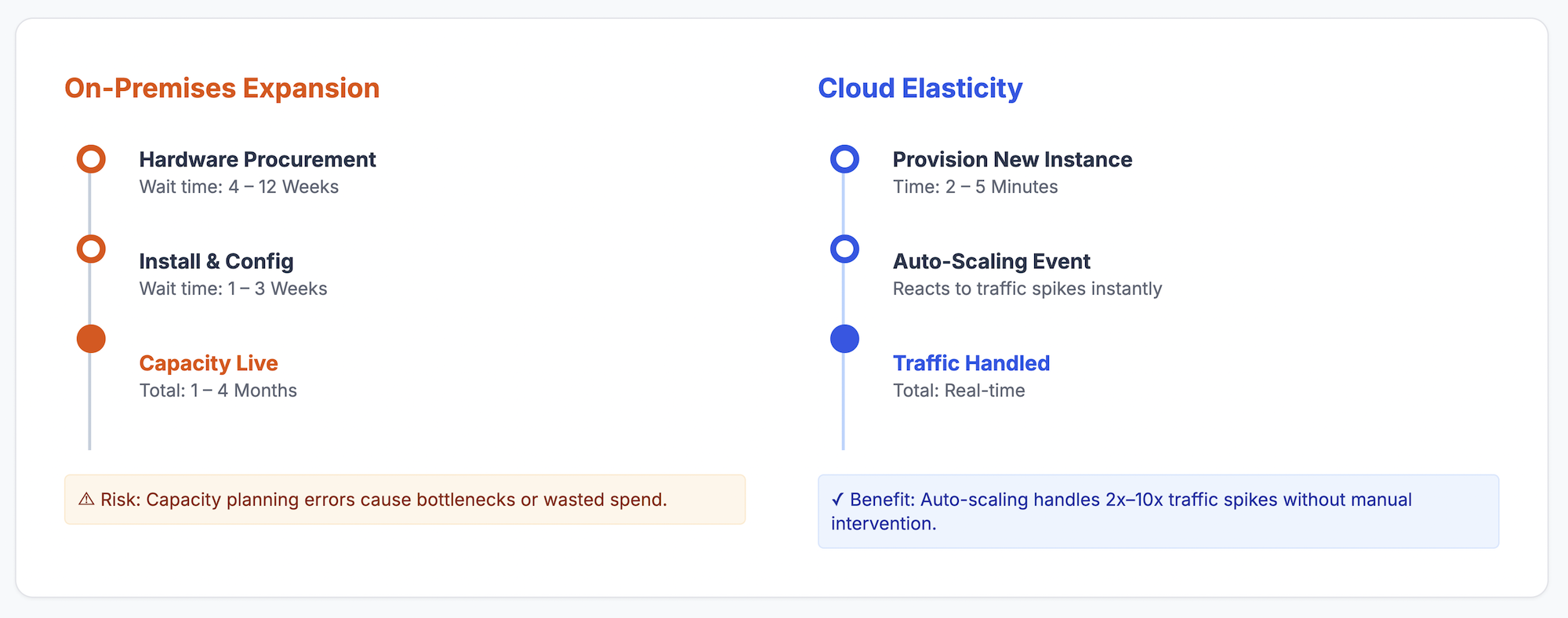
Both approaches carry expenses that don’t appear in initial quotes:
Neither model is inherently more secure. Security depends on implementation quality and organizational capabilities. Both approaches can achieve strong security postures with proper planning and execution.
On-premises infrastructure keeps data within your physical control. You know exactly where servers sit, who has access to the facility, and how data moves through your network. For organizations handling extremely sensitive information, this visibility provides peace of mind.
Cloud providers invest heavily in physical security—often exceeding what most businesses could afford independently. However, your data resides in shared facilities alongside other customers’ information, separated by software rather than physical walls.
Regulated industries face specific requirements that influence infrastructure decisions. Healthcare organizations managing protected health information, financial services firms handling customer data, and government contractors with security clearances all navigate unique compliance landscapes.
Some regulations specify data residency requirements or restrict certain cloud deployments. Others are cloud-agnostic but require specific security controls regardless of where infrastructure lives.
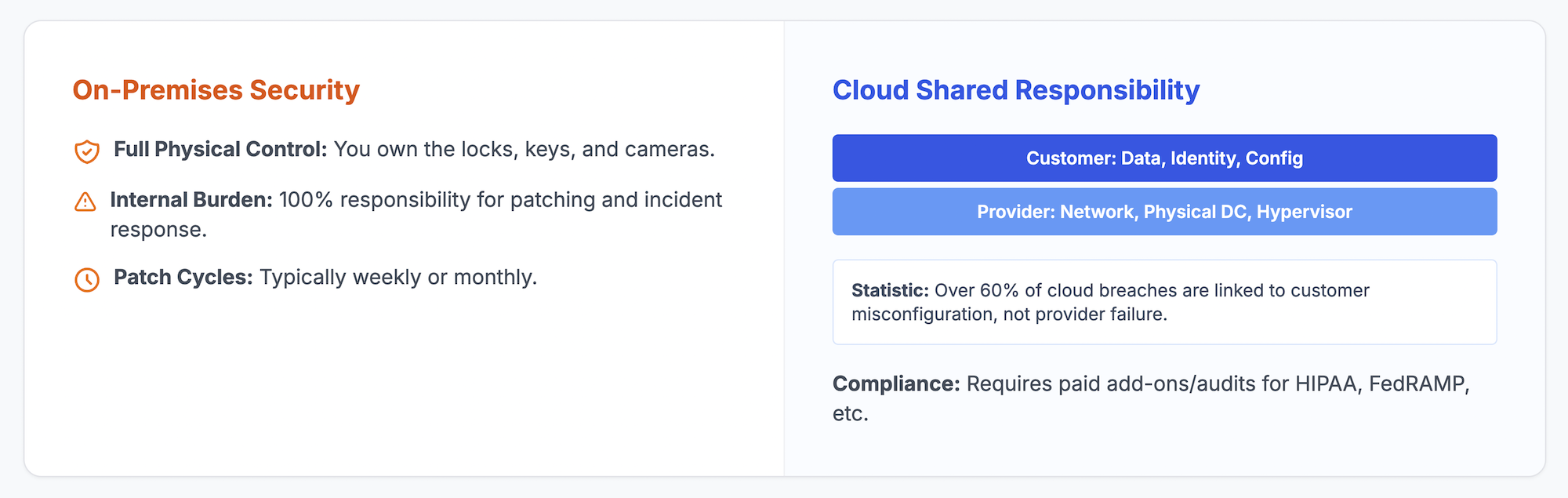
Cloud security operates on a shared responsibility model. The provider secures physical infrastructure, network architecture, and virtualization layers. You’re responsible for securing your data, configuring access controls, and properly using the security tools provided.
Misunderstanding this division causes many cloud security incidents. Organizations sometimes assume the provider handles security comprehensively, leaving gaps in their own configurations and access management.
Major cloud providers offer sophisticated security monitoring, threat intelligence, and incident response capabilities that most businesses couldn’t build internally. These tools can detect and respond to threats faster than traditional on-premises security operations.
On-premises environments require building or outsourcing these capabilities. While this gives you complete control over security operations, it demands significant expertise and investment to match cloud-native security services.
Performance requirements vary dramatically across applications and use cases. Understanding your specific workloads helps determine which model delivers better results.
On-premises infrastructure typically provides the lowest latency for users and applications within your facility. Data doesn’t travel across the internet, eliminating network variability and external bottlenecks.
Cloud performance depends on your connection quality and the provider’s regional presence. Applications requiring real-time responsiveness—manufacturing systems, trading platforms, or certain healthcare applications—may perform better on local infrastructure.
Cloud providers offer contractual uptime guarantees through service level agreements, or SLAs, often promising 99.9% or higher availability. When they miss targets, you receive service credits, though credits rarely compensate for actual business impact.
On-premises uptime depends entirely on your infrastructure design and IT team capabilities. Achieving cloud-level reliability requires redundant systems, backup power, and skilled staff available around the clock.
Cloud platforms simplify disaster recovery through built-in replication, geographic distribution, and automated failover capabilities. Recovering from a regional outage can happen in minutes rather than days.
Building equivalent disaster recovery for on-premises infrastructure requires duplicate facilities, data replication systems, and tested failover procedures. The complexity and cost often exceed what mid-sized businesses can justify.

Growth patterns significantly influence which infrastructure model serves your business better over time.
Cloud infrastructure scales instantly in response to demand. Launching a marketing campaign that triples website traffic? Cloud resources expand automatically, then contract when traffic normalizes. You pay only for capacity actually used.
This elasticity proves particularly valuable for businesses with seasonal fluctuations, unpredictable growth, or applications with variable usage patterns.
On-premises scaling requires purchasing, installing, and configuring additional hardware—a process measured in weeks or months. Capacity planning becomes critical because underestimating creates bottlenecks while overestimating wastes capital.
Organizations with stable, predictable workloads can plan effectively around these constraints. Those experiencing rapid or unpredictable growth often find on-premises limitations frustrating.
Many organizations find that neither pure cloud nor pure on-premises meets all their requirements. Hybrid approaches combine both models, placing workloads where they perform best.
Hybrid deployments offer several advantages:
Hybrid infrastructure fits organizations with legacy systems that cannot easily migrate to cloud. It also works well for businesses with strict data residency requirements for certain applications, and companies managing seasonal demand fluctuations that would be expensive to handle with on-premises capacity alone.
The right choice depends on your specific circumstances rather than industry trends or vendor recommendations.
Start with compliance and regulatory requirements. Some industries have clear guidance favoring one approach while others leave the decision to your judgment. Understanding these constraints narrows your options appropriately.
On-premises infrastructure demands skilled internal staff or reliable outsourced support. If your team lacks infrastructure expertise, cloud services reduce the technical burden while managed IT partnerships can fill capability gaps.
Consider where your business will be in three to five years. Rapid growth typically favors cloud flexibility. Stable operations with predictable workloads may benefit from on-premises economics over longer time horizons.
Making the right infrastructure decision requires understanding both your business requirements and the technical trade-offs involved. A managed IT services provider brings objective perspective and implementation expertise to help you evaluate options, design the right solution, and manage ongoing operations.
Whether you’re considering cloud migration, optimizing existing on-premises infrastructure, or building a hybrid environment, working with experienced professionals helps avoid costly mistakes.
Book a consultation to discuss your infrastructure strategy with IT GOAT’s team.


