
Oracle Cloud Infrastructure (OCI) is Oracle Corporation’s enterprise cloud computing platform—a complete set of cloud services for running applications, storing data, and building modern infrastructure without owning physical hardware. It competes directly with AWS and Azure while leveraging Oracle’s four decades of database expertise.
This guide covers OCI’s core services, deployment options, security features, and how it compares to other major cloud providers. You’ll also find practical guidance for evaluating whether OCI fits your organization’s workloads.
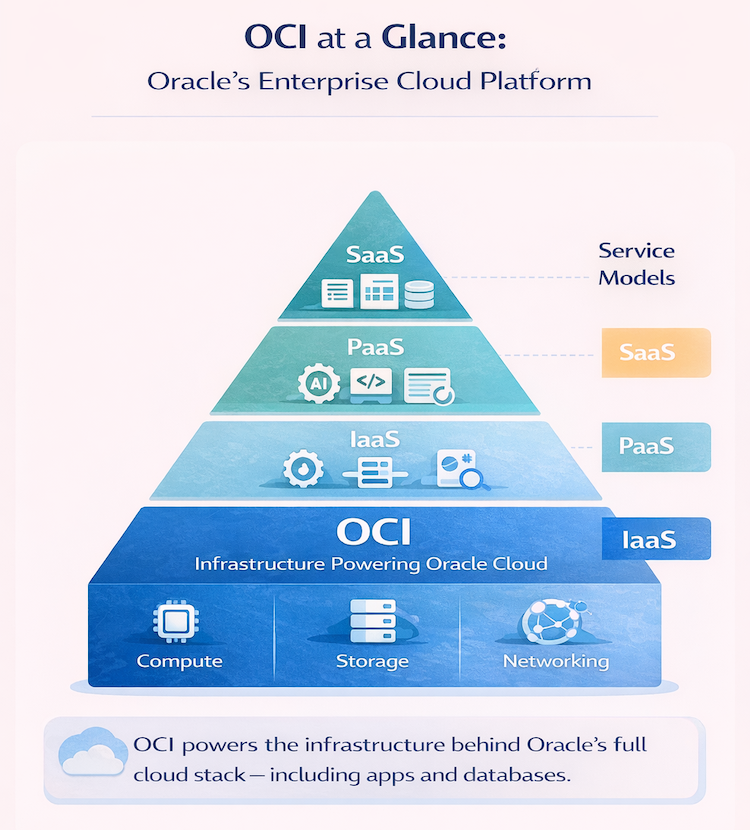
Oracle Cloud Infrastructure (OCI) is Oracle Corporation’s enterprise cloud computing platform, offering a complete set of cloud services for building, deploying, and running applications. Rather than buying and maintaining physical servers, businesses rent computing power, storage, networking, and databases from Oracle’s global data centers. OCI competes directly with Amazon Web Services and Microsoft Azure while bringing Oracle’s decades of database expertise to the cloud.
OCI operates across three service models you’ll encounter throughout cloud computing:
The distinction between OCI and “Oracle Cloud” trips up many newcomers. Oracle Cloud is the umbrella term covering everything Oracle offers in the cloud, from business applications to analytics. OCI specifically refers to the infrastructure layer—the compute, storage, and networking foundation that powers those higher-level services.
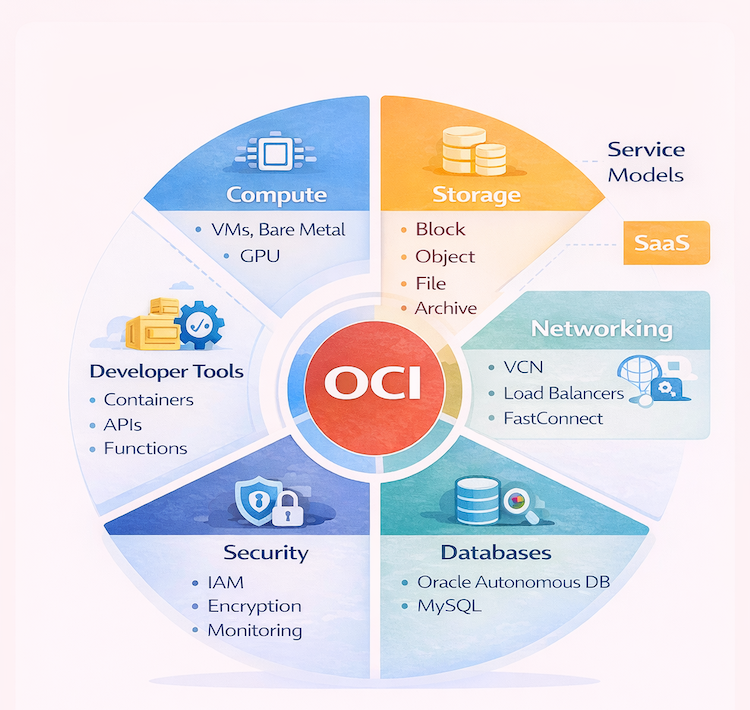
Oracle Cloud Infrastructure services cover the full stack of what modern businesses require from a cloud provider. Instead of cobbling together solutions from multiple vendors, OCI delivers integrated services designed to work together from the start.
OCI offers computing options ranging from virtual machines to bare metal servers. Virtual machines handle most workloads efficiently, sharing physical hardware with other customers while maintaining logical separation. Bare metal servers, on the other hand, give you dedicated physical hardware without a hypervisor layer—ideal for performance-sensitive applications like databases or scientific computing. GPU instances tackle specialized tasks like machine learning model training and 3D rendering.
Different data types call for different storage approaches:
Virtual Cloud Networks (VCNs) form the backbone of OCI networking. A VCN is essentially your own private, isolated network within Oracle’s cloud where you control IP addressing, subnets, route tables, and security rules. Load balancers distribute incoming traffic across multiple servers to prevent overload. FastConnect provides dedicated private connections between your existing data center and OCI, bypassing the public internet entirely.
Oracle’s database heritage gives OCI a distinct advantage here. Oracle Autonomous Database handles routine maintenance automatically—patching, performance tuning, backups—while delivering enterprise-grade reliability. Organizations already running Oracle Database workloads find native optimization on OCI that competing clouds cannot replicate.
Identity and Access Management (IAM) controls who accesses what within your OCI environment. You create users, organize them into groups, and define policies governing permissions across all resources. Encryption protects data both moving across networks and sitting in storage, enabled by default rather than as an optional add-on.
Containers have become central to modern application development. A container packages everything an application requires to run into a lightweight, portable unit. OCI supports container orchestration through Kubernetes (an open-source system for automating container deployment), serverless functions for event-driven code, and API management for connecting services.
One deployment approach rarely fits every organization. Regulatory requirements, existing infrastructure investments, and business strategies all shape where and how workloads run.
The standard OCI experience uses multi-tenant infrastructure accessed over the internet. You share physical resources with other customers while maintaining complete logical isolation. Public cloud offers the greatest scalability and eliminates capital investment in hardware.
Many organizations have data centers they cannot or choose not to abandon. Hybrid cloud connects on-premises infrastructure with OCI services, letting workloads span both environments. Oracle Cloud@Customer takes this further by placing OCI hardware inside your own data center while Oracle manages it remotely.
Running OCI alongside AWS, Azure, or Google Cloud has become increasingly common. Oracle established direct interconnects with other major cloud providers, making it practical to run Oracle databases on OCI while keeping other workloads elsewhere. This flexibility helps avoid vendor lock-in.
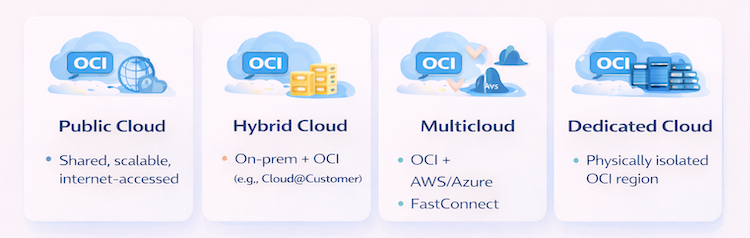
Some industries face strict data residency or isolation requirements. Dedicated regions provide physically separate OCI infrastructure for a single customer, meeting demanding compliance scenarios while still delivering full OCI capabilities.
The “which cloud is better” question depends entirely on your specific situation. Here’s how OCI stacks up on factors that typically matter most:
| Feature | OCI | AWS | Azure |
|---|---|---|---|
| Oracle Workload Optimization | Native support | Requires configuration | Requires configuration |
| Pricing Model | Consistent globally | Variable by region | Variable by region |
| Bare Metal Options | Extensive | Limited | Limited |
| Database Integration | Native Oracle DB | Third-party licensing | Third-party licensing |
| Market Maturity | Growing | Most established | Second largest |
OCI uses off-box network virtualization, meaning network processing happens on separate hardware rather than consuming your compute resources. The result is more predictable performance, particularly for network-intensive workloads. Oracle designed OCI’s non-blocking network architecture specifically for enterprise applications demanding consistent low latency.
OCI pricing stays consistent across all regions globally—a notable departure from AWS and Azure, where costs vary by geography. Data egress fees (charges for moving data out of the cloud) run substantially lower on OCI. For organizations with predictable workloads, this consistency simplifies budgeting.
Organizations running Oracle Database or Oracle applications find optimizations on OCI unavailable elsewhere. Oracle licensing often costs less on OCI, and performance tuning reaches deeper than third-party clouds can achieve. For workloads without Oracle dependencies, however, the competitive advantages become less clear-cut.
Beyond consistent global pricing, OCI’s flexible consumption model charges only for resources actually used. Reserved capacity discounts reward longer commitments, while the always-free tier allows experimentation without financial risk.
Native integration means Oracle Database runs faster on OCI than on competing platforms. Autonomous Database eliminates routine DBA tasks like patching and tuning, reducing operational overhead while improving reliability.
Oracle continues expanding its global footprint with data center regions across North America, Europe, Asia, and beyond. Within each region, availability domains provide independent power, cooling, and networking. Fault domains offer additional isolation within availability domains, protecting against localized hardware failures.
Security integrates throughout OCI rather than existing as a separate add-on. Encryption happens by default, network isolation comes standard, and security controls weave through the entire platform.
For organizations in regulated industries, OCI’s security architecture addresses common audit concerns:
HIPAA-compliant infrastructure supports electronic health records, medical imaging storage, and healthcare analytics. The combination of security controls and high-performance computing makes OCI suitable for genomics research and clinical trial data management.
Low-latency networking supports trading systems, while comprehensive audit trails satisfy regulatory requirements. Risk modeling and fraud detection benefit from OCI’s compute scalability.
Seasonal traffic spikes become manageable with elastic scaling. Customer analytics, inventory optimization, and omnichannel commerce platforms all run effectively on OCI.
IoT sensor data flows into OCI for processing and analysis. Manufacturing IT systems integrate supply chain optimization, predictive maintenance, and quality control applications leverage OCI’s integration leveraging OCI’s capabilities.
Exploring OCI doesn’t require a major commitment upfront:
Adopting Oracle Cloud Infrastructure represents a significant technical undertaking, even for organizations with experienced IT teams. The learning curve, migration complexity, and ongoing management requirements can strain internal resources quickly.
IT GOAT’s cloud solutions team brings hands-on OCI experience to organizations seeking Oracle’s cloud benefits without the operational burden. Our proactive monitoring catches issues before they affect your business, while our U.S.-based support team provides responsive assistance when questions arise. We integrate with over 750 enterprise applications, ensuring your OCI environment connects seamlessly with existing systems.
Book a consultation to discuss how managed IT support can simplify your Oracle Cloud Infrastructure journey.


