
Budgeting for network infrastructure used to mean large upfront purchases followed by years of unpredictable maintenance costs. NaaS flips that model by delivering enterprise-grade networking through predictable monthly subscriptions—even when the equipment sits in your own building.
This guide breaks down how NaaS pricing works for on-premises environments, what factors drive costs up or down, and how to evaluate whether the subscription model makes financial sense for your organization.
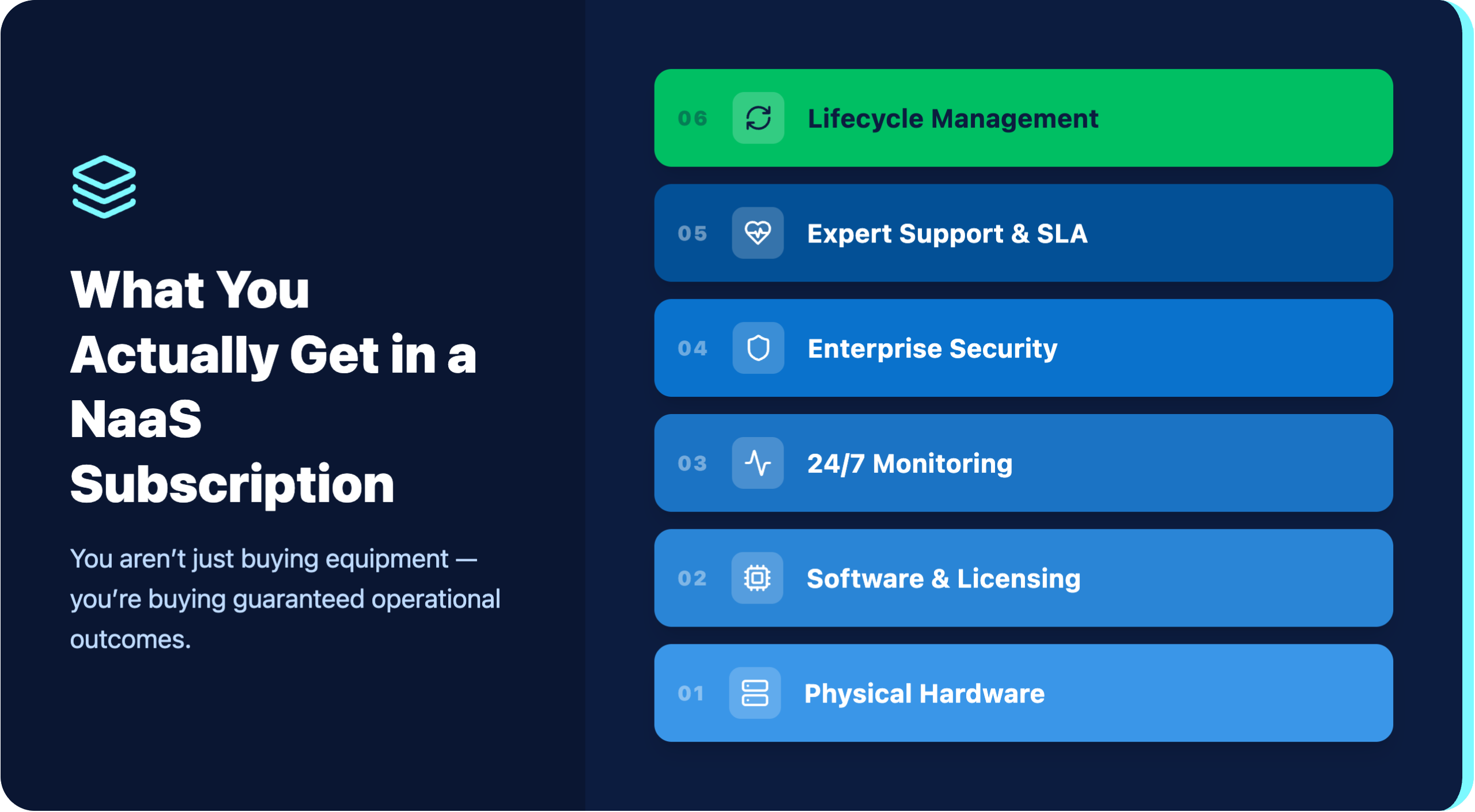
Network-as-a-Service (NaaS) for on-premises servers delivers networking infrastructure through a subscription model rather than traditional hardware purchases. With NaaS, a provider installs switches, routers, firewalls, and other network equipment at your physical location, then manages everything remotely for a predictable monthly fee. The equipment stays in your building, but the provider owns it, monitors it, and replaces it when the time comes.
This approach shifts networking costs from capital expenditure (CapEx) to operating expenditure (OpEx). Instead of spending tens of thousands upfront on hardware that depreciates over five years, you pay a consistent monthly amount that covers equipment, software licenses, maintenance, and support. Providers like HPE GreenLake have popularized this model by packaging hardware, management, and lifecycle services into a single subscription.
The distinction matters because NaaS for on-prem environments differs from cloud networking. Your data and traffic stay local, which appeals to organizations with compliance requirements, latency concerns, or existing investments in on-site infrastructure.
NaaS pricing depends heavily on your organization’s size, network complexity, and service requirements. A small business with straightforward networking typically pays less than a mid-market company with multiple locations and advanced security requirements. Enterprise organizations with complex architectures and strict compliance obligations pay more still.
Most providers don’t publish standard rate cards because each deployment involves different equipment, support levels, and contract terms. However, understanding how pricing scales across business sizes helps set realistic expectations before requesting quotes.
| Business Size | Typical Pricing Structure | What’s Usually Included |
|---|---|---|
| Small Business | Lower monthly subscription | Basic network equipment, standard support |
| Mid-Market | Moderate monthly subscription | Advanced equipment, enhanced SLAs |
| Enterprise | Custom pricing | Full infrastructure, dedicated support, compliance features |
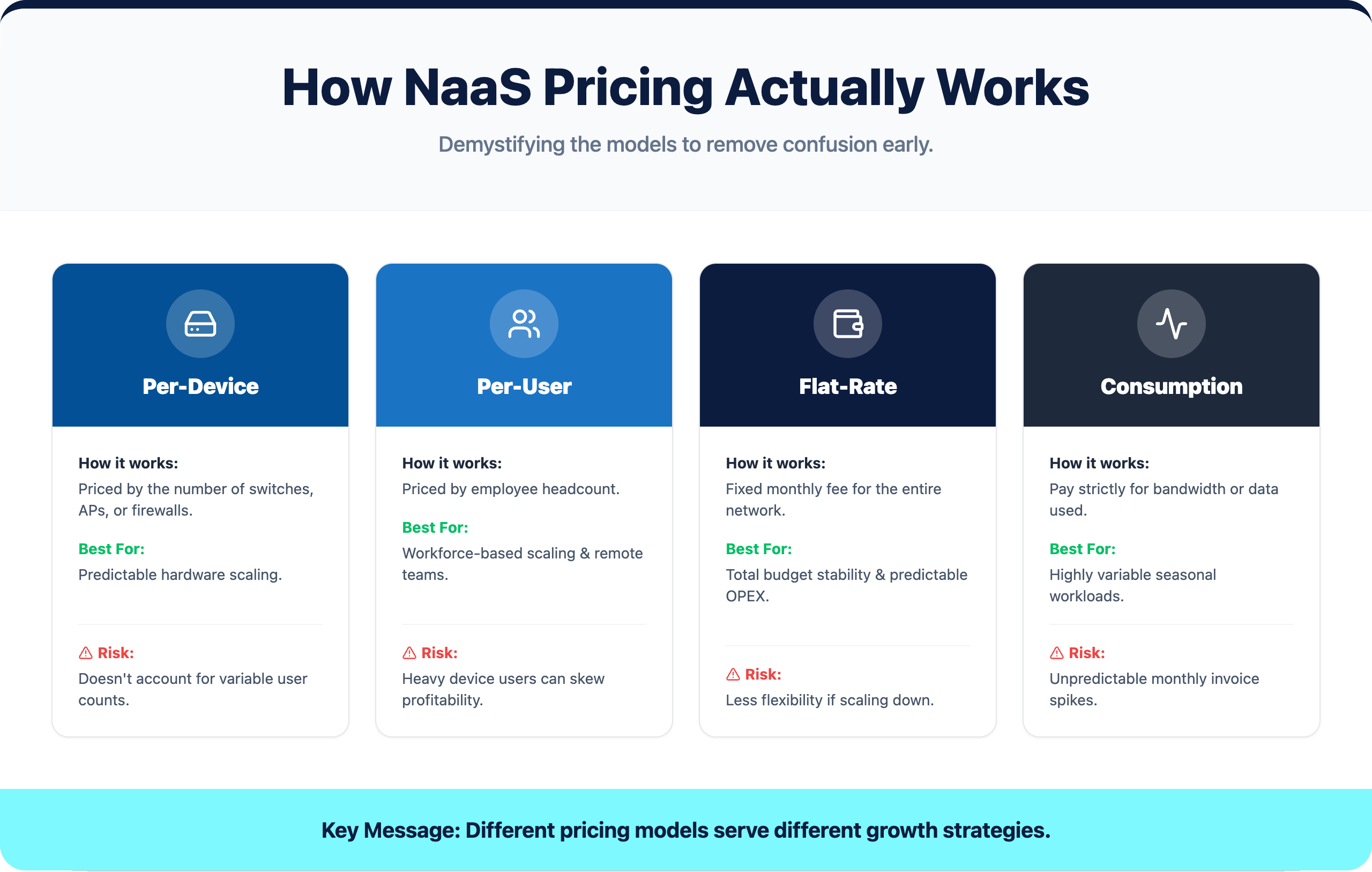
Businesses evaluating NaaS often compare it against broader IT spending benchmarks to understand whether subscription pricing aligns with industry norms. According to Gartner, organizations typically allocate 3% to 7% of total revenue toward IT, with infrastructure and networking representing a significant portion of that budget. Within that, network infrastructure alone can account for 10%–20% of total IT spend, depending on industry and complexity.
For small and mid-sized businesses, this often translates into $100 to $400 per user per month across total IT services, with networking forming a meaningful slice of that cost. NaaS pricing typically falls within or slightly above this range when bundled with security, monitoring, and lifecycle management.
This context helps frame NaaS not as an additional cost, but as a reallocation of existing IT spend into a more predictable model.
Small businesses typically encounter the most straightforward pricing. Providers often offer bundled packages designed for simpler network environments with a set number of devices and standard business-hours support. Comparing quotes across providers becomes easier at this level because the offerings tend to be more standardized.
Mid-sized organizations usually receive customized quotes because their networks involve more variables. Multiple office locations, specific compliance requirements, and more complex network topologies all influence pricing. Expect providers to conduct site assessments before delivering accurate numbers.
Enterprise pricing involves detailed discovery processes and multi-year contract negotiations. Volume considerations, dedicated account management, compliance documentation, and custom SLAs all factor into the final number. These engagements rarely follow standard pricing templates.
Providers structure their pricing in different ways, and understanding the common models helps when comparing quotes. Some charge based on equipment deployed, while others focus on user counts or actual consumption.
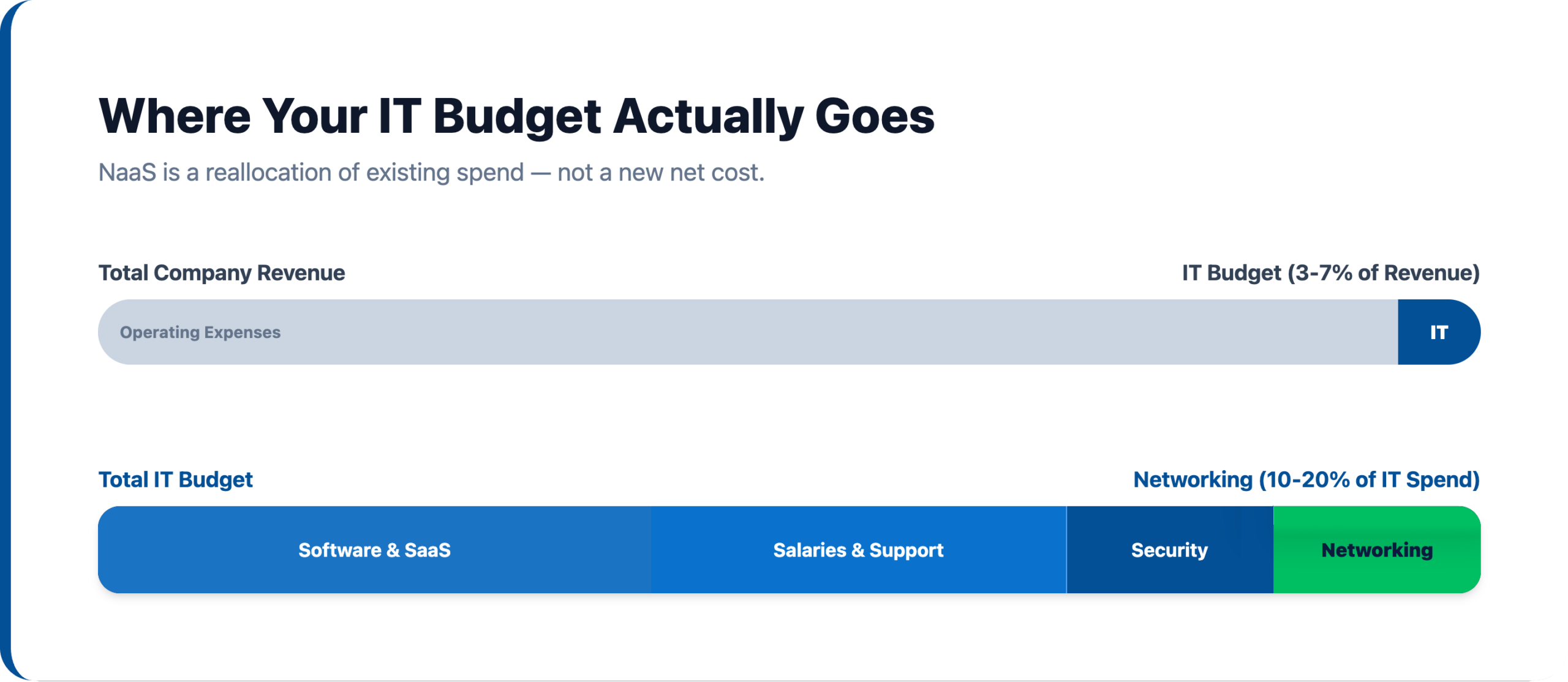
The right model depends on your usage patterns. Organizations with stable, predictable network demands often prefer flat-rate subscriptions. Companies with seasonal fluctuations or rapid growth might benefit from consumption-based approaches that scale with actual usage.
While providers rarely publish fixed pricing, industry benchmarks and vendor disclosures provide directional ranges. In most on-prem NaaS deployments, organizations can expect:
These ranges vary significantly based on uptime SLAs, compliance requirements, and whether advanced features like zero trust or SD-WAN are included. However, they provide a realistic starting point when evaluating proposals.
Several variables affect your final pricing quote. Understanding them helps you anticipate costs and ask better questions during the evaluation process.
More devices and endpoints increase subscription costs. A network supporting 50 endpoints costs less than one supporting 500, even when the underlying architecture looks similar.
Higher throughput requirements and low-latency demands typically command premium pricing. Operations that depend on real-time data transfer or video conferencing often fall into higher pricing tiers.
Faster response times and higher uptime guarantees increase monthly costs. A four-hour response SLA costs more than next-business-day support. Similarly, 99.99% uptime guarantees exceed 99.9% pricing.
Longer commitments often reduce monthly rates. Three-year contracts typically offer better per-month pricing than annual agreements, though you trade flexibility for savings.
Advanced threat protection, HIPAA compliance documentation, and SOC 2 audit support add to base pricing. Organizations in regulated industries often find compliance features and business continuity planning represent a significant portion of their total subscription cost.
Security is one of the fastest-growing cost drivers in network infrastructure. According to IBM’s Cost of a Data Breach Report, the average data breach now exceeds $4 million globally, with significantly higher costs in regulated industries.
As a result, organizations are investing more heavily in integrated security at the network level. Features like:
While these features raise monthly subscription costs, they can reduce risk exposure significantly. In many cases, organizations find that bundling security into NaaS is more cost-effective than managing separate security vendors, tools, and compliance processes.
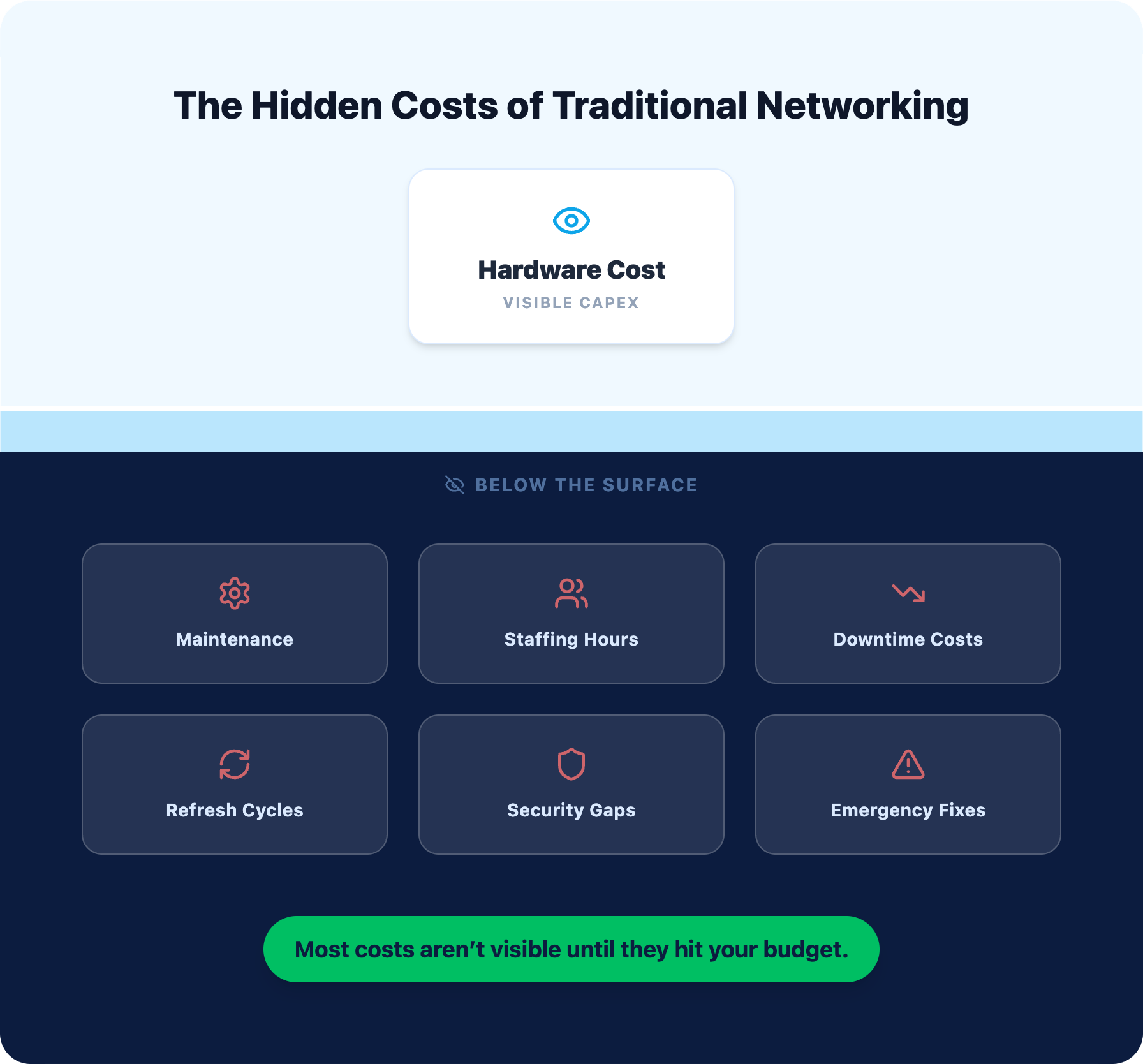
Comparing NaaS to traditional ownership requires looking beyond monthly payments. The subscription model eliminates several costs that traditional ownership carries but doesn’t always advertise.
| Cost Category | Traditional On-Prem | NaaS Model |
|---|---|---|
| Initial Investment | High upfront purchase | Minimal or zero |
| Monthly Expenses | Variable maintenance | Predictable subscription |
| Staffing Requirements | In-house expertise needed | Included in service |
| Technology Refresh | Self-funded every 3-5 years | Provider handles upgrades |
Organizations adopting NaaS or similar as-a-service infrastructure models often report measurable cost and efficiency improvements. IDC research indicates that companies using consumption-based infrastructure models can achieve:
Additionally, enterprises shifting to OpEx models often see faster deployment timelines—sometimes 50% faster implementation compared to traditional procurement cycles.
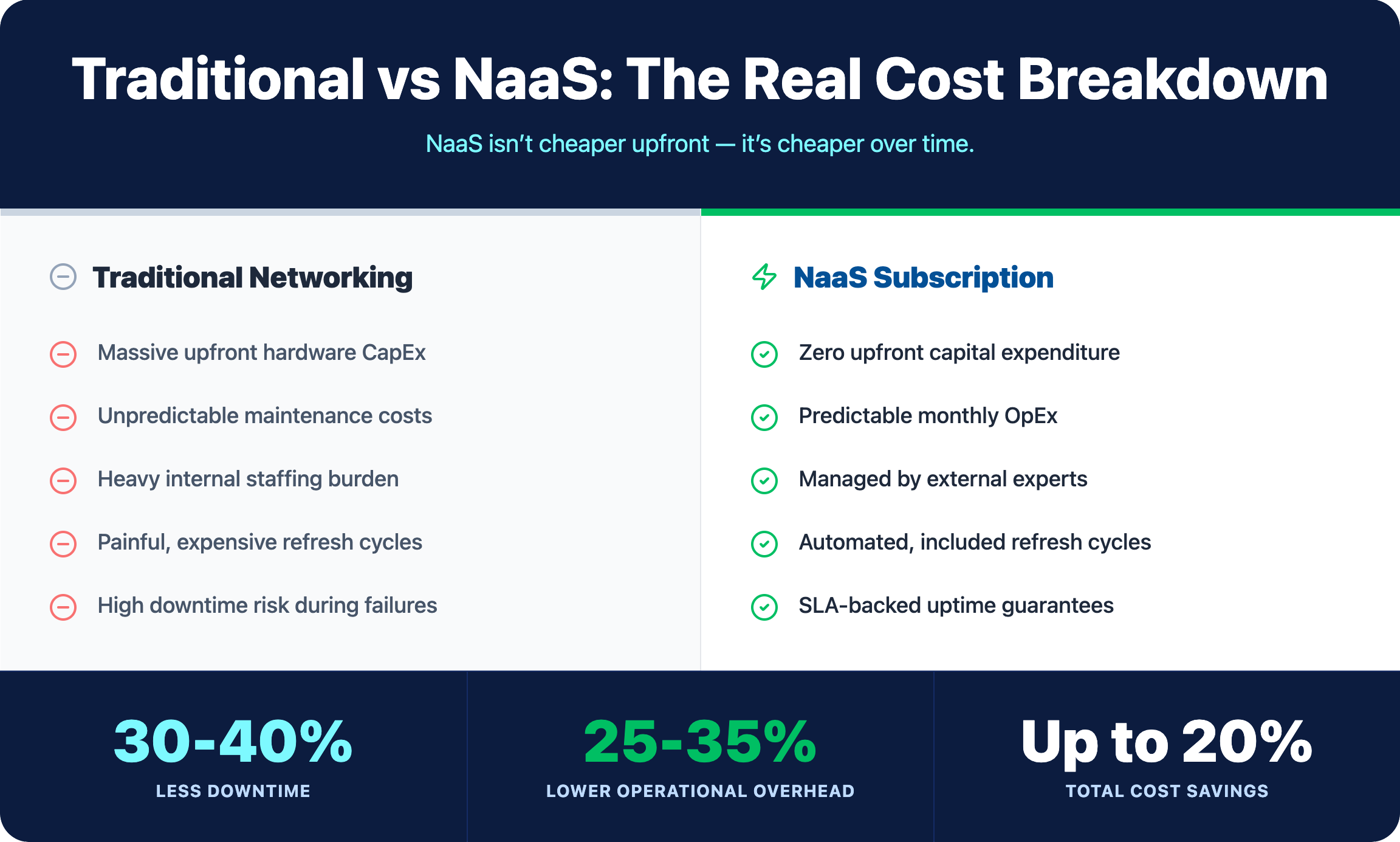
These gains are not purely financial. Reduced downtime and faster scalability directly impact productivity, which is often a larger hidden cost than infrastructure itself.
Traditional networking requires significant initial investment. Basic server infrastructure often starts around $25,000 or more. NaaS eliminates or dramatically reduces this barrier, making enterprise-grade networking accessible to organizations that cannot justify large capital outlays.
Traditional networking requires dedicated IT staff or expensive break-fix contracts. NaaS bundles management, monitoring, and troubleshooting into the subscription, which can reduce internal staffing requirements or free existing staff for other projects.
Network equipment typically requires replacement every three to five years. NaaS providers handle this lifecycle management automatically, removing both the financial burden and the planning complexity from your organization.
Traditional network infrastructure follows a predictable depreciation and replacement cycle. Most enterprise networking hardware—such as switches, firewalls, and servers—has a useful lifecycle of 3 to 5 years, according to vendors like Cisco and Dell.
However, many organizations delay refresh cycles due to budget constraints, which introduces risk. Studies show that aging infrastructure can increase failure rates and maintenance costs by 15%–25% annually after year three, while also exposing businesses to security vulnerabilities due to unsupported firmware.
NaaS eliminates this issue by embedding refresh cycles into the subscription. Instead of delaying upgrades, organizations maintain continuously supported and up-to-date infrastructure, reducing both risk and unexpected capital expenditures.
Not every cost appears in the initial quote. Asking about potential additional fees helps you budget accurately and negotiate better terms.
One-time charges for site surveys, equipment installation, and initial configuration can add thousands to your first invoice. Some providers include deployment in the subscription while others charge separately.
Some plans include usage limits with additional fees if exceeded. Understanding exactly what triggers overage charges and how providers calculate them prevents surprises.
Breaking a multi-year contract early typically incurs significant fees, sometimes requiring payment of the remaining contract value. Knowing your exit costs before committing protects you if circumstances change.
Requesting hardware upgrades outside normal refresh cycles may cost extra. If you anticipate growth or changing requirements, negotiating upgrade terms upfront saves money later.
The subscription model offers advantages that extend beyond simple cost comparison. For many organizations, operational benefits justify the pricing even when pure cost analysis favors traditional ownership.
Subscription pricing converts unpredictable capital expenses into consistent operating expenses. Finance teams know exactly what network infrastructure will cost each month, which simplifies budgeting and cash flow management.
NaaS shifts network management responsibility to the provider. Internal resources can focus on strategic projects rather than firmware updates and hardware troubleshooting.
Adding capacity becomes a contract adjustment rather than a procurement project. As your business grows, your network can expand without lengthy purchasing cycles or installation delays.
Providers typically refresh equipment on regular cycles, keeping your network current without additional investment. You benefit from improved performance and security features as they become available.
NaaS works well for many organizations, but the model has limitations worth considering.
Evaluating whether NaaS makes financial sense requires systematic analysis of your current situation and future requirements.
Document existing equipment, its age, current performance, and anticipated replacement timeline. This baseline establishes what you’re comparing against.
Identify your bandwidth requirements, uptime expectations, and desired response times. These specifications drive pricing across all models.
Gather proposals from several NaaS vendors to compare pricing structures and included services. Ensure each quote addresses the same requirements for accurate comparison.
Calculate cumulative costs for both NaaS subscriptions and traditional ownership, including staffing, maintenance, and refresh cycles. The longer timeframe reveals the true cost difference between approaches.
Choosing between NaaS and traditional infrastructure involves more than comparing monthly costs. Our vCIO team works with clients to assess current network environments, define performance requirements, and evaluate options that align with both technical requirements and business objectives. With proactive monitoring capabilities and U.S.-based support professionals, we help organizations implement and manage network infrastructure that supports their operations without creating unnecessary complexity.
Book a consultation to discuss your network infrastructure options


