
Managing your own data center infrastructure means juggling hardware purchases, security patches, cooling systems, and round-the-clock monitoring—all while trying to run your actual business. Cloud managed data center services shift that burden to specialized providers who handle servers, storage, and networks remotely through subscription-based models.
This guide covers how these services work, the different deployment options available, and what to look for when evaluating providers for your organization.
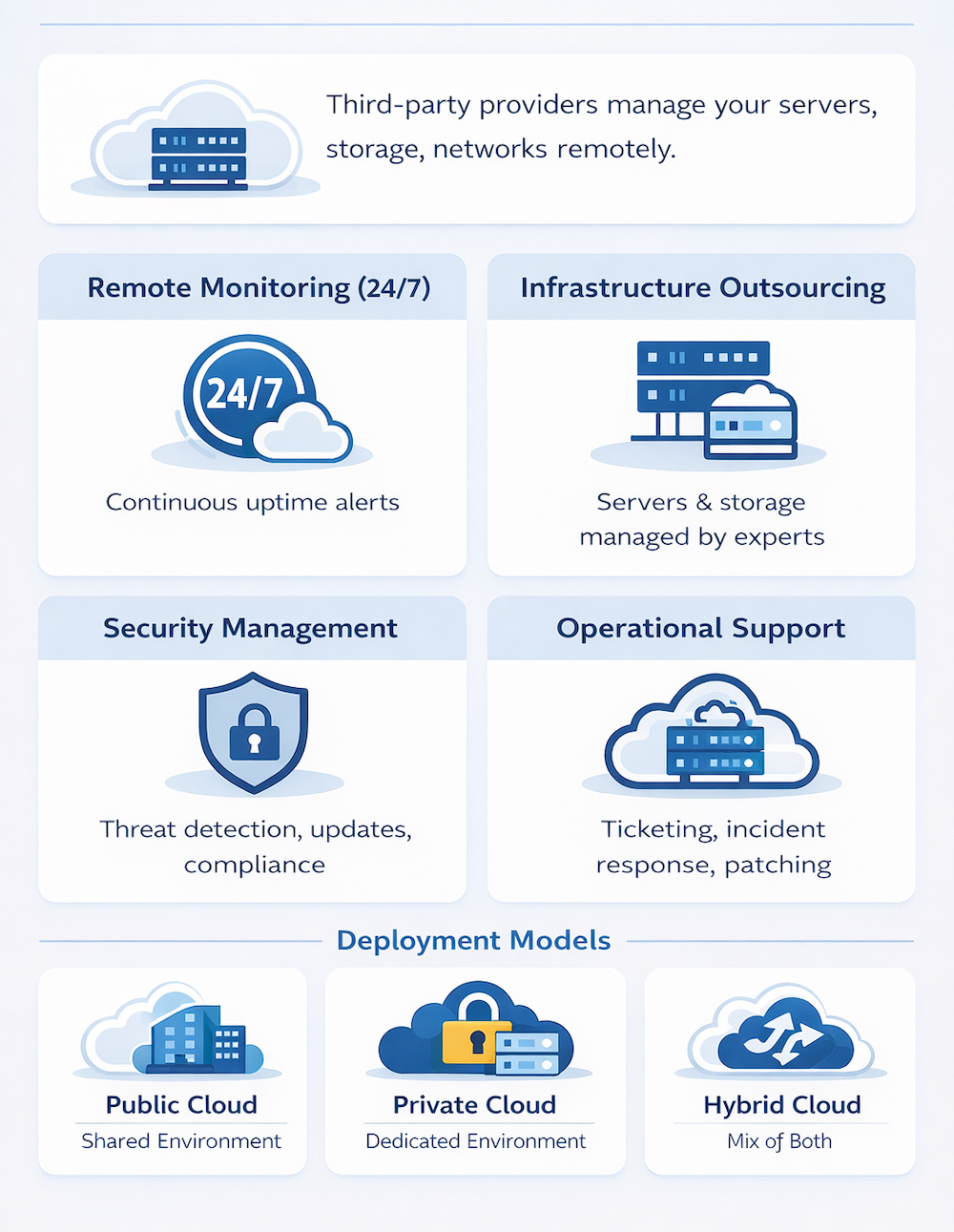
Cloud managed data center services involve a third-party provider handling your servers, storage, and networks remotely. Rather than building and maintaining your own infrastructure, you rent managed resources through a subscription model. The provider takes care of security, operations, and maintenance while your team focuses on running the business.
This approach works through public, private, or hybrid cloud models depending on what your organization requires. The provider handles physical hardware, software updates, security patches, and round-the-clock monitoring—all tasks that would otherwise fall on your internal IT staff.
What’s typically included:
Every managed data center runs on the same foundational elements. Understanding each component helps you evaluate what you’re actually getting from a provider.
Managed servers and virtualization layers form the foundation where your business applications run. Providers handle server provisioning, operating system management, and performance optimization. Virtualization allows multiple virtual servers to run on single physical machines, making better use of hardware resources.
Your business data lives in managed storage systems designed for reliability and accessibility. Storage solutions typically offer scalable capacity, so you can expand as your data grows without purchasing new hardware. Providers manage backups, redundancy, and data integrity behind the scenes.
Managed network connectivity ensures your applications communicate efficiently and securely. This includes bandwidth management, load balancing (distributing traffic across multiple servers), and interconnect services that link your cloud resources to your offices and users.
Automated backup systems capture your data at regular intervals. Disaster recovery planning ensures you can restore operations quickly after outages, hardware failures, or other disruptions. This component often proves its value during the moments you hope never happen.
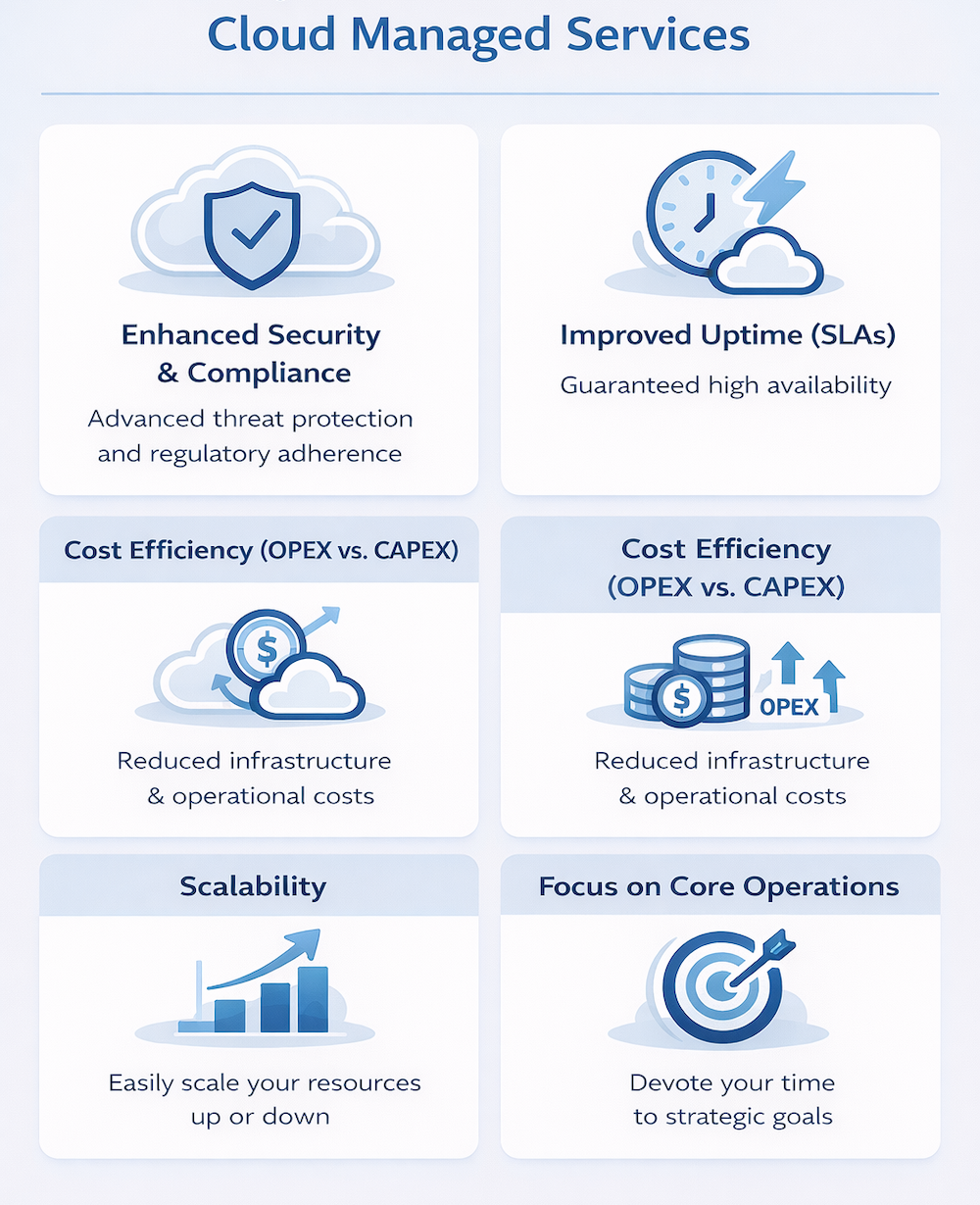
Organizations shift to managed data center services for practical reasons that affect daily operations and long-term planning.
Providers deliver enterprise-grade security measures that most mid-sized businesses couldn’t afford to implement independently. You gain access to advanced threat protection, security certifications, and expertise in meeting regulatory standards like SOC 2, HIPAA, or PCI-DSS.
Redundant infrastructure and guaranteed availability through service level agreements (SLAs) keep your systems online. SLAs are contracts that specify uptime commitments—typically 99.9% or higher—along with remedies if the provider falls short.
The shift from capital expenditures to predictable operational expenses changes how you budget for IT. Instead of large upfront hardware investments followed by unpredictable maintenance costs, you pay a consistent monthly fee that covers infrastructure, support, and updates.
Business demands fluctuate, and managed services accommodate that reality. You can scale resources up during busy periods or down during slower times, paying only for what you actually use rather than maintaining capacity for peak demand year-round.
Round-the-clock monitoring and certified technical support become available without hiring specialized staff. When issues arise at 2 AM, someone is already watching and responding on your behalf.
Offloading infrastructure management frees your internal teams to work on projects that directly advance business goals. IT staff can focus on strategic initiatives rather than routine server maintenance and patching.
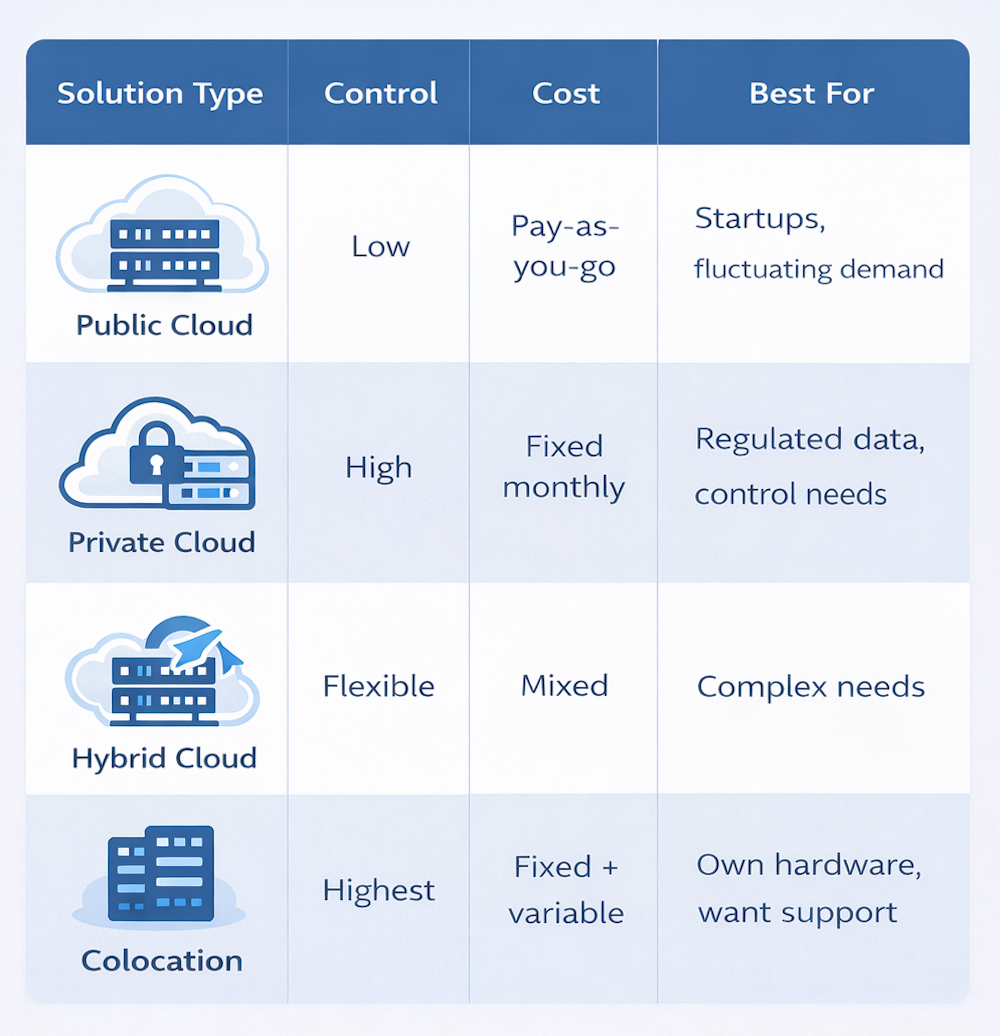
Different deployment models serve different business situations. The right choice depends on your security requirements, budget, and how much control you want to retain.
| Solution Type | Control Level | Cost Structure | Best For |
|---|---|---|---|
| Public Cloud | Lower | Pay-as-you-go | Variable workloads, startups |
| Private Cloud | Higher | Fixed monthly | Regulated industries, sensitive data |
| Hybrid Cloud | Flexible | Mixed | Organizations with diverse requirements |
| Colocation | Highest | Fixed + variable | Companies with existing hardware |
Shared infrastructure from providers like AWS, Azure, or Google Cloud works well for variable workloads. You share resources with other customers, which keeps costs lower but offers less customization. Public cloud suits applications where demand fluctuates significantly.
Dedicated infrastructure for your organization alone provides maximum control and isolation. Private cloud suits regulated industries or businesses handling particularly sensitive data where sharing resources with other organizations isn’t acceptable.
Combining public and private cloud gives you flexibility to place workloads where they make the most sense. Sensitive data stays in private infrastructure while less critical applications run on cost-effective public cloud resources.
Housing your own equipment in a provider’s facility gives you physical control over hardware while benefiting from their power, cooling, and connectivity. Managed services can be layered on top for additional support, creating a middle ground between fully managed and fully self-operated.
Traditional on-premises data centers give you complete control but require significant investment in hardware, facilities, and specialized staff. Managed services trade some control for convenience and expertise.
| Factor | Traditional Data Center | Cloud Managed Services |
|---|---|---|
| Upfront Costs | High (hardware, facilities) | Low (subscription-based) |
| Ongoing Maintenance | Your responsibility | Provider’s responsibility |
| Scalability | Limited by physical capacity | Nearly unlimited |
| Security Responsibility | Entirely internal | Shared with provider |
| Staffing Requirements | Dedicated IT team | Minimal internal resources |
The economics have shifted over the past decade. Running secure, reliable infrastructure requires increasingly specialized expertise, while cloud providers have achieved economies of scale that individual businesses cannot match. For many organizations, the math now favors managed services.
Selecting the right partner requires evaluating several factors beyond price. The provider you choose becomes an extension of your IT operations, so the relationship matters as much as the technical capabilities.
Verify the provider holds relevant security certifications and can support your specific regulatory requirements. Ask about security practices, incident response procedures, and compliance audit history. If you operate in a regulated industry, confirm the provider has experience with your specific compliance frameworks.
Review SLA commitments carefully. What happens when the provider misses uptime targets? Financial credits are standard, but understand the actual remedies available and whether they adequately compensate for business disruption.
Evaluate help desk availability and escalation procedures. How quickly will the provider respond to critical issues? Can you reach a human when you need one, or will you navigate automated systems during emergencies?
Check for certified professionals and relevant industry experience. A provider familiar with your industry will understand your specific challenges and requirements without extensive explanation.
Confirm the provider can grow with you. Ask about the process for adding resources and whether contracts allow flexibility as your situation evolves. Getting locked into rigid terms creates problems down the road.
Moving from on-premises infrastructure to managed services requires careful planning. Rushing the process creates unnecessary risk and disruption to daily operations.
Document existing systems, dependencies, and performance requirements. Understanding what you have today provides the foundation for planning what comes next. Include applications, data volumes, network configurations, and integration points.
Identify your priorities around security, compliance, scalability, and budget. Clear requirements help you evaluate providers and make informed decisions rather than reacting to sales pitches.
Evaluate providers against your defined requirements. Conduct due diligence including reference checks and technical assessments. Talk to existing customers about their experience, particularly during problems or outages.
Create a phased migration plan that minimizes business disruption. Moving everything at once rarely works well. Prioritize applications and migrate in logical groups, starting with less critical systems to build experience before tackling mission-critical workloads.
Implement the migration with testing and verification at each stage. Validate that applications perform as expected before decommissioning old infrastructure. Keep rollback options available until you’re confident the new environment is stable.
Security concerns often drive the decision to use managed services—or create hesitation about it. Understanding how providers protect your data helps you make informed choices and ask the right questions.
Encryption standards protect data both in transit (moving across networks) and at rest (stored on disk). Role-based access management ensures only authorized personnel can reach specific systems and information based on their job function.
Continuous security monitoring identifies potential threats before they become incidents. Providers typically maintain security operations centers (SOCs) staffed around the clock with analysts watching for suspicious activity across customer environments.
Common frameworks supported include SOC 2, HIPAA, PCI-DSS, ISO 27001, and FedRAMP. Your provider’s certifications should align with your regulatory requirements. Ask for audit reports and certification documentation during the evaluation process.
SLAs define security responsibilities and guarantees. Review these documents carefully to understand exactly what the provider commits to and where your responsibilities begin. The line between provider and customer responsibility varies significantly across different service models.
Managed services aren’t without complications. Acknowledging potential challenges helps you prepare for them and set realistic expectations.
Trusting a third party with your data requires careful vetting. Review contracts for data handling provisions, breach notification requirements, and liability terms. Understand where your data physically resides and who can access it.
While managed services offer predictable pricing, unexpected costs can emerge from overages or additional services. Maintain visibility into your usage and billing. Set up alerts for unusual consumption patterns before they become expensive surprises.
Compatibility challenges arise when connecting managed infrastructure to legacy applications. Thorough migration planning addresses integration issues before they become production problems. Test integrations extensively in staging environments.
Achieving optimal performance requires ongoing monitoring and tuning. Establish clear performance baselines and work with your provider to maintain them. Don’t assume the provider will proactively optimize your specific workloads without guidance.
The shift toward managed data center services reflects a practical recognition that infrastructure management has become increasingly complex. Organizations gain access to expertise, security capabilities, and reliability that would be difficult to achieve independently while maintaining predictable costs.
For businesses seeking a partner who combines responsive support with proactive security, the right managed services provider becomes a genuine extension of your team. IT GOAT’s cloud solutions deliver this combination through U.S.-based professionals, transparent communication, and the technical depth to support your growth.
Book an appointment to discuss your specific requirements.


