
Manufacturing has become the most targeted industry for ransomware attacks, and the tactics driving these breaches look nothing like they did even two years ago. Attackers no longer just encrypt files and wait—they steal data first, target production equipment directly, and infiltrate through trusted suppliers.
This guide breaks down exactly how ransomware tactics have shifted, why manufacturing environments face unique vulnerabilities, and the defense strategies that actually work to protect operations heading into 2026.
Ransomware in manufacturing has accelerated dramatically, with attackers now leveraging AI, Malware-as-a-Service platforms, and supply chain infiltration to disrupt operations far beyond simple data encryption. Modern attacks target both IT systems and operational technology simultaneously, which means production equipment itself becomes a hostage. Effective defense now requires Zero Trust architecture, immutable backups, AI-driven detection, and strong segmentation between business and production networks.
So why are manufacturers getting hit so hard? The answer comes down to leverage. When a production line stops, every hour costs real money—sometimes hundreds of thousands of dollars. Attackers understand this pressure creates urgency to pay quickly, often before organizations can fully evaluate their options.
Manufacturing also holds valuable intellectual property that commands premium prices on dark web marketplaces. Trade secrets, proprietary designs, and customer contracts all attract criminals seeking both ransom payments and data to sell separately. Meanwhile, many manufacturing organizations historically prioritized production efficiency over cybersecurity investments, leaving gaps that sophisticated attackers now exploit with precision.
The ransomware playbook looks completely different than it did even two years ago. Attackers no longer simply lock files and wait for payment. Instead, they’ve developed multi-pronged extortion strategies designed to maximize pressure from every angle.
Double extortion has become standard practice. Before encrypting anything, attackers first steal sensitive data and move it off your network. Then comes the encryption. Even if you restore everything from backups, they threaten to publish stolen information unless you pay.
For manufacturers with proprietary processes or sensitive customer contracts, the threat of public exposure often motivates payment even when technical recovery is entirely possible. The data is already gone—encryption is almost secondary.
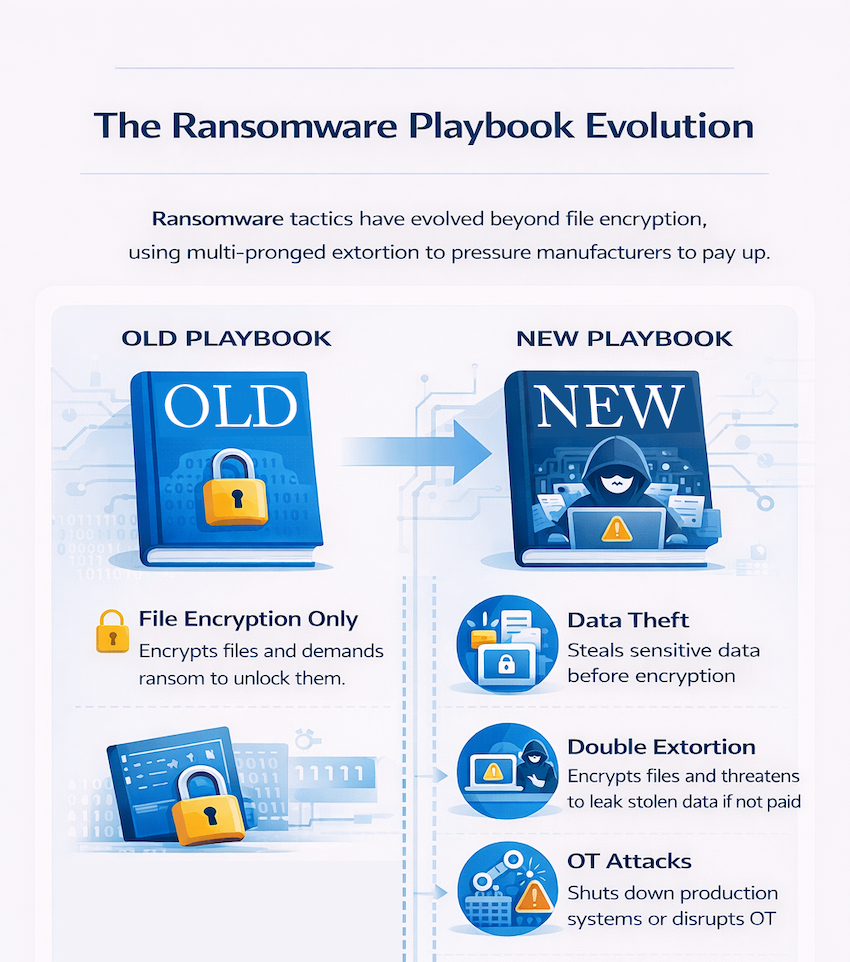
Perhaps the most alarming shift involves direct targeting of operational technology. OT refers to the systems controlling physical equipment—programmable logic controllers (PLCs), SCADA systems, and human-machine interfaces that run production lines.
When attackers compromise OT systems, they can halt production entirely or create genuine safety hazards. Unlike IT systems that might be restored in hours, OT recovery often requires specialized expertise, physical access to equipment, and careful validation before restarting operations.
Attackers increasingly infiltrate through trusted vendors and software updates. A compromised supplier with legitimate network access provides a backdoor that bypasses perimeter defenses entirely.
You might have excellent internal security, yet remain vulnerable through a less-protected partner who connects to your systems regularly. Third-party risk has become a primary attack vector that many organizations underestimate.
Manufacturing environments face distinct challenges that other industries simply don’t encounter. Understanding where weaknesses exist helps explain why the sector experiences disproportionate attack rates.
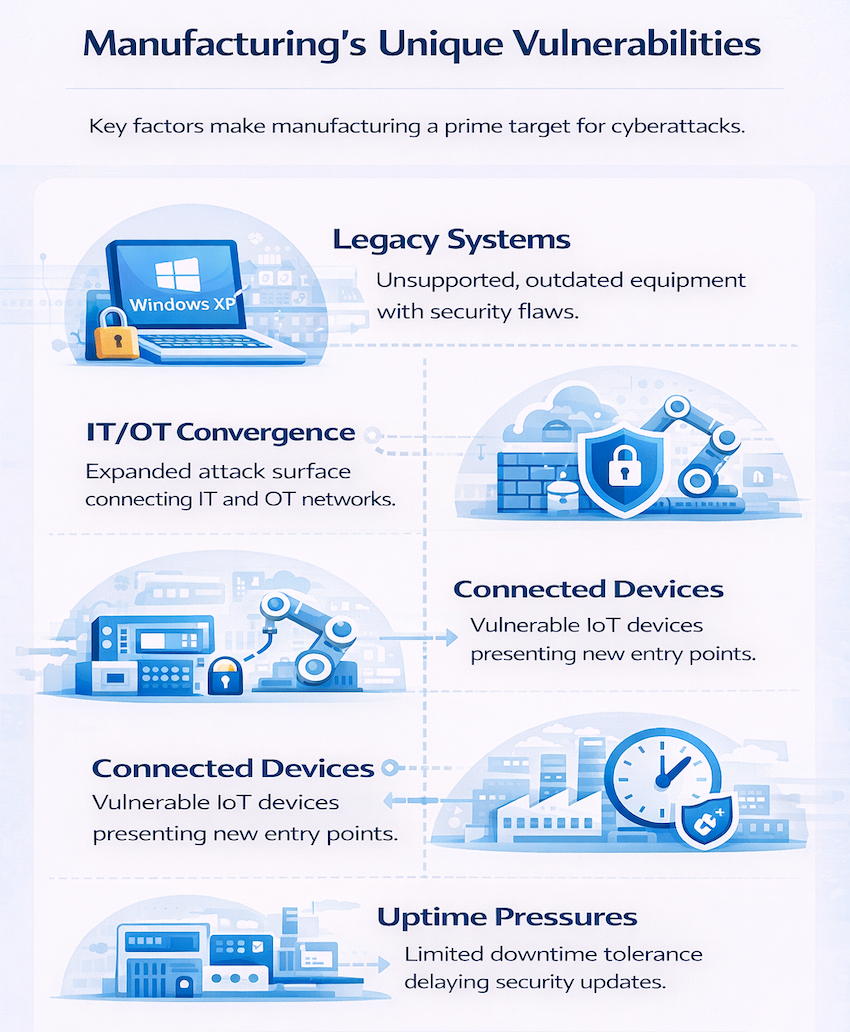
| Vulnerability | Why It Creates Risk |
|---|---|
| Legacy systems | Cannot receive security patches, remain perpetually exposed |
| IT/OT convergence | Creates expanded attack surface connecting business and production networks |
| Connected devices | Each sensor represents a potential entry point |
| Uptime pressure | Security updates get delayed to avoid production interruptions |
Many manufacturing facilities run industrial control systems on operating systems that vendors no longer support. Windows XP and other outdated platforms remain surprisingly common in production environments because replacing them requires significant downtime and capital investment. Without vendor support, known vulnerabilities remain permanently exposed.
The push for efficiency led many organizations to connect previously isolated production networks to business systems. While this enables valuable data sharing and remote monitoring, it also creates pathways for attackers to move from a compromised office computer directly into production equipment. What once required physical access now happens remotely.
The Industrial Internet of Things (IIoT) has transformed manufacturing efficiency through sensors, monitors, and connected controllers. However, each connected device expands the potential attack surface. Many IIoT devices lack robust security features or the ability to receive firmware updates, creating permanent weak points.
Manufacturing operates on tight schedules with little tolerance for unplanned downtime. This pressure often leads to delayed patching and security updates—the very maintenance that would prevent many attacks. When choosing between a four-hour maintenance window and meeting a production deadline, security often loses.
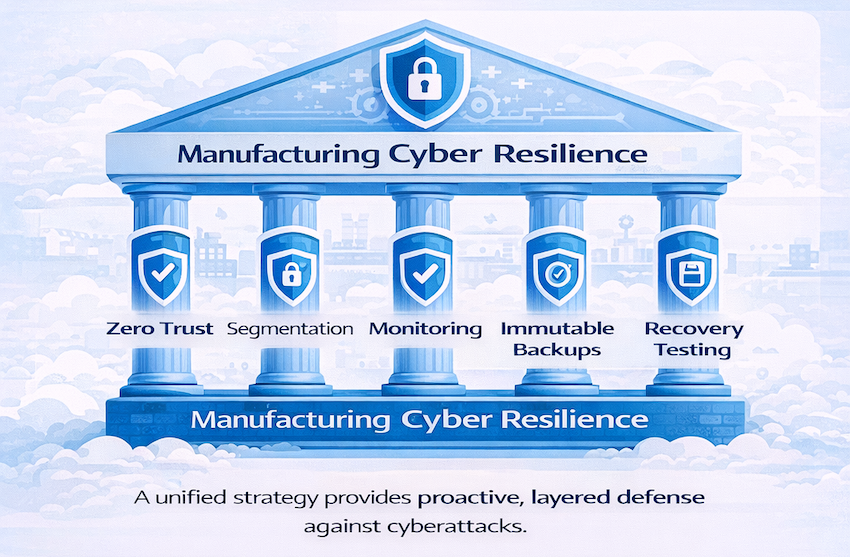
Network segmentation divides your infrastructure into isolated zones, containing breaches before they spread across your entire operation. For manufacturers, this approach proves essential for protecting critical production systems from threats that enter through less-secure areas.
The most fundamental segmentation involves creating clear boundaries between business networks and production systems. Air gaps or tightly controlled connections prevent attackers who compromise an office workstation from reaching production equipment. Traffic between zones passes through security controls that inspect and filter communications.
Beyond the basic IT/OT divide, effective segmentation groups assets by criticality and function. Production lines, quality systems, and administrative networks each operate in separate zones with restricted traffic between them. If attackers breach one zone, they encounter barriers before reaching others.
Micro-segmentation takes this concept further, applying granular controls at the individual workload level. Even within a single zone, systems can only communicate with specifically authorized partners. Lateral movement—the technique attackers use to spread after initial access—becomes far more difficult when every connection requires explicit permission.
Zero Trust operates on a straightforward principle: never trust, always verify. Rather than assuming anything inside your network is safe, this model requires continuous verification of every user, device, and application attempting to access resources.
Every access request—whether from an employee, contractor, or automated system—requires authentication and authorization. Identity verification happens before granting access to any resource, regardless of where the request originates. Being inside the network no longer grants automatic trust.
Once attackers breach traditional networks, they often move freely between systems using stolen credentials or exploiting trust relationships. Zero Trust prevents this lateral movement by requiring verification at each step. Reaching valuable targets becomes far more difficult when every hop triggers additional security checks.
Unlike traditional security that verifies identity once at login, Zero Trust continuously validates that users and devices remain trustworthy throughout their sessions. Unusual behavior—like accessing systems at odd hours or from unexpected locations—triggers additional verification or automatic access revocation.
Visibility into both IT and OT environments enables early threat detection before attacks cause significant damage. Proactive monitoring catches suspicious activity when response options remain available, rather than after encryption has already begun.
Continuous monitoring tools provide immediate alerts when suspicious activity occurs. For manufacturing environments, this includes monitoring both traditional IT systems and industrial protocols that control production equipment. Seeing what’s happening across your entire environment—not just the office network—makes early detection possible.
Anomaly detection identifies unusual patterns in machine communication or operator behavior. When a PLC suddenly communicates with an unfamiliar external address, or when a user account accesses systems it never touched before, behavioral analysis flags the deviation for investigation. Normal baselines make abnormal activity visible.
A dedicated Security Operations Center (SOC) provides round-the-clock monitoring and rapid incident response. Having trained analysts watching your environment continuously reduces the time between initial compromise and detection—often the difference between a contained incident and a catastrophic breach.
Traditional backup strategies often fail against modern ransomware because attackers specifically target backup systems. Destroying recovery options increases payment likelihood, so backup infrastructure has become a primary target rather than an afterthought.
Immutable backups cannot be altered or deleted, even by administrators with elevated privileges. Air-gapped storage—physically disconnected from production networks—ensures attackers cannot reach backup systems through network-based attacks. Both approaches protect recovery capabilities from compromise.
Backups only matter if they actually work when needed. Regular restoration drills verify backup integrity and measure recovery speed, identifying problems before an actual incident reveals them. Testing also builds muscle memory for recovery procedures under pressure.
Effective planning addresses maintaining operations during and after an attack. This includes manual fallback procedures for critical processes, alternative communication channels when email is unavailable, and clear decision-making authority when normal systems are offline.
Industry-recognized frameworks provide structured approaches to cybersecurity that help organizations prioritize investments and measure progress over time.
The threat landscape continues evolving rapidly. Staying ahead requires understanding where attacks are heading, not just where they’ve been.
Attackers now use AI to automate reconnaissance, craft convincing phishing messages, and identify vulnerabilities faster than manual methods allow. Defenders leverage similar technologies for faster detection and response, creating an ongoing technological competition where both sides continuously improve.
Vendor risk management has become an ongoing requirement rather than a one-time assessment. Regular security evaluations of suppliers and partners help identify weaknesses before attackers exploit them. The security of your partners directly affects your own security posture.
Static defenses cannot keep pace with evolving threats. Security systems that learn and adapt—adjusting rules based on new attack patterns and emerging indicators—provide more effective protection than fixed configurations that attackers can study and circumvent.
Ransomware defense in manufacturing requires more than point solutions—it demands a comprehensive approach combining technology, processes, and expertise working together. Organizations that treat cybersecurity as an ongoing program rather than a one-time project consistently achieve better outcomes.
Working with a dedicated IT partner provides access to specialized expertise, round-the-clock monitoring, and strategic guidance that most manufacturers cannot maintain internally. The right partnership transforms security from a reactive cost center into a proactive business enabler that supports operational goals.
Book an Appointment to discuss how your manufacturing operation can strengthen its ransomware defenses.


